Longest Wind Briefs – Hoola Hooping, the 32-Hour Workweek, and Heads Up

mota_ru_1062731

Life can be pretty entertaining, and sometimes it doesn’t take me ten pages to talk about it. Here are a few of the things that have piqued my interest in recent days. They’re all worthy of a longer article, but sometimes it is better to be brief.

Me, I Want a Hoola Hoop

hqdefault

This is a very funny video that I saw a long time ago but which keeps coming to mind. I think it is the universe’s way of telling me that I need to share it with my people. Please don’t go another day without watching this video:

https://www.youtube.com/watch?v=uBmUiouilQY

Ryan Carson’s 32-Hour Workweek

During my search for a modern-day Henry Ford, a hero of industry who had the courage to take a risk and change society’s opinion on how long a person ought to work each week, I stumbled across Ryan Carson, the CEO of Treehouse Island, Inc. As I mentioned in my previous article, The Atlantic did a short documentary on Carson titled The Case for the 32-Hour Workweek. I thought I’d embed it here for you to watch it:

You might notice that Carson approaches the problem from the humanitarian angle — people need time with their families — rather than Ford’s cold hard facts of industry angle. If Ford is truly the prophet some people have made him out to be, this might be why Carson had to go back on his promise of a 32-hour workweek in August of 2015. I’m not here to judge. I just thought this video was a quality source of food for thought.

Heads Up, Thumbs Up

hqdefault

My friend Nick recently introduced me to an app for both Android and Apple phones called Heads Up, which I have been known to describe as “like going in the bathroom and doing coke with your friends” despite having never experienced the latter. I watch a lot of TV, OK? When I first introduced this app to my wife, she was unimpressed, but at a friend’s party after a couple of refreshments my lady begged me to pull it out. The game works a lot like the communication boosting game where everyone puts a card on your head and without mentioning the actual word on the card the people who can see its text must get you to guess it. With Heads Up, you pick a category and place your phone on your forehead. You have a limited time to get as many correct answers as possible. If you guess correctly you tip your phone down and if you pass or someone accidentally says the word you tip your phone up. This game gets really loud at a party with adult beverages. I remember a particular round where we were supposed to describe the film Father of the Bride to my wife. Normally, I am fairly good at communicating to my wife, but as soon as I saw the title of the movie I started saying things like, “Have fun storming the castle,” and “Cary Elwes,” which are clearly fantastic clues… if you’re describing The Princess Bride. The funny, somewhat existential, part for me was that everyone was screaming so loud that nobody noticed my error (though when I recounted the story to my wife, she did admit she thought she remembered hearing me say, “Anybody want a peanut?”). The app was created by Ellen Degeneres, costs 99 cents, and comes with a feature that makes everything more fun, especially if you don’t tell anyone about it prior to playing. I have only paid for three apps during my entire time owning a smart phone, $4.99 for Comic Zeal, which allows me to read digital comics on my iPhone, $2.99 for Civilization Revolution, a fantastic game worth playing over and over again, and now $0.99 for Heads Up. If it’s good enough to be in this anti-consumer Dutch boy’s pantheon of purchases, it’s almost certainly good enough for you too.

Magic Wizards: Casting Your General from Your Hand in EDH

commander

When I began playing Magic: The Gathering back in 1994-95, it was a lot less complicated. With only a couple of sets to keep track of, it was not terribly difficult to understand the rules for each and every interaction that you might encounter. It has been over twenty years since Revised Edition — the set that I remember playing and collecting the most — was released and things are MUCH more complicated now. I recently reviewed the Commander 2015 pre-constructed EDH (Elder Dragon Highlander) decks, and that was fun and all, but my main goal in writing about Magic was to provide a resource where common issues are addressed in a complete and non-judgmental way. When we come across issues while playing Magic where two players disagree on how a situation is supposed to play out according to the rules, everyone at the table hops on their smart phones and scours the message boards for the answer so we can move forward with the game without hurt feelings or bruised egos. I thought maybe we could convert our private good into a public good, so every time we have a question over a ruling I am going to post it here along with the solution. Maybe we can flood the search engines with some useful information in the process.

What is the commander cost for a general that has been returned to your hand?

Whenever your general would be put into a library, hand, graveyard, or exile from anywhere, you get the option of returning it to the command zone instead. The benefit of returning your general to the command zone is that you can recast this important central player over and over again as needed without having to wait for some method of retrieval. The down side is that each time your general is returned to the command zone, it costs 2 colorless mana extra to cast. This additional cost is called the commander tax. If your general has a converted mana cost (CMC) of four, for example, and gets returned to the command zone, it will cost 6 mana the next time you cast it. The next time it is returned to the command zone it will cost 8 mana to play, and so on, and so forth. The commander tax could be considered the convenience fee of the EDH format. You can access your general at any time without the random elements that are involved in playing your other cards, but it will be more and more expensive each subsequent time you cast it.

Since you have the option to return your general to the command zone, this means that you also have the option to allow your general to go into your library, hand, graveyard, or exile. For most players this would be a disaster, because — except for the example of returning your general to your hand — you would completely lose access to the one card that every other card in your deck is meant to interact with in either a direct or indirect way. However, some EDH decks are equipped with cards which allow you to fetch cards from your library (Demonic Tutor, for example) or cast cards from your graveyard (Meren of Clan Nel Toth). I don’t currently know of any cards that allow you to cast your general from exile, but the ability to cast your general from your library, hand, or graveyard gives you some options. It is also the source of the problem we ran into the other night.

Our friend Matt had his general bounced back to his hand. He then attempted to cast his general for its face value (without commander tax) alongside another creature. The total mana cost for both of these spells would leave him exactly tapped out. In other words, if Matt was required to pay the commander tax he could only cast one creature, but if he was not required to pay the commander tax he would be able to cast both. We were at that point in the game where everyone was rolling out their heavy hitters, so the solution to our question had the chance to seriously impact gameplay.

As it turns out, Matt — and you, by extension — wouldn’t have to pay the commander tax when casting his general from his hand. Not only that, but I could see the smile on Matt’s face as he cast both of his creatures. Win, win. If a general is cast from your library, hand, or graveyard, or if it were possible, from exile, you pay for it the same way you pay for any other card, by using the amount of mana signified in the top right corner of the card (or if you have a card that allows you to cast for an alternate price you follow that card’s text instead). I want to repeat this in case I overcomplicated my simple explanation: The commander tax only applies when a general is cast from the command zone. It does not apply when the general is cast from anywhere else.

There is another slightly more complicated issue that accompanies this discussion of when the commander tax applies. On a couple of message boards, there was some confusion regarding what happens to the commander tax once a general is cast from another zone. To be clear, casting your general from your hand (or anywhere else that is not the command zone) does not reset the commander tax. I think the best way of understanding how this works is by imagining that there are actually two costs in the upper right hand corner of your general, the pre-tax, normal cost (the one that is actually printed there) and the post-tax, command zone cost (the one that is calculated as the normal cost plus two extra mana for each time the general has been returned to the command zone). By imagining that there are two permanent costs (one subject to periodic increases), it is clear that the general will always be cast referencing one of the costs, the normal cost if cast from a library, hand, graveyard, or exile, or the command zone cost if cast from the command zone.

Let me know if you have any further questions about this issue. Also, I know I’m not perfect, and I am talking about a format that goes through periodic rule changes, so if you have a correction, please feel free to let me know. The only caviat I have is that corrections should be accompanied by a good source. As I’m sure you can all understand, I don’t want to get into a war of opinions. Finally, if you’re having trouble getting some sort of ruling on an issue that you have encountered while playing, regardless of whether it is EDH, Standard, Modern, Draft, whatever, hti me up. I’ll be happy to search for an answer and put it upon the blog. I miss talking about Magic. Let’s make a habit of it, K?

Keynes and the End of the Economic Problem

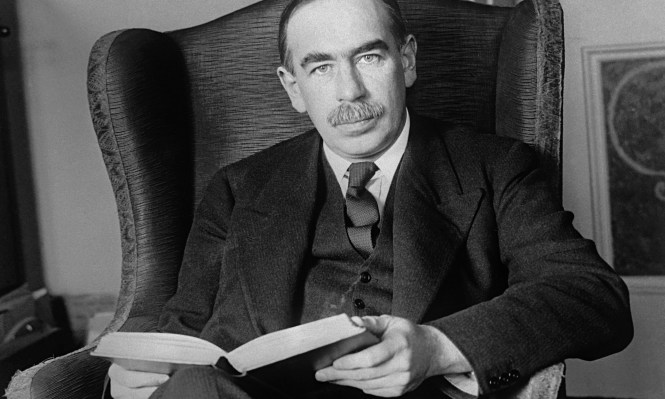
Economist John Maynard Keynes

When I was doing research for my first article on the outdated concepts behind the 40-hour work week, I stumbled across John Maynard Keynes’ 1930 writing titled Economic Possibilities for our Grandchildren. There were two reasons I didn’t share this reading with everyone at that time: 1. it is not as quotable as the sources from Roosevelt and Ford that I have shared in the past — harder to embolden the key points, and 2. I wasn’t so sure that this was what I would call a meaty part of the discussion, something that you cannot get around. I was right on the first issue — this is a well-researched scholarly piece whereas Roosevelt’s was a public speech and Ford’s was a popular interview — but I was dead wrong on the second issue. Keynes is one of the foremost names in economics and basically everyone concerned with the amount of hours worked in America is referencing this article. To make up for my shortcomings, I have decided to include the full article in this post.

I

We are suffering just now from a bad attack of economic pessimism. It is common to hear people say that the epoch of enormous economic progress which characterised the nineteenth century is over; that the rapid improvement in the standard of life is now going to slow down –at any rate in Great Britain; that a decline in prosperity is more likely than an improvement in the decade which lies ahead of us.

I believe that this is a wildly mistaken interpretation of what is happening to us. We are suffering, not from the rheumatics of old age, but from the growing-pains of over-rapid changes, from the painfulness of readjustment between one economic period and another. The increase of technical efficiency has been taking place faster than we can deal with the problem of labour absorption; the improvement in the standard of life has been a little too quick; the banking and monetary system of the world has been preventing the rate of interest from falling as fast as equilibrium requires. And even so, the waste and confusion which ensue relate to not more than 7½ per cent of the national income; we are muddling away one and sixpence in the £, and have only 18s. 6d., when we might, if we were more sensible, have £1 ; yet, nevertheless, the 18s. 6d. mounts up to as much as the £1 would have been five or six years ago. We forget that in 1929 the physical output of the industry of Great Britain was greater than ever before, and that the net surplus of our foreign balance available for new foreign investment, after paying for all our imports, was greater last year than that of any other country, being indeed 50 per cent greater than the corresponding surplus of the United States. Or again-if it is to be a matter of comparisons-suppose that we were to reduce our wages by a half, repudiate four fifths of the national debt, and hoard our surplus wealth in barren gold instead of lending it at 6 per cent or more, we should resemble the now much-envied France. But would it be an improvement?

The prevailing world depression, the enormous anomaly of unemployment in a world full of wants, the disastrous mistakes we have made, blind us to what is going on under the surface to the true interpretation. of the trend of things. For I predict that both of the two opposed errors of pessimism which now make so much noise in the world will be proved wrong in our own time-the pessimism of the revolutionaries who think that things are so bad that nothing can save us but violent change, and the pessimism of the reactionaries who consider the balance of our economic and social life so precarious that we must risk no experiments.

My purpose in this essay, however, is not to examine the present or the near future, but to disembarrass myself of short views and take wings into the future. What can we reasonably expect the level of our economic life to be a hundred years hence? What are the economic possibilities for our grandchildren?

From the earliest times of which we have record-back, say, to two thousand years before Christ-down to the beginning of the eighteenth century, there was no very great change in the standard of life of the average man living in the civilised centres of the earth. Ups and downs certainly. Visitations of plague, famine, and war. Golden intervals. But no progressive, violent change. Some periods perhaps So per cent better than othersat the utmost 1 00 per cent better-in the four thousand years which ended (say) in A. D. 1700.

This slow rate of progress, or lack of progress, was due to two reasons-to the remarkable absence of important technical improvements and to the failure of capital to accumulate.

The absence of important technical inventions between the prehistoric age and comparatively modern times is truly remarkable. Almost everything which really matters and which the world possessed at the commencement of the modern age was already known to man at the dawn of history. Language, fire, the same domestic animals which we have to-day, wheat, barley, the vine and the olive, the plough, the wheel, the oar, the sail, leather, linen and cloth, bricks and pots, gold and silver, copper, tin, and lead-and iron was added to the list before 1000 B.C.-banking, statecraft, mathematics, astronomy, and religion. There is no record of when we first possessed these things.

At some epoch before the dawn of history perhaps even in one of the comfortable intervals before the last ice age-there must have been an era of progress and invention comparable to that in which we live to-day. But through the greater part of recorded history there was nothing of the kind.

The modern age opened; I think, with the accumulation of capital which began in the sixteenth century. I believe-for reasons with which I must not encumber the present argument-that this was initially due to the rise of prices, and the profits to which that led, which resulted from the treasure of gold and silver which Spain brought from the New World into the Old. From that time until to-day the power of accumulation by compound interest, which seems to have been sleeping for many generations, was re-born and renewed its strength. And the power of compound interest over two hundred years is such as to stagger the imagination.

Let me give in illustration of this a sum which I have worked out. The value of Great Britain’s foreign investments to-day is estimated at about £4,000,000,000. This yields us an income at the rate of about 6½ per cent. Half of this we bring home and enjoy; the other half, namely, 3¼ per cent, we leave to accumulate abroad at compound interest. Something of this sort has now been going on for about 250 years.

For I trace the beginnings of British foreign investment to the treasure which Drake stole from Spain in 1580. In that year he returned to England bringing with him the prodigious spoils of the Golden Hind. Queen Elizabeth was a considerable shareholder in the syndicate which had financed the expedition. Out of her share she paid off the whole of England’s foreign debt, balanced her Budget, and found herself with about £40,000 in hand. This she invested in the Levant Company –which prospered. Out of the profits of the Levant Company, the East India Company was founded; and the profits of this great enterprise were the foundation of England’s subsequent foreign investment. Now it happens that £40,ooo accumulating at 3f per cent compound interest approximately corresponds to the actual volume of England’s foreign investments at various dates, and would actually amount to-day to the total of £4,000,000,000 which I have already quoted as being what our foreign investments now are. Thus, every £1 which Drake brought home in 1580 has now become £100,000. Such is the power of compound interest!

From the sixteenth century, with a cumulative crescendo after the eighteenth, the great age of science and technical inventions began, which since the beginning of the nineteenth century has been in full flood–coal, steam, electricity, petrol, steel, rubber, cotton, the chemical industries, automatic machinery and the methods of mass production, wireless, printing, Newton, Darwin, and Einstein, and thousands of other things and men too famous and familiar to catalogue.

What is the result? In spite of an enormous growth in the population of the world, which it has been necessary to equip with houses and machines, the average standard of life in Europe and the United States has been raised, I think, about fourfold. The growth of capital has been on a scale which is far beyond a hundredfold of what any previous age had known. And from now on we need not expect so great an increase of population.

If capital increases, say, 2 per cent per annum, the capital equipment of the world will have increased by a half in twenty years, and seven and a half times in a hundred years. Think of this in terms of material things–houses, transport, and the like.

At the same time technical improvements in manufacture and transport have been proceeding at a greater rate in the last ten years than ever before in history. In the United States factory output per head was 40 per cent greater in 1925 than in 1919. In Europe we are held back by temporary obstacles, but even so it is safe to say that technical efficiency is increasing by more than 1 per cent per annum compound. There is evidence that the revolutionary technical changes, which have so far chiefly affected industry, may soon be attacking agriculture. We may be on the eve of improvements in the efficiency of food production as great as those which have already taken place in mining, manufacture, and transport. In quite a few years-in our own lifetimes I mean-we may be able to perform all the operations of agriculture, mining, and manufacture with a quarter of the human effort to which we have been accustomed.

For the moment the very rapidity of these changes is hurting us and bringing difficult problems to solve. Those countries are suffering relatively which are not in the vanguard of progress. We are being afflicted with a new disease of which some readers may not yet have heard the name, but of which they will hear a great deal in the years to come–namely,technological unemployment. This means unemployment due to our discovery of means of economising the use of labour outrunning the pace at which we can find new uses for labour.

But this is only a temporary phase of maladjustment. All this means in the long run that mankind is solving its economic problem. I would predict that the standard of life in progressive countries one hundred years hence will be between four and eight times as high as it is to-day. There would be nothing surprising in this even in the light of our present knowledge. It would not be foolish to contemplate the possibility of afar greater progress still.

II

Let us, for the sake of argument, suppose that a hundred years hence we are all of us, on the average, eight times better off in the economic sense than we are to-day. Assuredly there need be nothing here to surprise us.

Now it is true that the needs of human beings may seem to be insatiable. But they fall into two classes –those needs which are absolute in the sense that we feel them whatever the situation of our fellow human beings may be, and those which are relative in the sense that we feel them only if their satisfaction lifts us above, makes us feel superior to, our fellows. Needs of the second class, those which satisfy the desire for superiority, may indeed be insatiable; for the higher the general level, the higher still are they. But this is not so true of the absolute needs-a point may soon be reached, much sooner perhaps than we are all of us aware of, when these needs are satisfied in the sense that we prefer to devote our further energies to non-economic purposes.

Now for my conclusion, which you will find, I think, to become more and more startling to the imagination the longer you think about it.

I draw the conclusion that, assuming no important wars and no important increase in population, the economic problem may be solved, or be at least within sight of solution, within a hundred years. This means that the economic problem is not-if we look into the future-the permanent problem of the human race.

Why, you may ask, is this so startling? It is startling because-if, instead of looking into the future, we look into the past-we find that the economic problem, the struggle for subsistence, always has been hitherto the primary, most pressing problem of the human race-not only of the human race, but of the whole of the biological kingdom from the beginnings of life in its most primitive forms.

Thus we have been expressly evolved by nature-with all our impulses and deepest instincts-for the purpose of solving the economic problem. If the economic problem is solved, mankind will be deprived of its traditional purpose.

Will this be a benefit? If one believes at all in the real values of life, the prospect at least opens up the possibility of benefit. Yet I think with dread of the readjustment of the habits and instincts of the ordinary man, bred into him for countless generations, which he may be asked to discard within a few decades.

To use the language of to-day-must we not expect a general “nervous breakdown”? We already have a little experience of what I mean -a nervous breakdown of the sort which is already common enough in England and the United States amongst the wives of the well-to-do classes, unfortunate women, many of them, who have been deprived by their wealth of their traditional tasks and occupations–who cannot find it sufficiently amusing, when deprived of the spur of economic necessity, to cook and clean and mend, yet are quite unable to find anything more amusing.

To those who sweat for their daily bread leisure is a longed–for sweet-until they get it.

There is the traditional epitaph written for herself by the old charwoman:–

Don’t mourn for me, friends, don’t weep for me never,
For I’m going to do nothing for ever and ever.

This was her heaven. Like others who look forward to leisure, she conceived how nice it would be to spend her time listening-in-for there was another couplet which occurred in her poem:-

With psalms and sweet music the heavens’ll be ringing,
But I shall have nothing to do with the singing.

Yet it will only be for those who have to do with the singing that life will be tolerable and how few of us can sing!

Thus for the first time since his creation man will be faced with his real, his permanent problem-how to use his freedom from pressing economic cares, how to occupy the leisure, which science and compound interest will have won for him, to live wisely and agreeably and well.

The strenuous purposeful money-makers may carry all of us along with them into the lap of economic abundance. But it will be those peoples, who can keep alive, and cultivate into a fuller perfection, the art of life itself and do not sell themselves for the means of life, who will be able to enjoy the abundance when it comes.

Yet there is no country and no people, I think, who can look forward to the age of leisure and of abundance without a dread. For we have been trained too long to strive and not to enjoy. It is a fearful problem for the ordinary person, with no special talents, to occupy himself, especially if he no longer has roots in the soil or in custom or in the beloved conventions of a traditional society. To judge from the behaviour and the achievements of the wealthy classes to-day in any quarter of the world, the outlook is very depressing! For these are, so to speak, our advance guard-those who are spying out the promised land for the rest of us and pitching their camp there. For they have most of them failed disastrously, so it seems to me-those who have an independent income but no associations or duties or ties-to solve the problem which has been set them.

I feel sure that with a little more experience we shall use the new-found bounty of nature quite differently from the way in which the rich use it to-day, and will map out for ourselves a plan of life quite otherwise than theirs.

For many ages to come the old Adam will be so strong in us that everybody will need to do some work if he is to be contented. We shall do more things for ourselves than is usual with the rich to-day, only too glad to have small duties and tasks and routines. But beyond this, we shall endeavour to spread the bread thin on the butter-to make what work there is still to be done to be as widely shared as possible. Three-hour shifts or a fifteen-hour week may put off the problem for a great while. For three hours a day is quite enough to satisfy the old Adam in most of us!

There are changes in other spheres too which we must expect to come. When the accumulation of wealth is no longer of high social importance, there will be great changes in the code of morals. We shall be able to rid ourselves of many of the pseudo-moral principles which have hag-ridden us for two hundred years, by which we have exalted some of the most distasteful of human qualities into the position of the highest virtues. We shall be able to afford to dare to assess the money-motive at its true value. The love of money as a possession -as distinguished from the love of money as a means to the enjoyments and realities of life -will be recognised for what it is, a somewhat disgusting morbidity, one of those semicriminal, semi-pathological propensities which one hands over with a shudder to the specialists in mental disease. All kinds of social customs and economic practices, affecting the distribution of wealth and of economic rewards and penalties, which we now maintain at all costs, however distasteful and unjust they may be in themselves, because they are tremendously useful in promoting the accumulation of capital, we shall then be free, at last, to discard.

Of course there will still be many people with intense, unsatisfied purposiveness who will blindly pursue wealth-unless they can find some plausible substitute. But the rest of us will no longer be under any obligation to applaud and encourage them. For we shall inquire more curiously than is safe to-day into the true character of this “purposiveness” with which in varying degrees Nature has endowed almost all of us. For purposiveness means that we are more concerned with the remote future results of our actions than with their own quality or their immediate effects on our own environment. The “purposive” man is always trying to secure a spurious and delusive immortality for his acts by pushing his interest in them forward into time. He does not love his cat, but his cat’s kittens; nor, in truth, the kittens, but only the kittens’ kittens, and so on forward forever to the end of cat-dom. For him jam is not jam unless it is a case of jam to-morrow and never jam to-day. Thus by pushing his jam always forward into the future, he strives to secure for his act of boiling it an immortality.

Let me remind you of the Professor in Sylvie and Bruno :

“Only the tailor, sir, with your little bill,” said a meek voce outside the door.

“Ah, well, I can soon settle his business,” the Professor said to the children, “if you’ll just wait a minute. How much is it, this year, my man?” The tailor had come in while he was speaking.

“Well, it’s been a-doubling so many years, you see,” the tailor replied, a little grufy, “and I think I’d like the money now. It’s two thousand pound, it is!”

“Oh, that’s nothing!” the Professor carelessly remarked, feeling in his pocket, as if he always carried at least that amount about with him. “But wouldn’t you like to wait just another year and make it four thousand? Just think how rich you’d be! Why, you might be a king, if you liked!”

“I don’t know as I’d care about being a king,” the man said thoughtfully. “But it dew sound a powerful sight o’ money! Well, I think I’ll wait-“

“Of course you will!” said the Professor. “There’s good sense in you, I see. Good-day to you, my man!”

“Will you ever have to pay him that four thousand pounds?” Sylvie asked as the door closed on the departing creditor.

“Never, my child!” the Professor replied emphatically. “He’ll go on doubling it till he dies. You see, it’s always worth while waiting another year to get twice as much money!

Perhaps it is not an accident that the race which did most to bring the promise of immortality into the heart and essence of our religions has also done most for the principle of compound interest and particularly loves this most purposive of human institutions.

I see us free, therefore, to return to some of the most sure and certain principles of religion and traditional virtue-that avarice is a vice, that the exaction of usury is a misdemeanour, and the love of money is detestable, that those walk most truly in the paths of virtue and sane wisdom who take least thought for the morrow. We shall once more value ends above means and prefer the good to the useful. We shall honour those who can teach us how to pluck the hour and the day virtuously and well, the delightful people who are capable of taking direct enjoyment in things, the lilies of the field who toil not, neither do they spin.

But beware! The time for all this is not yet. For at least another hundred years we must pretend to ourselves and to every one that fair is foul and foul is fair; for foul is useful and fair is not. Avarice and usury and precaution must be our gods for a little longer still. For only they can lead us out of the tunnel of economic necessity into daylight.

I look forward, therefore, in days not so very remote, to the greatest change which has ever occurred in the material environment of life for human beings in the aggregate. But, of course, it will all happen gradually, not as a catastrophe. Indeed, it has already begun. The course of affairs will simply be that there will be ever larger and larger classes and groups of people from whom problems of economic necessity have been practically removed. The critical difference will be realised when this condition has become so general that the nature of one’s duty to one’s neighbour is changed. For it will remain reasonable to be economically purposive for others after it has ceased to be reasonable for oneself.

The pace at which we can reach our destination of economic bliss will be governed by four things-our power to control population, our determination to avoid wars and civil dissensions, our willingness to entrust to science the direction of those matters which are properly the concern of science, and the rate of accumulation as fixed by the margin between our production and our consumption; of which the last will easily look after itself, given the first three.

Meanwhile there will be no harm in making mild preparations for our destiny, in encouraging, and experimenting in, the arts of life as well as the activities of purpose.

But, chiefly, do not let us overestimate the importance of the economic problem, or sacrifice to its supposed necessities other matters of greater and more permanent significance. It should be a matter for specialists-like dentistry. If economists could manage to get themselves thought of as humble, competent people, on a level with dentists, that would be splendid!

This may be the philosopher in me — I am one of those despicable types who has read Immanual Kant in his free time — but I really enjoy reading the rich thoughts, stemming from economics to history to ethics to poetry, of John Maynard Keynes. He has a basic classical disposition, reading like a John Stuart Mill or a John Locke or a Thomas Hobbes, and his thought is clearly bigger than simply financial theory. I would imagine there are some folk out there who have read Keynes extensively. If you have any recommendations — based on the quality of the work moreso than the relevance to the current topic — I would love to read more.

As for the discussion of the length of the workweek, the response from most people who read my previous article was pretty grim, and rightly so. However, after reading Keynes I realize that we couldn’t possibly be liberated from our financial woes until 2030, so we’re still good… (You can’t blame me for trying to stay positive.) Even if economic freedom is not on the horizon, I do think that Keynes’ imperative — here comes Kant again! — to stop focusing on the means (the money) and start focusing on the ends (the good that you intend to do with the money) is important. While there might be some more insidious factors (post forthcoming) that have kept us from the shorter and shorter workweeks that Keynes imagined, the causes that fit within our circle of immediate influence are certainly our obsession with consumerism in this nation. What would you do if you could actually enjoy your life without spending more money than you actually have to do so?

Longest Wind Briefs – Guns ‘n’ Roses, Yelling Seal, and Joss Whedon’s Wonder Woman

mota_ru_1062731

I really hope nobody ever gets tired of this picture of kittens on a clothes line, because it will be quite a tall order to replace it. For now, the posts…

GnR Reunion Blues

axlroseslash20153

When I first heard the rumors in 2015 that Axl Rose and Slash were going to be getting back together and touring as Guns ‘n’ Roses I was completely nonplussed. I have heard rumors like this for years and they never turn into anything, when rumors like this do end up being true all you get is some half-baked album like Chinese Democracy, and I honestly don’t know if Axl’s voice is really up to snuff anymore.

When the official announcement of Guns ‘n’ Roses tour dates in 2016 came on NPR a day or two before New Years I had a completely different reaction. I was driving to work in my cold Scion xD when all of a sudden this flush of warmth came over me and it honestly felt like I was blushing. If I didn’t know any better I would have thought I’d just taken a shot. I started remembering what it felt like to listen to Appetite for Destruction for the first time with that raunchy LA dive feel and those siren-like guitars.

I’m not sure which part of me is the better judge, but my brain is unexcited about the GnR reunion despite how into the idea my heart seems to be. At the end of the day, I think whether or not I see the band live is going to be the choice of my wallet, though, so I’m going to have to find a way to curb my enthusiasm somehow.

Pet Sounds (If Your Pet is a Seal)

maxresdefault

For a few days in early January I think my wife and I spent more time laughing than breathing. This is because we stumbled across a video that features a seal making a ridiculous sound. Because I am reading Moby Dick, I imagined how one might classify the seal during the peak of the whaling industry. I summoned to mind a wave-lapped old man in ratty clothing telling tall tales about a beast that looked like a dog on its front end, a fish on its hind end, and screamed like a man. Here is the video that inspired the high heights of my recent ecstasy:

Wonder Woman (2007)

4664604-5391158320-Wonde

Not too long ago, in about ’06-’07ish, Joss Whedon was hired by Warner Brothers to write and direct a Wonder Woman film, but the film fell apart. Joss Whedon said, “We just saw different movies, and at the price range this kind of movie hands in, that’s never gonna work. Non-sympatico. It happens all the time.” Now, Wonder Woman, written by Jason Fuchs and directed by Patty Jenkins, is going to be coming out in 2017. I imagine, after learning about this, Joss figured he was never going to get to use his script for a Wonder Woman film, because his original script for the film was recently released to the public. All I had to do was read the first little bit of description —

Wonder Woman

— and I was hooked. The script is 116 pages long and it is available all over the web. I highly recommend giving it a read. The script is incredibly visual, charming, and funny. Diana comes off like The Little Mermaid, misunderstanding the workings of the world like fear, greed, and stubble, but she also sees humanity from a stranger’s eyes. We have the potential to become something bold and original, and yet we fall into all of the same scripts. As Wonder Woman, Diana can be a guide for humanity to reach for our higher nature. Steve Trevor is a fantastic partner, courageous and worldly, but dedicated toward the good of others. They teach one another and they criticize one another, and every once in a while Diana swoops him up in her arms like a “damsel in distress” and escorts him out of harm’s way.

It is probably issues like the gender role reversal that I just mentioned that kept this film from getting made. Whedon was diplomatic about his parting of ways with the production company, but you have to wonder if his vision was censored by the people with money. Whedon’s Wonder Woman is intensely critical of humanity’s tendency toward war, clear gender boundaries and roles, and the status quo in general at the peak of the Bush administration when pacifist views were seen as “letting the terrorists win,” when marriage was defined according to the Defense of Marriage Act as between one man and one woman, and when anyone who questions the way things work would be labelled a Communist by the neo-McCarthyists we voted into office. Joss Whedon’s Wonder Woman was bold, and possibly the best thing he’s ever written. You all can keep dreaming for Firefly Season Two. I’m holding out for DC’s reboot of Wonder Woman with a Whedon script.

Commander 2015: My First Thoughts

magic-the-gathering

I haven’t been playing Magic: the Gathering as much since I started tackling my debt in earnest. Tabletop gaming superhero Wil Wheaton once said that he does not promote MtG because it revolves around a pay-to-play mechanic, and while I deeply love the game it is really hard to get around how much it can cost to keep up with the game. The perfect median is when you have friends with a bunch of Magic cards who really enjoy playing Commander/EDH (Elder Dragon Highlander) format. Commander is a casual format where players can construct their own decks around a legendary creature of their choice or choose to buy a pre-made deck. The decks themselves are more expensive than many other starter decks (as they used to call them), intro packs, or deckbuilder kits, but because you can only play one of every non-land card there are many more combinations which make each deck infinitely more playable. My friend Jordan recently purchased all five of the Commander 2015 pre-made decks — Call the Spirits, Seize Control, Plunder the Graves, Wade Into Battle, and Swell the Host — which revolve around a new experience counter mechanic and for his birthday he wanted to have a 5-player free-for-all involving all five decks. I thought I would do a write-up about the five decks and my experiences with them thus far.

c4rd4r7_EeHsRzUkg0

Call the Spirits is an Orzhov (white/black) deck featuring Daxos the Returned as its general. You gain an experience counter each time you cast an enchantment. Daxos has the ability to create spirit tokens for 1WB with power and toughness equal to the amount of experience counters you have accumulated. With enough mana, Daxos can turn into a creature factory, but in my experience the deck never gained any momentum. I only played two games with these five decks, but Call the Spirits definitely came off as one of the weakest decks in the bunch.

2_kjwciwjcijcw_Thumb

Seize Control is an Izzet (blue/red) deck featuring Mizzix of the Izmagnus as its general. If you cast an instant or sorcery with a converted mana cost (CMC) greater than the amount of experience you have, you gain an experience counter. Each subsequent instant/sorcery that you cast from that point on will cost 1 less colorless mana for each experience counter you have. During early deck discussion, many of us overlooked Seize Control, mainly because I play with a lot of people who really don’t like messing with blue. You spend so much time leaving mana open and hoping you can use it that it is often not worth it. After seeing this deck in action, it became a clear contender for best deck in the set. I won using Seize Control during the first match, and I got second place in the second match, defeated by — you guessed it — Seize Control. It is fairly easy to cast spells with CMC 1, 2, 3, 4, etc., in a sequence to maximize Mizzix’s value, especially with so many cards that have a Flashback cost, making it easy to get ahead and stay ahead. Usually, you’re going to win by stealing someone else’s best creature — often their general — but exercise with care. You can put a target on your back pretty easily that way.

c4rd4r7_rPv16hWLgt

Plunder the Graves is a Golgari (black/green) deck featuring Meren of Clan Nel Toth as its general. Whenever a creature you control dies, you gain an experience counter. When your end step comes around, you can choose a creature from your graveyard and if its CMC is less than or equal to your experience you can return it to the battlefield. Otherwise, you can return this creature to your hand. There are certainly some fun things you can do with this deck, and before we started playing I thought it was probably one of the best, but this is another deck that seemed kind of difficult to actually get going.

8_IIIWEHJC_Thumb

Wade Into Battle is a Boros (white/red) deck featuring Kalemne, Disciple of Iroas as its general. You get experience counters by casting creatures with CMC five or more, and Kalemne gets +1/+1 for each experience counter. Boros is probably my favorite two-color combination because of its speed and relentlessness, and the mana ramp in this deck is formidable enough to get those big creatures out quickly. On my first turn with this deck I played a Plains, tapped the Plains to cast Sol Ring, and finally tapped the Sol Ring to cast Fellwar Stone. When I played my second Plains on turn two, I already had five mana available. With ramp like this you can cast Kalemne on turn two and your first giant creature on turn three. The big danger is that you become an early target for Seize Control’s dominate spells, and that is why I think Wade Into Battle is probably the second best deck of the batch.

4_hhhsdgcdsc_Thumb

Swell the Host is a Simic (blue/green) deck featuring Ezuri, Claw of Progress as its general. Whenever you cast a creature with power 2 or less, you get an experience counter. When your combat phase begins, you get to put a +1/+1 counter on another target creature you control for each experience counter you have accumulated. While this deck wasn’t the most powerful on its own, it was certainly the most fun to interact with. There were multiple times when the person playing Call the Spirits would cast Thief of Blood and steal all of the counters from the creature. In fact, when I was playing with the Wade Into Battle deck there was a time where I was the only person of all five of us who had never possessed the massive creature created by Ezuri, Claw of Progress and Thief of Blood. If you want to win, Swell the Host might not be the best deck to play with, make sure this deck is in the mix.

I’m rarely excited about Wizards’ pre-made Commander decks and then I try them out and fall in love with basically all of them (to varying degrees). One of the only problems I’ve had with the last couple of sets is that there isn’t as much room to play with the new mechanics. For example, in a previous set of decks we were introduced to the concept of Lieutenants, cards that help you out assuming that your Commander is on the battlefield. To my knowledge, there are only five Lieutenants in existence at this time, one for each of the five pre-made decks. Similarly, it would be really neat to find some more cards that interact with experience counters. I doubt any of these cards are going to come out of a standard set in the near future, but I think it might be really neat to roll out some sort of Conspiracy-esque draft-centered set that feeds into the existing Commander product of the last couple of years. In my opinion, when you release a new game mechanic you need to provide resources for deckbuilders so that they don’t have to be limited by the cards and color combinations of the pre-made decks. That said, I can imagine playing with these decks once a week and not really getting tired of them for at least a year, and from a marketing standpoint I think that is what Wizards is aiming for. If you get bored after a year, there’s going to be another set of decks to delve into.

The Twilight of the 40-Hour Workweek

3c24545r

When Henry Ford rolled out the 40-hour workweek at Ford Motor Company in 1926, Ford did not view this move as any sort of sentimental decision or technical innovation in itself. He believed that workers getting paid the same for working fewer hours was a natural progression stemming from progress in industrialization and corporate organization. In an interview with Samuel Crowther titled “Why I Favor Five Days’ Work With Six Days’ Pay,” Ford said,

It is the rise of the great corporation with its ability to use power, to use accurately designed machinery, and generally to lessen the wastes in time, material, and human energy that made it possible to bring in the eight hour day. Then, also, there is the saving through accurate workmanship. Unless parts are made accurately, the benefits of quantity production will be lost-for the parts will not fit together and the economy of making will be lost in the assembling. Further progress along the same lines has made it possible to bring in the five day week.

A further benefit of Ford’s decision to enforce a 40-hour workweek is that his employees, and the employees of all other businesses who followed suit,* would have more leisure time to enjoy (and more money to spend on) the products of their labor, especially Ford automobiles.

While Ford believed that the 40-hour workweek was a natural bi-product of changes in modern industry, he was adamant about the fact that it is not the ultimate end for labor. Ford was merely dealing with economic concepts of efficiency that he believed to be proven quantities, but he imagined that more decreases in the workweek, probably fewer hours worked in the day rather than fewer days worked in a week, were on their way. Ninety years later, we’ve made plenty of advances in industry and the implementation of Internet-based business processes alone might be enough to renew this discussion. Is the 40-hour workweek outdated? What would we replace it with?

What We Talk About When We Talk About a 40-Hour Workweek

In February of 2000, under the supervision of Prime Minister Lionel Jospin’s Plural Left party and Minister of Labour Martine Aubry, France passed legislation for a 35-hour workweek. During the sixteen years since the ratification of the 35-hour workweek, it is still unclear whether the nation has seen any benefit. On the one hand, France has remained one of the most productive nations in the EU. On the other hand, France has seen its fair share of economic trouble in recent years. Simultaneously, we are seeing movements in France both to raise the workweek to 40 hours and to lower the workweek further to 32 hours. Unsurprisingly, at least for American audiences, these reform movements fall along party lines, conservatives favoring more hours in the week and liberals favoring fewer.

First and foremost, setting a 40-, 35-, or 32-hour workweek means that any hours above that amount will be paid at a higher rate. Second, I am not certain how benefits work in other countries, but in the United States this would also mean that anyone working at or over this threshold of average weekly hours would have access to company-sponsored health care and all other benefits earmarked for full-time employees. Finally, if we are to remain with the spirit of Henry Ford, employees would need to get somewhere between a 12.5% and a 20% raise across the board in order to make as much money as they would have working 40 hours a week. In other words, if you made $50,000 per year working 40-hour weeks you would still deserve $50,000 per year if you were working 32- or 35-hour weeks.

Outdated Labor Standards

Ford moved for a 40-hour work week based on cold business facts, and I think we should continue accordingly. Statistics point to some serious flaws in our current system of labor. An At Task survey of US employees working for large companies (1000 employees or more) and conducted by Harris Poll found that 45% of the work day is devoted to primary job duties whereas 55% — the majority of the day — is devoted to emails, meetings, administrative tasks, and interruptions. Perhaps more frightening was another survey which suggested that US employees spend, on average, 1.5 to 3 hours doing private, non-work activities while on the clock each and every day. Assuming a five-day work-week, this means that employees are “cyberloafing” for 7.5-15 hours each week, which is 19-38% of their time at the job, and if removed completely it would suggest that we are ready for a drastically shorter workweek of between 25 and 32 hours per week. Several other reports concluded that 70% of traffic on pornographic web sites takes place during traditional working hours, 60% of online purchases are made between 9am and 5pm, only 13% of employees report feeling engaged at work versus 26% who report feeling actively disengaged, and 17.7% of people who waste time at work report that they just don’t have enough to do.

There are a plethora of negatives associated with working more hours as well. Jobs with overtime schedules (more than 40 hours per week) have a 61% higher injury rate than jobs without, and in general the more hours you work the more likely you are to suffer illness, injury, or cognitive impairment. The following problems have been associated with working too much: hypertension, cardiovascular disease, fatigue, stress, depression, muskuloskeletal disorder, chronic infections, diabetes, general health complaints, all-cause mortality, occupational injuries, injuries, dementia, and impairment to cognitive processes, vocabulary, reasoning, grammar, and alertness.

What this data says is that something has to give. Clearly, employees are not working as efficiently as they could be, and that cuts into profit margins. Also, few things can take a business into the red faster than on-the-job injuries. What is not clear is whether or not reduced hours would solve all of these problems. I would like to entertain the possibility that we could solve these inefficiencies by pushing for a 25-hour work week, but there’s always the possibility that wasted time will always be assessed as a certain percentage of your workweek and we’d have the same problems with a shorter one. As for the physical and mental harm that results from working too much, most of the associated studies were focused on people who were already working more than 40 hours per week. If we were comparing between 32- and 40-hour schedules we might have some better ground to stand on, but when your control group is people working 40 hours and your experiment is people working any number of hours more you would have to engage in dangerous extrapolation to draw conclusions regarding people working 25-, 32-, or 35-hour workweeks.

Public or Private

Though it certainly would have fit well with Franklin Roosevelt’s platform, Henry Ford’s decision to push for a 40-hour workweek preceded FDR’s New Deal legislation by about a decade. Since that time, the federal government has codified the 40-hour workweek, but its popularity originated in the private sector. On the flip side, France’s 35-hour workweek originated within its own federal government. As we court the idea of a reduced-hour workweek in the United States, the question remains as to whose jurisdiction this problem pertains to, the private sector or the public.

I think the hope would be that we could find an executive at a big business who could become the mouthpiece for a 32-hour workweek in the US, an individual who could enact an enormous change the way that Ford did nearly a century ago. A few years ago, Ryan Carson of Treehouse Island, Inc. in Portland, Oregon enstated a 32-hour work week for all employees at his tech startup. Carson became an avid supporter of reduced weekly hours to the point that he was the subject of a documentary titled “The Case for the 32-Hour Workweek” by The Atlantic. Unfortunately, two months after the video started making waves Carson abandoned his 32-hour philosophy in order to keep up with his company’s growth. The way this video blew up on social media suggests that there were parties in the US who wanted to turn Ryan Carson into the new Henry Ford, but Carson’s return to the status quo almost certainly reversed the effect of his previous advocacy.

I would love to say that the American people could could push for a 32-hour workweek by writing letters to the appropriate representative or senator, but I am not 100% convinced that government intervention this early in the discussion is the answer. There are many highly productive countries with shorter workweeks than the United States, but so far as I know France is the only one who made this happen through government intervention. On the other hand, in a political climate where we hear more and more about deregulation and the dissolution of unions — that’s what we’re hearing in Michigan, at least — I am troubled by the idea of placing our trust for progress in the hands of CEOs. While the bubble for the minimum wage struggle has clearly begun to pop, I fear that we are going to need a heaping helping of research and a whole lot of activism before we can legitimately talk about a shortened workweek. When Ford made his announcement, he’d been playing with the idea for years. What the people need now is research and development, small businesses taking risks on working less hours, getting results, big businesses noticing these results, taking risks themselves, getting results, and reaching a critical mass that forces an amendment of current labor practices.

* * *

Earlier today, a bored co-worker asked me about my current research. After we cleared up the fact that I was talking about the 40-hour workweek and not Timothy Ferris’ self-help book The 4-Hour Workweek, which I haven’t read and therefore do not yet have an opinion about, we talked about what 40-hour workweek legislation entails. What resulted was a discussion of what businesses can and cannot do. Because of labor legislation, a business is required to pay extra for any hour over 40 hours, but there is no federal law that says you can’t pay extra for over 32 hours, or 25, or 1 for that matter. Obama is not stopping employers from providing benefits to part-time employees either. Businesses in the United States are able to tweak pay rates, hours per day, days per week, benefits, and conditions as much as they want so long as they meet certain standards. If you want a shorter workweek for employees nationwide and you own a business, start with your own employees. If you’re a consumer, do your research and support businesses who are taking the plunge and embracing a shorter workweek. There are always things that we can do. If you know of any other avenues we can explore in reference to updating the workweek, let me know. I would be especially happy to talk about current movements tackling this issue because such protests were surprisingly absent in my research. Let’s talk about work efficiency and labor justice and hopefully our discussion can fuel further posts.


* It was Ford’s belief that all businesses in this nation needed to follow suit and give their employees a 40-hour workweek. In the same interview, he said, “The industry of this country could not long exist if factories generally went back to the ten hour day, because the people would not have the time to consume the goods produced.”

Star Wars, Episode VII: The Force Awakens – Excessive Force (SPOILERS)

Star-Wars-The-Force-Awakens-poster

In the month since the release of Star Wars, Episode VII: The Force Awakens (TFA)*, there have been a lot of Star Wars developments. The theory that Rey is the grandchild of Obi-Wan Kenobi has gained a lot of supporters, but I’ve also heard some really interesting suggestions that Rey is either of Supreme Leader Snoke’s lineage or even the daughter of Boba Fett. The canon has officially opened to include a couple of TV shows, all of Marvel’s Star Wars comics since January of 2015, and a series of novels, among other sources. Probably the best news is that Disney has committed to releasing high resolution de-mastered versions of Episodes IV-VI or, as many of my geek friends might call it, The Holy Grail. What I would like to do with this post is move on from issues of family in TFA to what might be considered a much deeper issue, namely, the interpretation of the force in TFA.

I don’t know how any of you felt while watching TFA, but when I watched the opening scene where Kylo Ren immobilizes Poe Dameron and freezes his blaster bolt in mid-air the only thing that kept me from screaming and clapping with joy was an explicit promise I made to my wife to control myself. It was during this scene that I first realized that this isn’t “your daddy’s force.” In retrospect, I should have had some idea that there would be innovations in TFA regarding human manipulation of the force. After all, I had just watched the other six movies, each of which introduces new elements of the force.

Episode IV: A New Hope

-force attunement — feeling a disturbance in the force
-force choke
-force guidance of objects — grappling hook and presumably proton torpedo
-force perception
-force persuasion
-lightsaber use
-“Jedi death,” ie. disappearing rather than leaving a corpse
-postmortem communication

Episode V: The Empire Strikes Back

-force communication
-force jump
-force levitation of objects — an X-Wing, for example
-force pull
-force throw
-Jedi ghosts
-future vision
-“truth vision” — Luke’s revelation in the Dagobah tree
-laser blocking
-super long-distance force choke

Episode VI: Return of the Jedi

-force intuition – Leia knowing that Luke was her brother (IEWWWW)
-force lightning
-force push
-force strength

Episode I: The Phantom Menace

-force conception — discussed but never shown
-force door opening
-force relaxation — Qui-Gon calming Jar Jar
-force speed
-dual-bladed lightsaber use

Episode II: Attack of the Clones

-force animal husbandry
-force lightning block and reflection
-curved-hilt lightsaber use

Episode III: Revenge of the Sith

-control over life and death — discussed but never shown
-force disfigurement — Palpatine gets uglier
-force quake — NOOOOOOO!

Episode VII: The Force Awakens

-force immobilization of both matter and energy
-force interrogation
-force resistance of interrogation
-force reversal of interrogation
-visions of past events
-communication with objects
-hand-guard lightsaber use

What I think is interesting about the discussion of the myriad uses of the force is that when we enter the cinematic universe of Star Wars we have no idea what uses of the force that our characters are familiar with or what potential uses of the force they just don’t know how to do yet. There is no training manual or skill tree like in a Star Wars video game. Call me ridiculous if you’d like, but I would love to see force flight. I would love to see waves of force that can be thrown like blades and are capable of decapitating a foe. I want to be amazed, but I want my characters to have reasonable powers. I don’t want to see someone turn into some omnipotent Phoenix or Galactus or Beyonder. As much as I want power, I think we also need vulnerability.

The previous post featured a discussion of surrogate fathers which referenced Rey’s connection to Han Solo and Kylo Ren’s connection to Darth Vader. The same work discussion that spawned this distinction also spawned an interesting understanding of how each side makes use of the force. My coworker suggested that Han Solo represented compassion and Darth Vader represented power, and that these surrogate parents represented the respective characters’ desires for themselves. Rey was left behind on Jakku and has been waiting for years for her family to return to her, so clearly she is seeking the love of a family, whereas Kylo Ren has some unrevealed motive to overcome some unrevealed hurdle, and for that he needs power. If we understand compassion and power as a means of confronting the force, we may have some insight into the light side and the dark side. The Sith manipulate the force to accomplish their own ends, to dominate, to control, and to harm. On the flip side, the Jedi love the force and merely act according to its will. In this sense, it is the force that manipulates the Jedi to accomplish what the universe needs. There is a weakness in this understanding of the force, however. I do think that we have probably nailed down the dark side of the force fairly accurately, but we are far from correct regarding the light side. Yoda is unhappy with Luke when his compassion drives him to leave his training early in order to save his friends, suggesting that compassion is not the way of the Jedi. In fact, the Jedi are trained to be dispassionate and they are often seen utilizing the force toward their own purposes just like the Sith. In truth, the dark side tells the force what to do and the light side asks the force for its assistance, and yet it still stands to reason that there are those who simply listen to the force and do its will. If these individuals do not properly belong to the Sith or the Jedi, then where do they belong? Here’s where we are forced to confront the balanced force and what some are calling the gray Jedi.


There is certainly some precedent for the idea of gray Jedi in the expanded Star Wars universe. Hardcore fans like to reference a character named Jolee Bindo who was considered a gray Jedi, and Wookiee Jedi Master Tyvokka was quoted in a non-canonical Dark Horse comic saying, “Some believe [Qui-Gon Jinn] is a gray Jedi.”

aGVAWMG_700b

The latter certainly has canonical support as well. The prophecy of the Chosen One who would bring balance to the force is an important concept that lingers over the entire Star Wars film series. When it is introduced in Phantom Menace, Mace Windu appears to dismiss it as some rumor he learned of on some Jedi holocron, but Qui-Gon Jinn seems completely devoted to the concept of a balanced force. Jinn’s protégé Obi-Wan Kenobi would later (in Revenge of the Sith) lament two things when he is betrayed by Anakin Skywalker, that Anakin was his brother and that he was supposed to be the Chosen One. If there is evidence of the grays in Star Wars, it is certainly through this very prophecy, and the line of Qui-Gon Jinn, Obi-Wan Kenobi, Luke Skywalker, and potentially Kylo Ren lend it support in their rebellious natures.

What the balanced force would look like is another question. Some have suggested that it would involve individuals who are able to use both dark side and light side methodologies of force wielding, which sounds quite a bit like Kylo Ren’s struggle against light side leanings, but I think that the ultimate form of the balanced force would be surrender, as Rey does when she slips into Avatar-mode and becomes more powerful than the audience could possibly imagine. I would actually argue that the trilogy of trilogies has been building toward the gray/balanced force. Episodes IV-VI focus on the re-awakening of the light side (A New Hope) and its eventual defeat of the dark side (Return of the Jedi), whereas episodes I-III focus on the re-awakening of the dark side (The Phantom Menace) and its eventual defeat of the light side (Revenge of the Sith). Viewed this way, the original trilogy posts the thesis of the light side, the prequel trilogy its antithesis in the dark side, and following this logic, the sequel trilogy would focus on its synthesis with the balanced force or the gray.

This leads me to my final topic concerning the force, which is actually a couple of smaller topics surrounding the Jedi academy that Luke was said to have started at some point following the Battle of Endor.

First of all, I’d like to share my buddy Billy’s theory that Luke Skywalker taught his students how to use the force without the bias of either light side or dark side, but also without ever training them in the use of lightsabers. This explains why Kylo Ren has a lightsaber that appears so flawed in its composition, at least when compared to Anakin/Luke’s blue lightsaber. I, of course, love this idea because I have been a fan of the balanced force for some time and this fits into my Star Wars worldview. That said, I don’t know if there is much evidence to support this theory.

Second, there is a question that the new Star Wars movies are going to have to answer regarding who can actually use the force. How did Luke select his trainees without the support of a Jedi order? Perhaps more importantly, which of our main characters are trainable in the ways of the force. It seems pretty obvious that Rey is going to become a full-blown Jedi, and perhaps the most powerful Jedi of all time, but what of the others? Finn is surprisingly agile with a lightsaber. He’s been compared often to Han Solo, but he’s certainly doing quite a bit more than simply slicing open a dead animal with this thing. I have argued that the fact that he has been weapons-trained as a Storm Trooper since basically birth gives him good odds at handling a lightsaber, but I really don’t want there to be limits. I would be perfectly happy with Rey, Finn and Poe joining Luke Skywalker’s new, post-Ren school. As you probably remember from my previous post, I would also like to see Leia as a Jedi Knight, but now that the existence of Chewbacca’s son is canon (as of the Marvel Chewbacca mini-series) I wouldn’t mind seeing Lobacca (or whatever his name is) get some Jedi training as well.

Finally, there is an important question of whether training under an existing Jedi is the only way that one can become a competent Jedi. In the case of Rey, it seems as if her ability to surrender to the force might be more powerful than many, if not most, forms of training. Don’t get me wrong. I want to see Rey get trained by Luke Skywalker. When it comes to movies, there are few things I want to see more than this training. I think the reason I bring up this distinction is because I doubt Luke Skywalker knows the whole truth about the proper training of one who is force adept. Besides, if the theories that Luke is going to become the new Darth Vader are true, then Rey is going to need some tricks up her sleeves that even he is unfamiliar with.

At this point, most of my friends have seen TFA somewhere between two and five times, which makes me wonder exactly why anyone would want to read my posts about the film considering the fact that I have still only seen the film once. Maybe a second in-theater showing is still in my future. Hopefully. Either way, I was thinking about following up this post by starting a more in-depth discussion of World War II references in TFA than I have to date seen online. I know of some people who felt taken out of the film because of the Storm Troopers doing a “heil” motion, but I thought the historical parallels between post-WWI Germany and the post-Endor “Empire” are absolutely perfect. I will, of course, save the rest of my commentary for the next post. Until then, let me know if any of these topics inspire you into some kind of comparison, revelation, epiphany, or whatever else you feel when you talk about Star Wars. Also, and I’m serious, lets just talk about anything pertaining to Star Wars, especially if it involves your own home-brewed theories. If anyone’s interested I have a theory about Yoda that is somewhere between completely unsupported and contradicted by canonical evidence. You tell me yours and I’ll tell you mine.


* I would have written this follow-up a couple of weeks earlier, but I got hung up on Kirk Cameron and Company’s assertion that George Lucas created Star Wars with an agenda to indoctrinate and convert people to Buddhism. What was originally meant to be a preface to this very post turned into a several paragraph rant against this suggestion based on my own religious training. I decided not to post it because the last thing I really want right now is to get smacked around by Kirk Cameron’s lackeys. If enough people want to read this post, I may put it up in the future, but I expect that it will remain in my draft folder for an indefinite amount of time.

Comic Recommendations: January 6, 2016

This week’s new comics: Dark Horse Comics released Lone Wolf 2100: Chase the Setting Sun #1, a re-imagining of Dark Horse’s own 2002 series Lone Wolf 2100 which itself was a re-imagining of Kazuo Koike and Goseki Kajima’s manga Lone Wolf and Cub; DC Comics welcomed Swamp Thing co-creator Len Wein back to work with his baby in Swamp Thing #1; IDW Comics relaunched “classic Angry Birds” with Angry Birds Comics #1; Image Comics released the first issues of the second arc to Joe Kelly’s 2008 series Four Eyes titled Four Eyes – Hearts of Fire #1; Marvel Comics’ first all-female Avengers team has spilled over from Battleworld to normal continuity in A-Force #1, Obi-Wan and Anakin #1 delivers a canonical story that takes place during the Star Wars prequel trilogy, we get yet another Deadpool-related title with Spider-man/Deadpool #1, and Magneto gathers together some of the more villainous mutants together to form a team in Uncanny X-Men #1.

NOTE: Injustice: Golds Among Us: Year Five #1 was released this week in print form, but it was originally released on December 21, 2015 in digital form so I didn’t include it with the January 6 comics.

UNSPOILED

  1. Angel & Faith Season 10 #22 (Dark Horse Comics), Unspoiled Edition

Angel & Faith Season 10 22 01

Angel & Faith has certainly been building toward something special, and starting at issue 22 it seems like we’re starting to get some heavy payoffs from our investment. What is particularly interesting about this new urgency is that there are still eight issues left until the conclusion of Season 10. Dark Horse started this current season with Angel & Faith, and I wouldn’t be surprised if the main story and biggest payoff of Season 10 happens to be found in the pages of this book. In other words, keep reading this title. The best is yet to come.

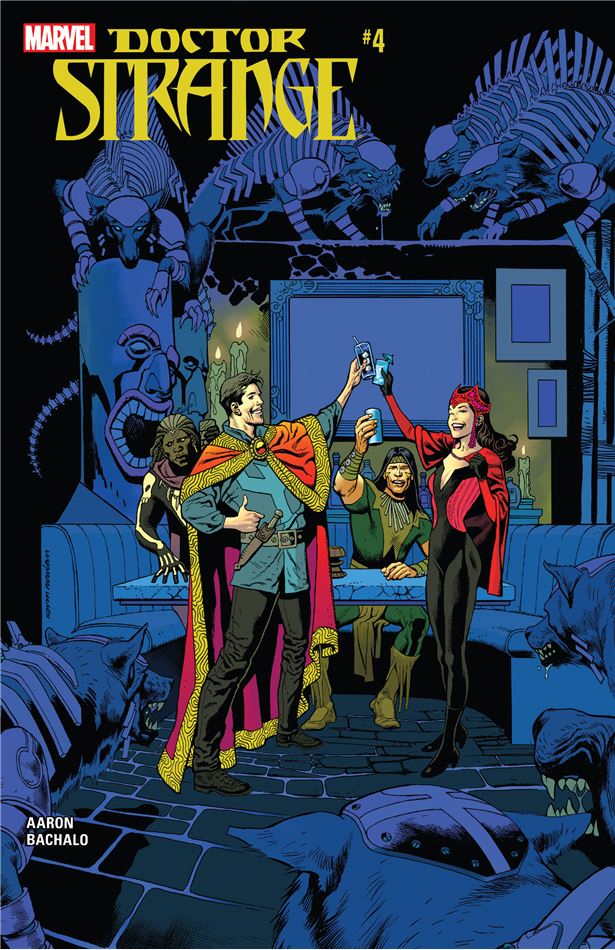
  1. Doctor Strange #4 (Marvel Comics), Unspoiled Edition

Doctor Strange 04 01

One of the people working at my local comic book shop suggested that each issue of Doctor Strange has been better than the previous and while I appreciate that sentiment I don’t agree with it. Doctor Strange #2 was BY FAR the best issue that has been released so far. I think a more accurate thing to say would be that each issue makes the whole developing story look much more sturdy and exciting. The fourth issue was pretty fantastic, and it is hard not to see awesome things on the horizon now that Strange’s relationship with the myriad magic-wielders of Marvel-616 has been established.

  1. Obi-Wan & Anakin #1 (Marvel Comics), Unspoiled Edition

Obi-Wan & Anakin 01 01

While seeing Anakin Skywalker with his Padowan rat tail (or at all) might be off-putting to those who would prefer to imagine that the prequel films never happened, the era of Anakin’s training under Obi-Wan Kenobi is a relatively untapped and potentially fruitful mine of Star Wars awesomeness. As witnessed by the last issue of theChewbacca mini-series, these canonical comic books have the potential to contain serious reveals about our favorite characters, but if the potential for big plot developments is enough the fantastic art of Marco Checchetto should be enough to keep your attention.

SPOILED

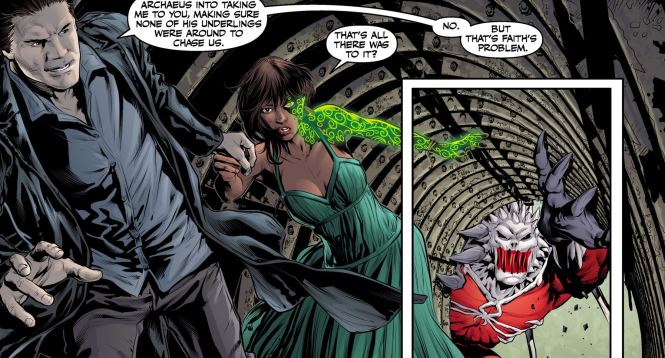
  1. Angel & Faith Season 10 #22 (Dark Horse Comics), Spoiled Edition

Angel & Faith Season 10 22 07

When Nadira first got kidnapped by Archaeus, I started narrowing my focus in on Angel & Faith Season 10. In my humble and limited opinion — I haven’t yet become an expert of Dark Horse’s offerings — this is probably the best book the publisher has put out since they lost the rights to Star Wars. In fact, Nadira, a magically affected individual who has a strange, passive relationship with the powers at play in Magic Town, is becoming a character of central importance. She claims that she does not command the magic in Magic Town, that she is more of a mouthpiece, but there are some serious questions surrounding the exact meaning of her relationship with this fount of energy.

Angel & Faith Season 10 22 03

Could she control or influence the magic under duress or with training? Is it possible that the magic has been using her as a tool for some intentions that she does not yet understand? More frightening: Might the magic choose a different host like Archaeus in order to assert its own will?

The question of Archaeus brings us to what is probably the most important issue of Angel & Faith this season, the issue of Angel’s vampire family.

Angel & Faith Season 10 22 02

Archaeus is the demonic progenitor of the line of vampires of which Angel is a part, and as a result he has the ability to influence and control Angel and Drusilla, as witnessed in Angel & Faith, and Spike, as witnessed in Buffy the Vampire Slayer. I think what we are supposed to fear at the end of this season is that Archaeus might be able to siphon the mystical energies of Magic Town (perhaps with the help of the mysterious statue that was introduced at the end of this issue) and overcome Angel and Spike’s defenses, thus adding Angelus and Spike the Slayer Slayer to his army.

Angel & Faith Season 10 22 08

What I am a little bit haunted by is the memory that Angel’s sire and former lover Darla hasn’t been referenced in any significant way. I know that she was staked on the Buffy TV show, only to be resurrected and killed again on Angel, but the book of magic has been rewritten, literally, which means that all bets are off. I guess the big question is whether there are still some fruits to come from a continued relationship/rivalry between Angel and Darla. My knee-jerk reaction is that there is still a lot of fun to be had with those two vampires, but then again, I was always a fan of Darla, so I’m a little biased.

In reference to the bigger picture of this season, with Buffy and crew falling in with some of the bigger powers of our dimensions — the counsel, the military, the two main vampire representative groups — in order to battle some of the bigger powers from other dimensions — Godzilla-style mega-monsters trampling major cities, it remains unclear where Angel and Archaeus’ war games will fit in. My gut says that Archaeus is the prime mover in this story, that he will acquire the power of Magic Town and potentially of the book of magic in order to get all vampires worldwide under his power, but my mind says that Joss Whedon is much smarter than my gut and he’s going to impress me more than my own theories ever will.

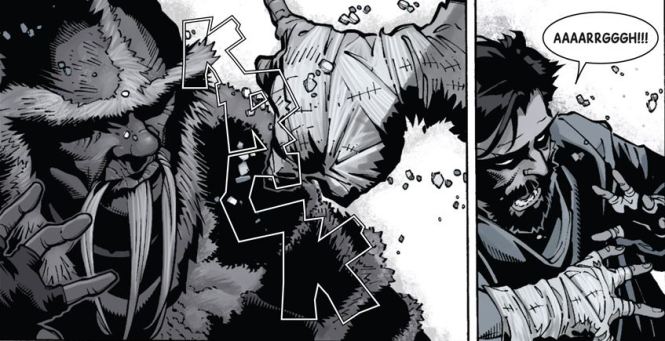
  1. Doctor Strange #4 (Marvel Comics), Spoiled Edition

Doctor Strange 04 02

I may have downplayed their inclusion in the short description I wrote above, but I could not be more excited that Doctor Strange has already met with characters like Scarlet Witch, Magick, and Shaman by Doctor Strange #4.

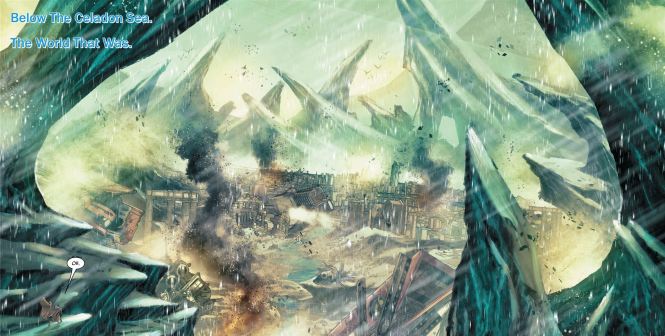
Doctor Strange 04 04

What this suggests to me is that these characters are likely to pop up here and there as the story progresses and that they will be highly developed and integral to the story once we begin to march toward Jason Aaron’s endgame. I really loved seeing Chris Bachalo’s depiction of Illyana Rasputin when he was doing the art for Bendis’Uncanny X-Men, and I’m already a fan of his work on Wanda Maximov. When it comes to character development, I’m happy to see Shaman again. Back in my day, I was really into Alpha Flight, and I would love to see this old guy get a bigger piece of the action. I’ve mentioned before that I love how Jason Aaron writes Illyana Rasputin, and while there has been talk about Strange and Magick training together I wouldn’t mind seeing them in action a little more often than I have in the past. Of course, at the end of the day, I think I might be the most excited about Aaron potentially fleshing out some of the lesser known sorcerers in the crowd and making them his own.

While the main story continues to be the elimination of the various Sorcerers Supreme from across the multiverse, what I am really excited about is the fact that Doctor Strange #4 is mainly dedicated to explaining Strange’s taste for disgusting food. During the flashback at the beginning of this issue, Aaron establishes a theme of, “Every punch comes with a cost.” The literal understanding of this maxim is made plain when Stephen Strange punches his master with one of his maimed hands only to be met with intense pain.

Doctor Strange 04 03

The analogical understanding is that you cannot use magic without also paying a cost. This cost is a kind of purging. It sometimes involves vomiting profusely, but it has been suggested that one can purge oneself without vomiting actual stomach contents. What I really liked is how the idea that magic has its cost is now tied to the arcane pasta in Strange’s refrigerator. Since the Sorcerer Supreme has lost so much of his original self to the magic that he has cast to protect the universe (and then some), he is now only able to eat terrifying Cthulhean jelly that apparently tastes like lepers.

Doctor Strange 04 05

Comedy aside, I think my response to every punch coming with a cost would be not to punch, but that option is removed near the end of the issue. We are told that a world without Stephen Strange would be just fine, but a world without magic wouldn’t be worth living in. If Strange is the one who must keep magic alive in our universe, then he needs to keep punching, regardless of the cost.

Doctor Strange 04 06

Now that we’ve spoken about a wizard-world support group and the cost of magic, I think it is about time we talked about Doctor Doom, because if there is going to be an arcane battle against anti-magic Doctor Strange is almost certainly going to need Doom’s support and there is almost certainly going to be a cost. I hope Brian Michael Bendis is willing to share Victor Von Doom with Jason Aaron for this purpose. If not, I trust these creators to do what’s right, but I find it hard to believe that there will be a battle for the fate of magic that doesn’t involve Doom. If there were, he’d be whining about it in third person for years to come. “Boo hoo. Nobody invited Doom to the apocalypse get-down.”

  1. Obi-Wan & Anakin #1 (Marvel Comics), Spoiled Edition

Obi-Wan & Anakin 01 02

By the end of Episode VI: Return of the Jedi, the assumption is that there is only one Jedi left in the universe and zero Sith. Sure, Leia is naturally strong in the force, but she hasn’t (yet?) gotten any training in the ways of the force. If the original trilogy is your main entry point for Star Wars, then Obi-Wan Kenobi’s comment that there are only 10,000 Jedi in the universe during the time of the Obi-Wan & Anakin mini-series (between Phantom Menace and Attack of the Clones) feels pretty ridiculous. Charles Soule certainly plays on the highly political tone of Episodes I-III, but he does so on a distant non-Republic planet. In other words, we are not hit by a brick wall of political intrigue, confusing and confounding us the way Phantom Menace and its droogs unfortunately did. Instead, there is a pretty simple description of the Senate and the Jedi and their place in the universe. The Jedi Order are at the disposal of the Senate, and the Senate protects planets that have resources they need while completely abandoning others.

Obi-Wan & Anakin 01 04

I have been pushing the idea that the Jedi Order of I-III is already corrupt and only a couple inches from the dark side at all times, and this is something that would have been the case even without Palpatine’s machinations. When Obi-Wan explains this structure to Anakin, he does so very matter-of-factly, clearly attempting to mask his dissatisfaction with the shape of things. I would be really happy if this comic gave us more canonical support for Qui-Gon Jinn’s middle-path between the corrupt natures of both the Jedi and the Sith, but I will certainly settle for a balanced portrait of Anakin Skywalker and Obi-Wan Kenobi.

Obi-Wan & Anakin 01 03

The other interesting development is that Anakin and Obi-Wan’s quest to this abandoned planet appears to be a shell for a more important story in which Anakin Skywalker contemplates leaving the Jedi Order. I think what we’re supposed to want — despite the fact that it would make everything thereafter no longer work continuity-wise — is for Anakin to leave the Jedi Order, because if he is never trained to use his powers he can never become the weapon of Palpatine. I used to be of this school, but I have recently abandoned this line of thinking. If we are to believe that Pelagius is able to manipulate life and death (as described in Revenge of the Sith) and that Anakin was conceived by the force (as described in Phantom Menace) resulting in the conclusion that Anakin was created by Pelagius, then one way or another Anakin was going to become a tool for the Sith. What is truly amazing is that in his last moments (Return of the Jedi), Anakin overcame the evil purpose he was created for. Now, that’s good story-telling. As for Anakin wanting to leave the Order, what concerns me in this mini-series is why he wants to and why he decides against it.

I’m hoping Soule decides to keep playing up Anakin’s slave background, because this is one of the most under-addressed ethical issues (alongside the consequences of the destruction of Alderaan) in all of Star Wars.

Obi-Wan & Anakin 01 05

Phantom Menace made slavery on Tattooine seem fun and goofy and I’d like someone to have the courage to posit the truth about slavery and forced labor. Hopefully, Charles Soule is my guy.

* * *

New Avengers Illuminati Special 01 03

In preparation for Captain America: Civil War, I decided to go back and read the 2006-07 Marvel’s Civil War mini-series and surrounding issues. Obviously, I am going to recommend that you all do so as well, because that means I will have more people to talk to. Captain America: Civil War is inevitably going to diverge quite a bit from the original Civil War of a decade ago, and I am certainly not into the idea of movie-goers booing a film because it does not stick to a strict pre-existing story, but I am happy to use the film as an excuse to do some catch up.

I only got around to reading one Civil War comic this week and it was The New Avengers Illuminati special issue by Brian Michael Bendis and Alex Maleev featuring “The Road to Civil War” banner.

New Avengers Illuminati Special 01 01

I have to say that this was probably one of the heaviest comics I have ever read. There is a lot to discuss about this issue, but the most important aspects for the current conversation come down to Tony Stark’s monologue near the end of the issue. He basically explains that he is a futurist and then describes a story of how in the near future a young Avenger will get into some sort of trouble, the media is going to jump on it, the people are going to get scared, and they are going to pass the Superhero Registration Act. Once this Act is passed, friends and families are going to be divided by a Civil War and people are going to die. Stark describes it as if it is inevitable and believes that his fellow Illuminati ought to volunteer to register and get in good with SHIELD before the hammer comes down.

New Avengers Illuminati Special 01 04

I thought maybe Bendis would ease into this story, but already we basically know what happens. Unfortunately, most of us already know the biggest casualty of the war to come, but the original audience had no idea what was coming. For all they knew, this was just another crossover.

I can’t help but to see Stark’s desire to bring the entire superhero community together as a parallel to what was going on during that time at Marvel Comics from a production standpoint. When I started reading comics again in 2011, the post-Civil War world that I had entered into seemed much more organized than the various comics I had read from the 1960s through the 1990s. What I had inferred about Civil War was that Marvel had used it to bring together scattered franchises like Avengers, Fantastic Four, Spider-man, Daredevil, and company, in a way that mirrored the successful dynamic of Professor X and Magneto in the 1960s. With Captain America (the idealist) at odds with Iron Man (the pragmatist), the world of non-mutant superheroes would now have a shape, and every character would have a reason for existence that connected to some central idea. It has always worked for the X-Men, making them the most compelling superhero team in comic book history, and now Marvel would make it work for all of their other titles as well. Genius!

New Avengers Illuminati Special 01 05

Of course, my hypothesis can only stand on two legs if it survives the actual battle, and I’m really excited to put it to the test by reading Civil War. As with every post, if you see something you want to talk about, let’s talk about it. If you want to talk about something that isn’t referenced in this post, let’s talk about it just the same.

It’s Only Forever: Making Peace with David Bowie’s Passing

Photo Jan 11, 9 09 26 AM

Don’t tell me truth hurts, little girl
‘Cause it hurts like hell

-David Bowie

Do you remember the words to the songs your parents would sing to you to put you to sleep, the various lullabies of your early youth? The Tiemeyer boys sure do. Well, at least one of them… It went something like this:

There’s a Starman waiting in the sky
He’d like to come and meet us
But he thinks he’d blow our minds
There’s a Starman waiting in the sky
He’s told us not to blow it
‘Cause he knows it’s all worthwhile
He told me
Let the children lose it
Let the children use it
Let all the children boogie

I’ve brought this up with a decent amount of my friends, but my brother and I legitimately thought David Bowie’s “Starman” was a bedtime lullaby. We knew the song by heart before we’d ever heard the actual song, simply because that was what dad sang to us as we were rocked in his arms. I spent the first half of my life rebelling against my dad’s favorite bands — David Bowie and The Rolling Stones most of all  — but now David Bowie is dead and I’m left with regret that I didn’t begin paying my respect sooner.

gettyimages-85057401_custom-f865d003d25a1da5c2dfcf2512b5a3fde118483b-s900-c85

At first, I thought the posts about Bowie’s passing might be just another one of those celebrity death hoaxes like what happened with Jeff Goldblum, Mark McGrath, and Cher, but the story checked out this time. Once I found out that this was the real deal — that David Bowie was really gone — I honestly didn’t know what to do or say, so I broke it down into a to-do list in my mind: call dad at some point today, remove “[ ] See David Bowie live” from the bucket list, figure out something to say about his death… My wife later told me that she cried on the bus to school when she found out. Some girl tried to talk to her and she nearly shouted, “Your generation doesn’t even know what you just lost.” When she asked how I was doing, I told her it felt like a death in the family. In one way or another, David Bowie has always been with me, so I opened up a blank WordPress window and started writing anecdotes about the years I’ve spent with Bowie.

* * *

david-bowie-jareth-labyrinth-Favim.com-154271

When my brother and I were young, we would spend the afternoons at our aunt’s house while both of our parents worked. There were a lot of perks about Aunt Sue’s house. She had a swimming pool, a clipboard and lots of blank paper to draw or write on, and she had all of the premium channels that we didn’t subscribe to at home. One afternoon I flipped over to HBO where some strange puppet/song-and-dance film was playing and I couldn’t take my eyes away. The strange part was that I felt as if I’d watched this film before, with the puzzles and the strange characters. When I saw the little baby crawling on the ceiling, I knew this film was the source of some recurring childhood nightmares.

That evening I boldly confronted my parents. “I saw this movie starring David Bowie and a bunch of Muppets at Aunt Sue’s today. It was called Labyrinth and I swear I’ve seen it before. I remember the baby on the ceiling from my dreams.”

My dad explained that he’d taken me to see Labyrinth when I was three years old, just four months after my younger brother Micah was born. We had gone to this strange theater on 29th street called the Quad 6 because my dad wasn’t going to miss David Bowie’s new movie and when you have both a baby and a little guy in your life you don’t get to sneak out without taking at least one of them with you. It wasn’t my first movie in theaters. I’d seen The Care Bears Movie and Sesame Street Presents Follow that Bird the year before. Labyrinth had certainly stuck with me in a jarring way, but because my dad took me to see the film at such an early age I was better prepared than anyone else when hipsters brought the magnifying glass to David Bowie’s funk opera in the early 2000s.

When I was a child, Labyrinth was the stuff of nightmares, but as a teenager I’d come to terms with the film enough that I could pop it on every day after school if I wanted and even go to sleep with it running in the background.

* * *

For a year I lived with my brother Micah and a guy named Travis on the Northern border of the University of North Texas campus no more than a block away from the DFW’s emerging party Mecca on Fry Street in Denton, Texas. Travis was a musician, photographer, and band promoter, and it was not uncommon for me to come home from work at Chicken Express and find our top-floor apartment filled with people and beer. I was in my mid-twenties with two degrees and I was finally having a traditional college experience.

The centerpiece of our apartment was a formidable wooden plank placed over our entryway at waist-level that we used as a beer pong table. Above it, on the wall, was a poster of David Bowie from the cover of Aladdin Sane. When we played beer pong we made use of what we called the Bowie Rule. If you bounced the ball off of Bowie’s face and it made it into your opponent’s cup, you would automatically win and the loser would have to drink all remaining cups of beer.

1924161_524977346118_7173_n

I knew most of my Texas friends were acquainted with our setup, but I had no idea how far the legend of Bowie Rules beer pong had gone until I was hanging out on Fry Street and overheard a group of complete strangers talking about how someone nearby had a beer pong table with a picture of David Bowie overlooking it. The stranger proceeded to explain how one could use Bowie for the sake of crushing ones beer pong adversaries as if it were some local legend and not some silly thing my brother and I had come up with a couple months earlier. In fact, I wouldn’t be surprised if someone in North Texas who either can’t remember or never learned my name, Micah’s name, or Travis’s name, saw the news about David Bowie’s death and immediately thought of Bowie Rules beer pong.

* * *

The year before I met my wife, I swear there wasn’t a day that went by where I didn’t listen to David Bowie’s album Hunky Dory. The album spoke of artists and poets as space aliens and mutants and expressed dissatisfaction at the ape-like behaviors of your ordinary, every day humans. One of my favorite moments took place about an hour outside of Roswell, New Mexico when the car I borrowed from my brother cast a long shadow on the desert sand and my buddy Stephan and I decided to play this album for our friends Adam and Tom for the first time.

26104_744153503475_3572313_n

When I met Amy, I welcomed a woman into my life who had more David Bowie records than I did. Preparing for our wedding, we had serious problems deciding whether Amy would use Bowie’s song “Kooks” for the father/daughter dance or if I would use it for the mother/son dance. Amy ended up winning, and watching her dance with her step dad Cliff was one of my favorite moments of our wedding. My own dad turned to me and gave me an exhilarated thumbs up when he heard the tune.

1512438_10202104214766469_6775158535387665066_n

Despite the fact that our puppy has torn up nearly all of Amy’s undergarments, socks, and shoes in the eight months he’s been a part of our lives, I don’t think Amy was ever quite as sad as when Tiberius tore up her special edition vinyl copy of David Bowie narrating Peter and the Wolf. Of course, there is a kind of justice in the universe, because this past Christmas my dad went downstairs abruptly and came back with his original copy of the record. This is a record I’d heard my old man talk about nearly as often as he’d talked about how “uncanny” the resemblance was between Johnny Van Zant and deceased Lynyrd Skynyrd lead singer Ronnie Van Zant’s voices or how Mick Jagger was actually a shrewd businessman, and he’d decided he wanted Amy and I to have it.

* * *

Whenever a celebrity dies and people take to the web to express their sadness, there is inevitably going to be someone out there who shames fans because they’re not mourning a more appropriate tragedy like victims of some crisis overseas or a shooting on American soil. Forgive me for my language, but that is a crock of horse shit. Some of us can point to a song, a movie, or a book, and say, “That’s what got me through high school,” or “That’s the reason I didn’t kill myself in 1996.” Somebody had to go to a dark place him/herself in order to make that art and save your sorry ass from yourself. As for me, I can say that David Bowie is a part of some of my most fruitful relationships. My dad introduced Bowie to me before I was even capable of making memories and I heard him sing songs from Bowie’s vast library every day when he took his afternoon shower. My brother Micah was the one who kickstarted my own David Bowie odyssey and he even had a blog for a while called “Letters to Bowie” that, at the time, was my favorite thing on the Internet. I think my wife and I might have still gotten together in a world without Bowie, but we’d be missing some key memories.

David Bowie neither burned out nor faded away. He burned hotter and longer than anyone else I can think of and, like a bright, distant star, we’ll be feeling his influence for years to come. He died last night, on Sunday, January 10, 2016, two days after his 69th birthday and the release of his twenty-fifth studio album Blackstar and after an 18-month struggle with cancer.

12507274_10103004975611805_5429575392921478651_n

I didn’t end up crying until I read Simon Pegg’s tweet about David Bowie’s death. You may want to grab a tissue before you scroll down any further. The following is a Tweet by Dean Podesta that was retweeted by, made popular by, and mis-credited to Simon Pegg.

https://twitter.com/JeSuisDean/status/686090202226528257

December 31, 1969

10906263_10205920051068528_7745438291295767990_n

Tom Mitsos is a good friend of mine. You may know him as the guy who went to the 2014 Winter Classic with me. I have known Tom since around 2002-03, when a band that I was in at the time called Craig played a benefit concert to help Tom pay for medical bills accrued due to his battle with cancer. On December 31, 2015, Facebook alerted me that I had been friends with Tom (on Facebook) for 46 years.

To put this in perspective, I thought I would include some information about the two of us. I turned 33 nearly a week before Facebook made this claim, Tom is currently 29, and Facebook itself will be 12 years old this coming February. There is no way that Tom and I have been friends for 46 years. Nor is there reason for Facebook to believe that we have been friends for that long. I’ve certainly been called an old soul at times, but this is ridiculous. And we weren’t even the only ones. After posting about this apparent error on Facebook’s part, four or five friends immediately responded that they’d experienced the same thing, begging the question: What’s so important about the date December 31, 1969?

UNIX Epoch

The short answer is that the UNIX (UNIplexed Information and Computing Service) operating system, which is the basis of many web servers, operates under the assumption that the beginning of time happened on January 1, 1970 at midnight Greenwich Mean Time. Because the Western Hemisphere didn’t get to 1970 quite as quickly as the time lords in the Greenwich district of London, England, a time zone-adjusted calculation of this zero hour would give us some specific hour on December 31, 1969, varying according to where exactly you live. Moving forward, events in UNIX time — also known as POSIX (Portable Operating System Interface) time or Epoch time — were measured in seconds after the epoch date 46 years ago.

Keeping this in mind, the massive worldwide Facebook notification turns out to be nothing more than a bug in the way that some of Facebook’s servers are calculating time. This glitch can happen on any system that uses UNIX’s epoch as the keystone for measuring time and it usually occurs either when the time returns no value or when its value has been reset for whatever reason. It’s my assumption that if Facebook hadn’t rolled out its On This Day notification platform many of us would have never noticed this server hitch.

Blankman

For years people have been getting phone calls, blank texts, blank picture messages, blank emails, blank Facebook comments, blank voicemails, and seeing information on eBay, Amazon, news web sites, pizza delivery web sites, recorded TV programs, and even home security systems dated December 31, 1969 in the Western Hemisphere or January 1, 1970 in the Eastern Hemisphere. Though many of those afflicted with these phantom communications are now familiar with the UNIX Epoch glitch, there are some other details that have lead some people to suspect that something else is going on surrounding these odd messages. Many of the emails, often called ghost or phantom emails, cannot be deleted and fade in and out of existence. One person reported getting a phantom phone call from an 859 area code where the second to last digit was the letter C (859-???-?C??). Another person reported what appeared to be an encrypted message:

BMy ÓÍ2óè?~d4eA~ݹycÓ?b »ñiÙ?

?ytAOÏ>?v®ASF?h4óA¿vÏ(0 é??EÀ[1]

Perhaps more disturbing is not the content of these messages, but some of the information surrounding them. If we are to trust the scattered online discussion, we would have to conclude that certain individuals are being targeted more often than others by these messages. In fact, many who report these issues have mentioned that they either experienced a recent death of a family member or close friend or are actively involved in subversive political discussions. One person on a cell phone message board suggested that he had tracked down a guy in the Washington DC area who was spying on the American public and somehow these messages were proof. Because of these incidental details, many are suggesting that these messages are evidence of Big Brother watching us or, to use more specific terms, evidence of NSA conducting illegal surveillance of the general populace.

12118846_811704252279567_7492788549169545391_n

It is incredibly difficult to find information on what might be called conspiracy theories surrounding the UNIX Epoch, and this fact could either feed into the validity of people’s claims or prove that the suppositions have already been invalidated according to the UNIX error. If there is such thing as a central hub for these phantom messages, it would probably have to be a pair of Facebook pages called December 31, 1969 and January 1, 1970. On these pages, concerned web surfers post pictures of strange comments on Facebook by an anonymous user that some have begun calling Blankman and discuss issues of NSA overreach and persecution. The individual who started the page has put up many posts in the last year or so about how his access to this page which he created had been blocked and various other complications had taken place. The people on this page do not take this lightly. They are convinced that there are federal employees whose entire job is spying on the American population, and they’re doing what they can to out these people for what they are doing.

Cyber Burial

All of the claims about the origin of these phantom messages appear to be unsubstantiated, but it does make a person wonder. I did run across a post on the Justice Gagged blog titled “My Dec. 31, 1969 Google+ Posts” where writer/activist Mary “Loves Justice” Neal collects all of her posts that were re-dated to December 31, 1969 in order to keep them from public viewing. I think the logic behind this accusation is that posts enter public feeds according to the date and time they were posted, so if some posts are mis-dated to before blogging was even a thing they could just collect unread in a mass grave of posts with the same date and time. In other words, the UNIX Epoch error could essentially be weaponized in order to bury information perceived to be dangerous to the interests of our federal government for whatever reason.

Mary Neal fit into both of the above categories of the people who appear to be harassed the most by phantom posts. According to Neal’s profile, her brother Larry Neal was “a handicapped American who was secretly arrested and returned to his family as a naked corpse after 18 days with records and accountability denied.” After this event, Mary Neal dedicated herself to outing the people who did this to her brother, advocating for mentally handicapped individuals in the prison system, and responding to retaliation, both on the Internet and in person, for her claims. The difference between Neal and the people we were talking about earlier is that instead of encountering ghost posts on social networking sites, her posts are being ghosted at an alarming rate. I’m not going to lie. I felt a little bit of a shiver when I read the following question on her blog post:

Does this symbolize NSA’s attempt to hide my existence in order to cover up the government’s secret arrest and murder of Larry Neal and prevent advocacy for 1.25 million mentally ill inmates in the U.S.A.?

I can’t verify the truth of Neal’s assertions, but I can verify that her posts express some real hurt. Whether the conspiracy that she speaks of is legitimate or not, something heinous certainly happened to her brother Larry and I can understand her desire for answers and for justice.

The USA PATRIOT Act of 2001

If history had unfolded in a different way, I think that the accusations of Blankmen with their empty messages and cyber burial could be immediately dismissed as groundless. However, because the USA PATRIOT (Uniting and Strengthening America by Providing Appropriate Tools Required to Intercept and Obstruct Terrorism) Act of 2001 breezed through Congress to an eager President’s desk in the aftermath of the September 11 terrorist attacks, there has never been more reason to suspect that government agencies are involved in monitoring and disappearing American citizens.

To start, Title II gives the FBI what appears to be a blanket authority over the surveillance of American citizens. With the use of National Security Letters (NSLs), the FBI was given the power to search telephone, email , and financial records without a court order. For those of you who like to follow the party line and blame this massive overreach under George W. Bush’s leadership, keep in mind that when Edward Snowden leaked classified information regarding a massive NSA data harvesting campaign fingers pointed to the Obama administration as well. The only difference between the Blankman accusations and the verifiable reality is that the FBI/NSA probably would not leave these blank after-images to mark their overreach. If our data was being gathered or disrupted, we would probably never know.

As for disappearing and potentially killing American citizens, there is reason to believe that the USA PATRIOT Act of 2001 has a provision for that as well. Under section 412, the act justifies indefinite detention without trial for resident aliens suspected connections to terrorist organizations or activities. As is the case with an unfortunately large amount of US policy concerning immigration and/or terrorism, racial profiling becomes a concern. For years, I have heard of people reporting that persons of color had been detained, sometimes intentionally, sometimes accidentally, without ever being charged a crime and without being able to contact friends and family members, let alone a lawyer.

Perhaps the most famous example is that of Jose Padilla, a US citizen from Brooklyn, New York. Padilla was held for three and a half years as an enemy combatant and subjected to enhanced interrogation techniques with no explicit criminal charges raised against him. Eventually, his case was brought before a series of courts where it was deemed that the President lacks the constitutional authority to detain Americans on American soil outside of a zone of combat. The Bush administration was eventually ordered to release Jose Padilla or charge him. Either way, his period indefinite detention had to come to an end.

I doubt it would surprise Mary Neal if her brother experienced a similar illegal detention and interrogation, if his mental handicap was perceived as willful lack of cooperation, resulting in harder interrogation that was simply more than he could survive. I am not saying that this is what happened. What I am saying is that the United States has not had a great track record for respecting civil liberties in the fifteen years since the USA Patriot Act was signed into law and this gives the people reason to believe that such abuses are much more commonplace than they might have believed during other periods.

* * *

In writing this post I promised myself that I would follow what I then referred to as “the conspiracy theories” as far as I could, and I think I have done so. Regarding Facebook’s assertion that I have been friends with Tom Mitsos for 46 years, I think this was little more than a widespread server error. There are some who suggest that Facebook’s severs aren’t UNIX based and others who believe any such error should be viewed as a serious security risk, but in my opinion I think the incident that brought about my inquiry was probably fairly benign. As for the accusations against the government, I think most of them fall under the category of a stopped clock being right twice a day. The strange artifacts of the UNIX Epoch only accidentally point to a government conspiracy, and it is only coincidental that we now have verifiable proof that the FBI and NSA are committing espionage against the people of the United States. I’d like to be a little more careful with the case of Mary Neal and her deceased brother Larry. Something happened here, and the last two Presidents have given us plenty of reason to believe that Mary Neal’s suspicions are true. Unfortunately for Neal, I doubt she will ever find the truth she is looking for.

Is Big Brother watching me? Probably, but I can’t imagine he’s finding anything interesting. It certainly crossed my mind that NSA surveillance might be the reason I was hit with the Facebook UNIX Epoch error rather than someone else. In the week prior to the incident, I’d published a critical post about wage and labor and a documentary film round-up post referencing the Edward Snowden film Citizenfour and the 9/11 conspiracy film Loose Change, and that wasn’t even the worst of it. I’ve been courting revolutionary ideas about economic reform for over four months and there’s a veritable bread trail out there to prove it. That said, I have to believe that what separates me from those we might call conspiracists is an understanding that I am just not that important to the NSA, the FBI, the CIA, and President Barack Obama himself. I could be a nuisance some day, but only with a lot of effort and no interruptions. At the end of the day, I’m just not a big enough fish for the President and all the President’s people to fry at this time.

To conclude this article I just want to say one more thing to my good friend years, Tom Mitsos:

Hey buddy.

If you’re reading this I want to wish you a happy 2016. We’ve crammed 46 years of friendship into somewhere near a decade of intensive hanging out. Here’s to 46 more years of the same.

Your friend,

Justin Tiemeyer

PS. If I get disappeared you know who did it. Tell Tiberius he can finally fulfill his dream and eat all my underwear, socks, and shoes. Tell my wife I love her very much. She knows.

PPS. You might want to back up this post on your hard drive and maybe with a hard copy as well, just in case it gets disappeared too. I wish I could have sent a droid with a holograph, but alas, we have the technology to monitor every human on the planet but an astromech droid is beyond us.