The githzerai was surprised at the appearance of this older version of Jenkins, and he was put off by the mystery of the two wizards, but for his comrades — those who had traveled with Jenkins and lived according to his authority for so long — the disbelief was complete. Were they not beset on all sides by a swarm of mucous-slaked giant insects, this would have been a fantastic time to clear the air on exactly what was going on. As it was, however, the conversation would have to be put on hold.
Perhaps of greater importance was the fact that the party’s entrance into this foreign realm had just been cut off and, like this broken old man with dirty, tangled curtains of hair, they would be trapped here until other adventurers found a way into this strange plane.
“What is this place?” Wiliken said to the older Jenkins.
The wizard was weeping. At first the githzerai thought them tears of pain. After all, this Jenkins was limping about on a leg turned sideways, likely broken years ago and healed incorrectly. It took a few moments for Wiliken to realize they were in fact tears of joy. Jenkins was among friends he hadn’t seen for years, friends he’d likely thought long dead. “No place,” Jenkins said, confused, as if language no longer came easy to him.
Wiliken stomped his foot twice on the solid ground beneath him. “This. Place.”
“No place,” Jenkins said. “Thing.”
“What?” Wiliken responded.
“Leviathan.”
If this were the real Jenkins, Wiliken thought, and it seemed so from his response to seeing his supposedly fallen comrades, then who was the wizard they’d seen in the remains of the Shining City, the man that Wiliken had revealed his deepest desire to, the one he’d hoped to enlist the help of in order to stop his son? Who was this man who had chosen to set Wiliken free?
As Wiliken fired off arrow after arrow into the sky above them, he noticed Jean-Baptiste take off frantically into the darkness, and he might have been swallowed by the horde of parasites were it not for the reflexes of strong Ugarth who grabbed their friend by the shoulder and pulled him back.
“You’re no good to us dead,” Ugarth said.
“But,” Jean-Baptiste said, “the portal.
“We stick together,” Ugarth said. “We survive.”
“A portal!” Jenkins shouted. “You have a portal?”
“We had a portal,” Jean-Baptiste corrected him.
“No! No! No! No!” Jenkins shouted. The old wizard scurried off in the same distance Jean-Baptiste had attempted to traverse. He succeeded in escaping the grasp of Ugarth, who cursed under his breath. Wiliken darted forward only to stop dead in his tracks and recoil as a blinding beacon shot up into the air around them. For a moment, the sky was as bright as a sunny day, and the multitude of flying beasts was uncannily clear. When that moment had concluded, there remained a faint jet of light travelling off into the distance, tracing the path to their collapsed portal. The old wizard Jenkins apparently had a few tricks up his sleeves even now.
Wiliken and friends used the moment of brightness to regroup around the wizard.
“Can you reopen the portal?” Wiliken asked.
“I can,” Jenkins said. “But we will have to get closer.”
Wiliken stepped forward before Jenkins stopped him. “Not that way,” he said, and then he pointed in the opposite direction. “That way.”
It was a leap of faith, but Wiliken turned in the opposite direction and ran with the surprisingly spry old man. He and his allies kept the creatures from flying down and swiping at the wizard who might be their only way out of this place. Sometimes to go one step forward it was required to go two steps back.
The group ran, Ugarth punching the dive-bombing insects out of the sky, Wiliken popping off quick shots, sometimes two at once, everyone helping in their own way, and it seemed like they were running a fool’s errand, but when they approached a large membranous chasm, they stopped.
“I think I sense what Jenkins was saying,” Jean-Baptiste said. “In fact, I’ve been sensing it since we got here. This thing we are on. It is alive.”
“Ah,” Wiliken said. “The ancient beast of legend. The leviathan. Large as a world, ever twisting and turning through the nether.”
Grace pointed to the chasm. “Then what is this?”
“A nostril,” Jean-Baptiste said. “I have an idea.”
He shoved his staff into a pink spot on the ground, and it gave way before his strength. A din erupted in the air that threatened to shatter the githzerai’s eardrums. Whatever this beast was that they were currently upon, leviathan or otherwise, they had hurt it. Jean-Baptiste pulled back on his staff, working it like a lever inside the creature’s sense organ, and Wiliken could feel the ground move as the monster fought against Jean-Baptiste. As Jean-Baptiste struggled with his staff, a surprising smile came over his face. Jean-Baptiste was winning. He was turning the beast around.
“Now it’s your turn,” Wiliken said. “Get that portal open.”
Ugarth had turned into a living shield for the wizard Jenkins who had brightened the sky once more with his staff. The now familiar trail of brightness shot off in the same direction as before, but this time it did not taper at the end and whisper away. It continued throughout the emptiness and brightened at its furthest point. As Jenkins muttered silent words from his lips, waves would flow along the route of this string, and the string itself began to grow. Before long the portal was once again visible. It was growing.
But the leviathan was now hurtling toward the portal, and it became clear that the portal was growing too slowly.
“We’ll never make it,” Grace said.
Wiliken was surprised by his own feeling, but he felt his own kind of brightness, something he couldn’t remember feeling. Wiliken had friends. In his mind, he’d called these people friends for most of the day, and sometimes in previous days as well. His wife was dead and his son was a vicious murderer bent on destroying most of what Wiliken had ever known, and yet he felt hope. Nobody was as surprised by this as the githzerai, despite the strange silence that erupted when he placed his hand on Jenkins’ shoulder and spoke.
“Yes,” Wiliken said. “We will.”
Jenkins was straining beyond what should have been his limit, and yet he pushed even harder, breaking any mental barrier, stepping outside of the game of human limitation, a true wizard in every meaning of the name. The githzerai had once encountered a tribe of humans during his military days who had a secluded shaman of great power. They had explained that one of these individuals was born in each generation, and the word they had used for this shaman translated loosely to “miracle.” Jenkins was one of these miracles.
They were far too close to the tiny portal for comfort, and it became clear that the consequences of the leviathan barreling head-first into this tiny portal would be cataclysmic, but at the last moment Jenkins screamed and there was a sudden burst of light. The portal ripped open wide. They were going to make it.
“The portal,” Ugarth said.
“Yes,” Grace said. “It’s open. We’re going home.”
“No,” Ugarth said. “We have to close it.”
“What?” asked Grace.
“We have to close it,” Ugarth said. “If we don’t, this leviathan will destroy everything we’ve ever known. Everything we’ve done will have been for nothing.”
“Can you do it?” Wiliken asked Jenkins, but the old man had collapsed. “Jenkins?”
It is a well-documented fact that I understand the meaning of a variety of highly revered holidays differently than my peers. This fact is perhaps best exemplified by the fiasco surrounding my interpretation of “veteran” which disrupted many of my Facebook friends’ celebrations of Veterans Day in 2013. As such, it should come as no surprise that my own personal traditions during the Christian holy week leading up to Easter differ from standard liturgy of the season.
My ideal Good Friday involves sitting back and watching Star Trek II: The Wrath of Khan with optional artisan bread and wine. Widely acclaimed as Star Trek’s greatest moment, The Wrath of Khan is perhaps best remembered for its conclusion in which beloved science officer Spock (played by Leonard Nimoy) sacrifices himself in order to restore the warp core of the Enterprise and prevent the demise of its entire crew. Those of you who think I am as antithetical to holidays as a Jehovah’s Witness may find my ritual surprisingly close to the ceremony of the body and the blood and the personal sacrifice of Christ observed by your standard issue Christian.
This year’s viewing of The Wrath of Khan is likely to be profoundly different than those of years past because of a couple of changes that have taken place in the past few months.
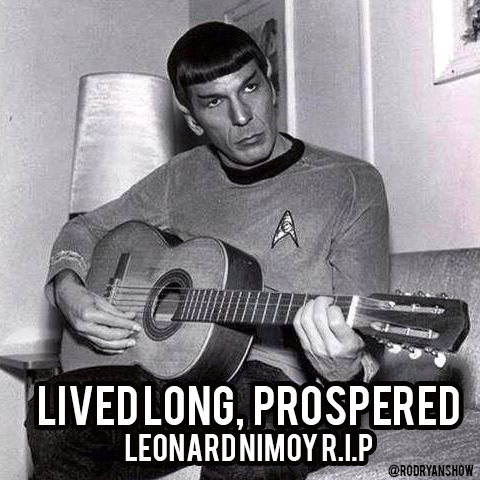
Nobody will be surprised to learn that the death of actor Leonard Nimoy at the age of 83 near the conclusion of February is likely to factor into the general mood of this year’s Good Friday. The actor best known as Spock has had an inordinate amount of influence on my life since the early childhood Star Trek conventions my father would take the family to.
Leonard Nimoy passed away on February 27, 2015 at the age of 83 due to complications related to chronic obstructive pulmonary disease (COPD).
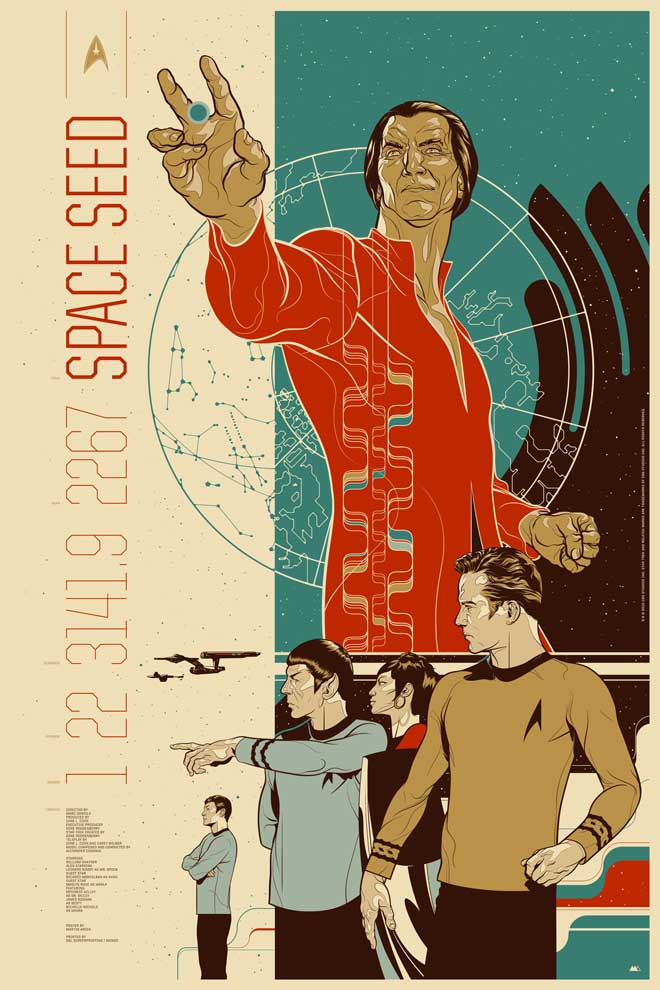
But it wasn’t just the influence of Leonard Nimoy that made The Wrath of Khan one of my favorite films of all time. After dissatisfaction with Star Trek: The Motion Picture in 1979, Paramount executives brought producer Harve Bennett into the discussion about where to go with its sequel. Bennett is reported to have watched all 79 original series episodes in preparation, and it was during this process that he was struck by Ricardo Montalban’s portrayal of Khan Noonien Singh in the 1967 episode “Space Seed.” Bennet’s desire to bring Khan and crew back from exile was the “seed” that grew into Star Trek II: The Wrath of Khan. Producer Harve Bennett and actor Leonard Nimoy, both heavily responsible for some of the best scenes in film history, died within days of one another.
These deaths are likely to add a great deal of gravity to the final scenes of The Wrath of Khan, but perhaps more transformative even than the deaths of Nimoy and Bennett is the fact that I have been rewatching the early episodes of Star Trek: The Original Series with a group of friends. This past week, like Bennett before me, I watched Khan’s first appearance in “Space Seed” myself. While the episode is rife with difficulties, from the awkward emphasis on romance between Khan and ship historian Marla McGivers to the Kirk’s foolish oversight in giving a tyrannical super soldier access to the ship’s most sensitive documents, there was a general agreement that something great was happening in this episode. Admittedly, our perception of the episode was colored by the film sequel we knew would come years later, but “Space Seed” also succeeded at developing a large chunk of the history between the 1960s era when Star Trek was produced and the 2260s era when Star Trek takes place. Ultimately, I think there is reason to believe that it is a great episode in its own right, even despite its shortcomings.
The episode “Space Seed” of Star Trek: The Original Series introduced the quintessential Trek villain Khan Noonien Singh (played by Ricardo Montalban).
It was a point brought up by fellow Longest Wind writer Josh Toulouse that promised to “color” my future viewing of The Wrath of Khan. Josh was so spot on in his criticism that I wish to quote him directly from his Facebook post:
Watching this episode, I was again reminded how much the latest Star Trek movie kind of annoyed me. SPOILERS: How the hell is Benadict [sic.] Cumberbatch Khan? People get so pissed off when they hire a person of color to play characters that have previously been white (see the new Johnny Storm and the rumor that the new Spidey might be a black actor or that Idris Elba might be the new James Bond), which is ridiculous since the race rarely has anything to do with who those characters really are. Here, however, Khan is very defined by the fact that he is not a white European or American, so of course the new movie hires a white Englishman to play him. Rubbish. Ruined the film for me, even more than the nonsensical Historian Star Fleet officer ruined this episode [“Space Seed”] for me.
While I couldn’t help but to solicit Josh to write a post expanding on this juxtaposition, possibly throwing in references to casting choices for Kingpin in Daredevil, Nick Fury in The Marvel Cinematic Universe, and Heimdal in Thor, I knew that my friend Rod Thomas had actually written two-part review of Star Trek Into Darkness that got to the root of Josh’s problems back in 2013 for his blog The Resist Daily.
In the first part of his review, titled “Star Trek Into Darkness Review Part One: What I Enjoyed,” Rod started out with the positive aspects of the film. In addition to giving praise for the performances of many of the main characters, Rod was generally happy with the importance of persons of color in this film.
Into Darkness passes the Race/POC Bechdel test, which for those unfamiliar is just a way of measuring racial diversity of a film. How so? There has to be one scene where 2 people of color discuss anything but (usually) white protagonist. That simple, really. The Help barely passes. No, I’m dead serious, it was 90 minutes into that movie before it happened. Into Darkness within the first 2 scenes I believe had a scene with Sulu and Uthura [sic.] taking about the U.S.S Enterprise. It was a pleasant surprise.
The second part of the series “Star Trek Into Darkness Review Part 2: Whitewashing Khan Means Plotholes & Mediocre Science Fiction” was unsurprisingly less pleasant. Rod notes the “Space Seed” depiction of Khan as “a political tyrant from India in the 1990s, possibly Sikh” and The Wrath of Khan‘s similar portrayal as “a POC powerful villain who outmatches Captain Kirk,” both of which are strongly at odds with J.J. Abrams’ decision to cast British actor Benedict Cumberbatch. Rod does note the problems associated with Gene Roddenberry’s decision to cast Ricardo Montalban, an actor of Spanish and Mexican heritage, as a dictator originating in the Indian subcontinent, but notes a consistency of message in this early faux pas, the idea that a “person of color can portray a complex, sympathetic antagonist, one who puts our leader on the brink, and who REMAINS part of the cast in what is considered one of the greatest (if not the greatest) science fiction films of all time.”
Benedict Cumberbatch succeeds Ricardo Montalban as Khan in Star Trek: Into Darkness.
Rod goes on to list several other critiques he has of Star Trek Into Darkness, but I do not wish to discuss them here. His posts are well-worth reading and I have linked them above for your enjoyment. In fact, it is worth noting that Rod nearly overshadows his valuable criticism of Into Darkness with an exposition about his love for Star Trek: Deep Space Nine which is about as on-cue as any description I’ve ever read of the series.
When I look forward to Good Friday, I cannot help but to see a contradiction, and that is the fact that my traditional holiday is proving to be more and more a-traditional with each passing day. It is true that I have at times prided myself at being described by others as an iconoclast, but that doesn’t mean that I’m completely against finding little bastions of comfort here and there, especially as I get older and have more difficulty dealing with change. The important question I have to ask myself is whether or not this change is for the better, and I believe the answer must be yes.
To watch Star Trek II: The Wrath of Khan was to become like a child again. I could easily put myself into the shoes of the boy who would watch his dad’s old VHS copy or catch the film during a TBS holiday weekend marathon. Slowly, however, I’m beginning to see things through the eyes of the father. I’m married and seriously entertaining the idea of having children in the next couple of years. It is only right to add some depth to my Good Friday tradition. Life is not without pain. Leonard Nimoy and Harve Bennett have passed away, and so must we all. Life is also not without injustice, and it is our job to name the sources of injustice and do our best to overcome them.
And after these servants of entropy waltz into my life, what of my original tradition will remain?
Rebellion against the breaking apart of the universe, no matter how hopeless, or, as it is more commonly known in most circles of society, communion — this will remain. In the spirit of communion I welcome all of you to join me on Friday, April 3, “Good Friday,” as it is called, in order to watch Star Trek II: The Wrath of Khan, to eat, to drink, and to remember.
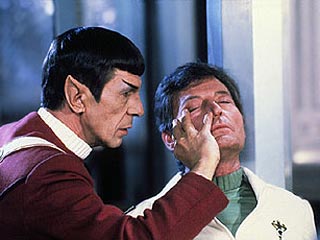
Leonard Nimoy as Spock and Deforest Kelley as Bones in the 1982 film Star Trek II: The Wrath of Khan. “Remember.”
It’s Sunday and it is time to catch up on the best the internet had to offer during the past week. If you have any article suggestions for the Sunday Roundup send me a tweet @tbone1225.
“The narrative that the 21 martyrs in Libya somehow fit into the American Culture War is just as dangerous and inaccurate as the claim that the Coptic faith does not fit into Christianity.” Guest blogger Nathan Lewis Lawrence of George Mason University returns to The Resist Daily with an article titled “Will ISIS Bring About Christian Unity?” which addresses the implications of ISIS in discussions of Christian identity.
Blackhawk Duncan Keith teaches wheelchair bound child Cammy to skate
“The two quickly hit it off by bonding over how many teeth each have lost, and sharing their love for the Blackhawks.” C. Roiumeliotis of CSN Chicago tells the heartwarming story of the day a young Blackhawks fan named Cammy skated with her favorite hockey player Duncan Keith in his article “Duncan Keith makes Blackhawks fan’s dreams come true.”
Howard, Jurco, Zidlicky and Cole may decide Red Wings playoff berth
Darkness. Darkness was the feel of this place, the thought that came to the githzerai’s mind when he tried to capture this alien world in his mind, and yet this landscape was not without light. A strange glow arose here and there, casting strange shadows with dull bio-luminescence. The ground was rough and moist, pebbled with slick scales. Wiliken half-expected a light rain, like those that arise in dense, murky forest, not because of clouds in the sky but because the muggy air had become greedy in its liquid holdings — like all others punished for their hubris its prize was forfeit. Thus the rain. But not so here. Where there should have been water, there was a hot, acrid stench. The githzerai was certain that no life could form in this place. Perhaps they had finally arrived at that preached of place where darkness rules and the inhabitants bite down on stone and bitumen, the place of living death. Perhaps this was the final chapter for Wiliken and his allies.
In death there is nothing left to fear. Wiliken could not remember the source, but the quote had long resonated with him. When he entered this world from the other one and all who came with him were put to the sword, though he was just a boy he would not let the despair of death defeat him, and when the allure of death brought him into the service of the Iuzian empire as one of their most feared warriors he feared neither the foes who stood in his way nor the punishment of his leaders were he to turn from their orders. Perhaps some dark prophet of the god Iuz emerged from one of his ecstasies with only those words on his tongue. Perhaps it was some profound poet of revolutionary peace. To the githzerai, it did not matter. These words were in his blood. They commanded him to move forward one footstep at a time, to trust his senses, to surrender to the inevitability of the landslide of time.
The strange light revealed mounds to either side of the githzerai, few taller than his tallest comrade, mountains in the miniature. He’d seen similar in some of the villages he’d walked through, those less advanced than the cities he’d always called home. These mounds marked where the people had put to rest their loved ones once they had passed away. Even in those days Wiliken had felt reverence for such mounds. It could have been that he’d valued life even in his darkest days or even that he knew that he had put many of those people in the ground either directly or due to the consequences of his choices, but he felt reverence no less.
Time and time again, the githzerai had noted that life will show itself in the most unlikely of places, for even in this place tiny pests skittered this way and that, revealing themselves in the gloomy light. Larger sounds spoke to the possibility of larger beasts. Wiliken drew his bow and readied an arrow. He’d expected a grey-scale gloom and eternal nothingness, but perhaps he ought to have readied himself for the vicious beasts that had proven strong enough over the generations to survive in this horrid clime. Wiliken detected a shuffling behind one of the mounds some fifty paces to his right, and, having decided that the best defense is a good offense, he sneaked off toward the origin of the sound, himself the night-stalker.
His keen ears detected a strange variation of a yawn, a quiet shuffling, and then rest. As he stepped sideways, one foot over the other, he noticed that the sound had died down. His prey was alerted to his presence. Though the beast was clearly attempting to go noiseless, Wiliken heard its labored breathing on the stink-filled air.
Wiliken paused, uncertain how to proceed. He heard the familiar footsteps of his allies as they crept up behind him. The beast might be dangerous, but the githzerai would not die alone if the battle went poorly. It’s better than I deserve, he thought before shouting out, “We have the greater numbers! Show yourself!”
He heard a slight shriek followed by a skittering not unlike a two-hundred pound rodent. What emerged from behind the mound was certainly human, a pitiful old cripple covered in a shroud and stinking of his own waste. The man pulled back his hood to reveal a pair of rheumy eyes, and an unmistakable complexion, if not marred by wrinkles and scars. “Hello,” said the tentative voice. “Who are you?” He raised a staff, still brimming with the spunk of a man accustomed to winning at quarrels.
It was Jean-Baptiste who uttered the impossible words that everyone was thinking: “Jenkins?”
The old man cocked his head sideways like a trained dog at the sound of an unfamiliar command. “Do I know you?”
The last syllables of his question were drowned out by a sudden din as the ground around them erupted with seismic waves. It was as if the stones of the earth themselves were attempting to take form and eject these foreigners.
“Oh no! Oh no! Oh no!” Jenkins said, clutching at his few remaining wisps of hair. “You’ve really done it this time! You’ve really done it this time!”
There were enough explosions in quick succession that it began difficult to track exactly where the sound was coming from, but what was present to the githzerai’s senses was the fact that large nests of insectoid creatures emerged in a blast of puss-like ooze with each blast. Where once there was complete and utter waste, now there emerged a swarm of aggressive beasts that had already began to take quick and painful swipes at Wiliken and his allies.
He raised nocked an arrow and halted. Something else had changed. Something perhaps more dangerous than the flying parasites. The darkness here was different somehow. It was more complete. No sooner had Wiliken posed the mystery to himself than Grace solved it.
“The portal,” she said, holding a limp coil of rope in her hand. “It’s closed itself. We’re trapped here.”
It’s Sunday and it is time to catch up on the best the internet had to offer during the past week. If you have any article suggestions for the Sunday Roundup send me a tweet @tbone1225.
Social justice, science (fiction), and animated flicks are amongst the winners of the Josh2K14
Mere hours before the Academy Awards aired, Joshua Toulouse at Fat Train put up his post “TOP TEN FILMS OF 2014.” Josh is my go-to guy when it comes to film and television, and I look forward to his top ten all year.
“At the Lord’s Table, characterization and dehumanization must end.” For Adam Schneider, graduate student at The Seattle School of Theology & Psychology and guest writer for The Resist Daily, the transformation that takes place during the Eucharist is enough to change the world and bring about nonviolence. Read more from his theology of communion in his article “The Path of Forgiveness: Inviting ISIS to the Eucharist.”
Wil Wheaton joins the entire universe in mourning Leonard Nimoy’s death
“In ways that I couldn’t articulate at the time, I wanted to be Mister Spock because if I was, I could be myself — quiet, bookish, alien to the people around me — and it wouldn’t be weird. it would be awesome.” Internet geek mogul and Star Trek alumnus Wil Wheaton reflects upon Leonard Nimoy’s influence on his life in his article “REMEMBERING LEONARD NIMOY.” Nimoy, best known for playing the beloved Vulcan Spock, passed away on February 27th after a long battle with COPD.
“What I am not for is a Black History Month that exists as a ritual that reminds Black people annually of our need to assimilate to the dominant culture.” Rod Thomas at The Resist Daily discusses the achievements of African Americans, the contradictions of Black life, and the reasons why there is not a White History Month in a brief post titled “Why I Won’t Waste My Time Defending Black History Month.”
Blackhawk Brent Sopel’s retirement and his impact on the LGBT sporting community
“Brent Sopel bringing the Stanley Cup to the Pride Parade may not define his 18 years as a pro or 12 years in the NHL — nor does it erase some of the other questionable stances he’s taken — but it remains an important moment for LGBT hockey players and fans.” Greg Wyshynski at Puck Daddy recounts the impact of Brent Sopel’s decision to bring the Stanley Cup to a 2010 Pride Parade in his article “As Brent Sopel retires, impact on LGBT hockey not forgotten.”
It’s Sunday and it is time to catch up on the best the internet had to offer during the past week. If you have any article suggestions for the Sunday Roundup send me a tweet @tbone1225.
Things you’ve always wanted to know about the Red Wings
“The perfect storm of Northern amnesia and largely white rural-sides weave a story that claims that Northern racial tensions (if they exist at all) only seem to occur in large cities where blacks are concentrated; thereby subtly implying that the issue is the very presence of said communities.” Guest writer Nathan Lewis Lawrence writes about manifestations of white supremacy in northern states in general and Ohio specifically in his post “Four Things You Didn’t Know About Northern Racism” for The Resist Daily. Check out his other writings at his blog Taming Cynicism.
Exploited foreign workers and the spiritual season of Lent
“I think it is appropriate here to illustrate the exploitative nature of outsourcing through the context of the current season of Lent.” With the religious observance of Lent in mind, Richard Thomas discusses concepts of freedom in the face of oppressive economic institutions in his article “Our Bondage And Our Freedom: on Lent and neoliberalism” for The Resist Daily.
It’s Sunday and it is time to catch up on the best the internet had to offer during the past week. If you have any article suggestions for the Sunday Roundup send me a tweet @tbone1225.
“I’ve said in the past that Mrazek has done all that he can in the AHL. He has more than 50 wins and backstopped his team to a Calder Cup during the 2012-13 season. He has nothing left to prove at that level.” Tom Mitsos discusses goalie Petr Mrazek’s likely fate after head goalie Jimmy Howard returns in his article “Has Petr Mrazek Played His Way Onto Red Wings” at The Hockey Writers.
It’s a good time for social justice cinema
“It’s no laughing matter to see enslaved Black persons being beaten on the big screen. These social justice films are enjoyable, but I would not say that they are entirely pleasant experiences. We’re not talking about rom-coms here.” Rod Thomas of The Resist Daily shares his critical observations about the Ava Duvernay film Selma in an article titled “5 Takeaways from #Selma @SelmaMovie.”
Miracle: the Russian perspective
“[I]t was Tarasov’s love of the game and big-hearted nature that helped the Soviet Union players fall in love with the sport.” Tom Mitsosreviews ESPN’s new 30 for 30 hockey-umentary “Of Miracles and Men” for The Hockey Writers.
Defense fails Mrazek in Red Wings loss to Penguins
“Mrazek most likely played his last game in Detroit for a while, now that both Howard and Jonas Gustavsson are healthy.” After a difficult loss to the Penguins, Tom Mitsos laments Petr Mrazek’s relatively short season as goaltender for the Red Wings in his article “3 Observations from Red Wings’ Loss to Pittsburgh” on The Hockey Writers.
The hypothetical cost of Kessel
“It’s a very solid lineup for sure. Kessel on the top line with Pavel Datsyuk and Justin Abdelkader is a dream lineup, and the possibility of Henrik Zetterberg taking Abdelkader’s spot on the wing only makes the line that more dangerous.” Tom Mitsos weighs the pros and cons of the Red Wings trading a big chunk of their roster for Toronto’s Phil Kessel in his article “Red Wings Hypothetical Trade: How Much for Kessel?” for The Hockey Writers. Special thanks to hockey analytics researcher David Malinowski for the prompt.
Goalie Tom McCollum on his time with the Red Wings
Tom Mitsos and The Hockey Writersinterview Red Wings goalie prospect Tom McCollum about his short stint in Detroit, his continued presence with the Grand Rapids Griffins, and how he got into hockey in the first place.
It’s Sunday and it is time to catch up on the best the internet had to offer during the past week. If you have any article suggestions for the Sunday Roundup send me a tweet @tbone1225.
Red Wings need to work on their penalty kill
“When you already are down a man, chasing the puck is the worst sin you can commit on the penalty kill, especially if you are facing a team that is good at cycling the puck.” Despite a winning record, the Red Wings have had some serious problems shoring up their penalty kill. Tom Mitsos discusses ways the team can overcome this issue in his article “How to Fix the Red Wings’ Penalty Kill” for The Hockey Writers.
Croatia is just the latest in a long line of debt cancellation programs
“Whatever happens in this latest game of brinkmanship between creditors and debtors, history shows that mass debt write-offs are neither as rare nor as taboo as we might think.” From the early Jewish concept of the “Year of Jubilee” and the Babylonian Code of Hammurabi to post-war debt forgiveness plans in France, Greece, Italy and Germany, Telegraph writer Mehreen Khan explains how debt cancellation has been a central tenet of many of history’s greatest economic success stories. Check out Mehreen’s article “The biggest debt write-offs in the history of the world” and the book that inspired it titled This Time Is Different: Eight Centuries of Financial Follyby Carmen M. Reinhart and Kenneth S. Rogoff.
Seahawks decision to pass at the 1-yard line is NOT the biggest coaching foible of all time
After the Super Bowl, football fans were quick to label Pete Carroll’s fateful decision to pass instead of run the ball as the worst coaching mistake of all time, but to Tom Mitsos of The Hockey Writers that award goes to Soviet Union ice hockey coach Viktor Tikhonov who pulled goalie Vladislav Tretiak, who was touted as the best goalie in the world, resulting in a loss to the United States in the 1980 Olympics. “Tikhonov even admitted pulling Tretiak was the worst mistake he ever made, and no one knew Tretiak as an athlete better than Tikhonov.” For more, read Tom’s article “Bigger Coaching Gaff: Viktor Tikhonov or Pete Carroll?”
Harper Lee’s sequel to To Kill a Mockingbird
The internet was set ablaze following the discovery of a sequel to To Kill a Mockingbird written by Harper Lee. Comic writer Paul Cornell and Twitter wisdom curator Jon Winokur were among the many who took this to heart in their daily Tweets.
A great season for Darren Helm, Luke Glendening, Justin Abdelkader, and Kyle Quincey
While many Red Wings fans will attribute the team’s recent bout of success to Datsyuk, Zetterberg, Tatar, and Nyquist, their assault on the top spot in the Atlantic Division wouldn’t be possible without Michigan natives Luke Glendening, Justin Abdelkader, formerly injury-prone center Darren Helm, and Kyle Quincey, the defensemen that many fans last year would have been happy to get rid of. “When general manager Ken Holland re-signed Kyle Quincey to a two-year deal alst summer, it reeked of a panic move after he struck out on all of the free agent defensemen he was pursuing. However, Quincey has been one of the more consistent defensemen for the Red Wings this season.” Tom Mitsos breaks down the reasons to celebrate these four players in his article “4 Red Wings Having Surprisingly Good Seasons” at The Hockey Writers.
For the right price the Red Wings might welcome Toronto’s Cody Franson to Detroit
“In the end, the price has to be right for Franson, whether the Red Wings can get that price will decide whether they should pull the trigger or stand pat.” Tom Mitsos responds to trade deadline speculation that right-handed defenseman Cody Franson might be coming to Motown. While it is clear that Franson would be a great fit in Detroit, many fans are uncomfortable with the potential cost. Read Tom’s article “Red Wings Trade Talk: Is Cody Franson the Missing Piece?” featuring the expert testimony of The Hockey Writers Maple Leafs contributor James Tanner.
Expect a better second half of the season from Red Wings prospect Anthony Mantha
“[N]ow that [Mantha] has 35 games under his belt, he’s no doubt got a good grasp of what will and will not work at the AHL level.” Though 20-year-old junior league star Anthony Mantha has not been measuring up to the high expectations set for him this season, writer Tom Mitsos remains optimistic about his future as the 2014-15 season marches toward its conclusion. Check out his article “Anthony Mantha Determined to Have Better Second Half” at The Hockey Writers.
How cosplay is the great equalizer
Comic book writer Dan Slott decided to post an uplifting tweet on Saturday:
Girls get 2B Batman, little kids get 2B Spider-Man, everyone of every shape, size, race, & gender get 2B whoever they want. That's cosplay.
We live in the flicker — may it last as long as the old earth keeps rolling! But darkness was here yesterday. – Joseph Conrad
This kind of mystery is like a source, a gas or kerosene lamp, a gas-powered or hand-crank electric generator. It gives birth to stories, powers them. – Ander Monson
In case you can’t read the baby blue spraypaint, it reads “PAULDING LIGHT”
My descent into the unknown loosely resembled a family vacation. Driving North, our first stop was Cadillac, where we visited a quaint gaming shop called Wargames North and Amy got an eight-sided di (a D8, for the initiated) from a gumball machine. From there we cut East toward Higgins Lake. Circling the pristine waters, Amy told me stories about spending time at her grandparents’ cottage and her brother’s four-wheeler antics. The sun went down while we walked around Mackinaw City at the top of the lower peninsula. We peaked through the window at Amy’s great uncle’s bakery. It was closed by the time we got there. On the way back we would stop by the shop and pick up donuts, but the ants would get to them before we could. That evening we checked in to a cabin just on the other side of the Mackinac Bridge that had looked awesome four years earlier when we’d come that way before, but which was, in fact, nasty.
The ultimate destination of this trip was a spot in Ontoganon County where one can witness a mysterious phenomenon called the Paulding Light, but Amy didn’t know that yet. (Those of you who have already read my previous #ParanormalActivities post might think our destination was actually The Humongous Fungus of Iron County, Michigan, but that was always intended to be an interesting side trip on the way to see the light.) When I first had the idea weeks earlier all I said to Amy was, “Don’t make any plans for the weekend of the Fourth.” When she asked me why, I simply said, “It’s a surprise,” and she was satisfied. Surprises, like sunshine and movement, are a kind of currency with Amy.
I had first heard of the Paulding Light in a book titled Other Electricities: Stories by Michigan author Ander Monson. (After re-reading the book, I realize that Monson also made references to the humongous fungus in his book. Oh, the sources of my intrigue!) In the early 2000s I was lucky to be enrolled in the first Creative Writing class Monson taught at Grand Valley State University in Allendale. I was also among the few he invited to celebrate the end of his tenure there by singing karaoke at a frightening dive bar on the west side of Grand Rapids. In-between, Monson became the single most influential figure in my pursuit of a career in writing. (I am currently in transit. Wish me luck.) The following passage from the short story that this volume derived its name from was the marble that set off a long and complicated Rube Goldberg mechanism that would eventually bring me into the presence of the mysterious glow itself:
One night while he was up top, we took the car. He didn’t notice.
I drove it, gassed it up; we took it down to Paulding, Michigan, home of the Paulding Light. Which is not a light exactly. Nor anything exactly. It has no power source, no explanation, no obvious cause. It is not a hoax. It made Unsolved Mysteries one year. We watched it on tape a while after it aired, copied from someone who had recorded it from TV.
You go down this road and turn your lights out. You can only drive so far. Several miles down the path along the power lines into the distance — as far as an eye can follow — lights appear and seem to roll back and forth. My brother had never been there before. This was another electricity, I told him. Watch that thing.
I’m sad to say that it took me nearly a decade to finally set out on this path, but the wait had its up side. I was engaged to a beautiful woman that I would marry the following September and we were repeating the first trip that we ever took together. In 2010, we had attempted to make it all the way to the light, but some barrier had stopped us, adding drag like an object approaching the speed of light. We started something four years ago, and for some reason it felt like we needed to finish it before we could get married, so on the morning of July the fourth we left the nasty cabin and continued on our way.
When we reached Manistique cutting West into the Upper Peninsula, I pulled over at a McDonalds. As Amy ran inside to find the restroom, I used the momentary spike of wireless internet reception in order to investigate where I needed to go to find the Paulding Light and what I should expect. Also known as the “Dog Meadow Light” or the “Lights of Paulding,” the mysterious spectral phenomenon was found outside of Paulding near Watersmeet off US 45 on Robins Pond Road / Old US 45. The purported first sighting was in 1966, when a group of teenagers dragged the sheriff down to watch the light dancing along the power lines. People over the years thought this shining light was the ghost of a railroad brakeman walking along, lantern in hand, or the spirit of a slain mail carrier or dancing Indian. It was described as strange geologic activity or swamp gas, but for years the phenomenon remained unexplained, until 2010, that is.
I felt the contents of my intestines shift. I didn’t want to go on reading any further. I had spent a decade working up to this moment, and for nearly half of that time my unexplained guiding light had been revealed as something mundane, something ordinary. The same year Amy and I met and made our first attempt to visit the light, a group of students from the Michigan Tech chapter of the Society of Photo-Optical Instrumentation Engineers (SPIE) lead by then PhD candidate Jeremy Bos pointed a telescope directly into the light and learned its secrets. That thing, that object-of-sorts, glowing and pulsating, the one that drove me into the mysterious north, was no more curious than headlights passing by on US-45. The Paulding Light was a hoax, and I’d wasted our only vacation weekend hoping to see headlights like some big, dumb deer in the middle of the road.
I had invested a full day, a couple tanks of gas, two or three meals, and a whole lot of expectation into this trip, and the stubborn guy that I am, I was not about to turn around. After all, Amy didn’t know that the Paulding Light was a hoax. She didn’t even know we were heading off to see the Paulding Light. She deduced the latter a little before we got to Iron County and I spilled the beans about the former to her in a hotel in Eagle River, Wisconsin nearly an hour south of Paulding. (It was strangely difficult to find a hotel in a small, barely-on-the-map town in Michigan’s Upper Peninsula during possibly the busiest tourism weekend of the year when you haven’t made reservations.)
Finding the viewing site at the end of Robbins Pond Road was easy enough. At the end of the road there was a tattered guard rail with the words “PAULDING LIGHT” spray painted upon it. When we arrived that evening there was already a gathering of people who had shown up before us. An elderly woman explained the phenomenon, and by phenomenon I mean the fact that dozens of people show up nearly every evening to see a flickering light in the distance even after it was proven to be the headlights of a car. She was thoughtful and kind, if a bit skeptical. Her children and grandchildren joined her that night because they were up for Independence Day and the youngest had never seen the light. For the sake of ease of communication, I will call her Jackie. I’ve worked as a part-time news reporter for over two years and I still haven’t acquired the knack for asking and remembering the names of interview subjects. She looked like a Jackie.
The other woman, Jackie’s foil, was more of a Laurie. Her minivan was backed right up to the guard rail, and she hung out just just inside with insect spray, cameras, and clothing for all weather, clearly a Paulding Light veteran. Laurie claimed that she had been studying the light with a physicist for the past fifteen years. Each word she croaked out with great difficulty and sometimes she couldn’t get a sentence out without coughing excessively. She smoked cigarettes, even in the face of the obvious signs of impending emphysema and possible lung cancer.
“A lot of it has to do with energy fields and portals,” Laurie explained to Jackie’s inquisitive daughter.
“And ghosts?” the daughter sarcastically suggested.
“Uh, yeah!” said Laurie, as if nothing could be more obvious.
Laurie must have read a different article as I had, because according to her the true story was that the expedition of Northern Michigan students had been thrown to the ground by the paranormal force associated with the light. As for their conclusions, Laurie had what I can only explain as a Taoist response. For the followers of the Tao in ancient China, the “tao” (way, path, truth, …, there is virtually no limit to the interpretations offered for this single Chinese character) that can be spoken of is not the eternal tao. So also for Laurie, who believed that the headlights spoken of by the SPIE members at NMU were not the true Paulding Light. Rather, the true Paulding Light, in one of its many incarnations, presents itself as the energy field which magnifies the headlights of automobiles passing by.
“How do you know if it’s the real thing?” Jackie’s daughter asked, her sincerity clearly suspect at this point.
“Because the real thing will come flying up here in 30 seconds or less.”
The thought was chilling.
While Jackie’s daughter engaged Laurie in conversation, Jackie described the Paulding Light to us in what seemed a much more reasonable way. I couldn’t help but wonder if Jackie were attempting to fight off the notion that Yoopers (those hailing from the Upper Peninsula) are all wacky conspiracy nuts.
“You can look it up on the computer too,” she said about the light. “It’s interesting.”
This is where Laurie interjected disapprovingly: “Yeah, there’s a lot of CRAP on the computer too.”
As the sun set, the Paulding Light arrived exactly where it had been described. The power lines drew the eye to a break in the trees, and there flickered a light, sometimes bright, sometimes dim, changing from one color to another at times. It was really something to behold. It didn’t dart this way and that, and it certainly didn’t ride the power lines all the way up to us. It was exciting and new for a little while.
Amy and I were covered in insect repellent. It was Amy’s idea. She’s the thoughtful one. She’s also the one who has difficulty standing in one place for too long, and the sound of the mosquitoes buzzing all around her, even though they weren’t landing on her, seemed too much for her. We had seen everything that we were going to see, but I felt the need to stay. I knew what we were looking at, one set of headlights after another, but for some reason I believed that the true Paulding Light, the one that couldn’t be explained away with words or optics, might come down upon us. I wanted my encounter with the real. I wanted to be swept away.
Laurie was showing a blurry picture of a bright light. It didn’t look like anything at all, but to her it was proof that there was something else going on here.
“By the time it got up here it was so huge it couldn’t even fit in the camera,” she said.
Amy was a good sport. I would have stayed all night if I were a young man without attachments, but Amy convinced me that we should go back to the hotel. After dragging my feet for well over an hour, I obliged.
Reflecting upon Laurie and how much she had bought into the local legend, I was reminded of something I read in the article about the Michigan Tech students who myth busted the light. It was a quote from Jeremy Bos:
We’ve been told we haven’t seen the real Paulding Light. I’ve been out there 15 times, hours at a time, in the heat, in the cold, and the rain. It’s always the same. We were out there Monday with a man who saw the headlights on our computer, and he refused to believe it… No matter what, some people will believe what they want to believe.
I can understand how someone like Laurie comes to be, how one can need the mystery beyond the explanation. Amy was sensitive to my disappointment even though I was too stubborn to admit it. I went on about how people explain UFOs away as swamp gas or weather balloons, but that I would be amazed to see swamp gas, to watch the methane belched from the churning muck only to catch flame and singe the overhanging branches. As for the Paulding Light, I noted the SPIE team’s suggestion that heat rising off of the pavement and the existence of an inversion layer in the atmosphere may have caused the distortion of those headlights. I wanted to believe that Mother Nature’s sleight of hand was enough and that I was satisfied, but I wasn’t. I wanted to park my van there nightly and be the one to watch the Paulding Light without end, waiting for the moment it slips up and shows its true colors, but that wasn’t me. I was the guy who was getting married in a couple of months and who was already practiced at spitting out explanations for strange noises in the night before I’d ever even considered honestly their sources. I was the guy who closed doors and made them safe when once I was the one who peaked through the doors that were open just a crack, hoping to see a fleeting image of the sublime.
We straddle the gap between the magical and the scientific. Perhaps humanity has always done so, but it seems so much more true for our generation. Famed author Arthur C. Clarke’s third law said it best — “Any sufficiently advanced technology is indistinguishable from magic” — and yet we find ourselves ousting the “man behind the curtain” on what seems like an everyday basis. The planets are not gods, but other bodies floating in space much like the earth. The rain comes or doesn’t come regardless of our dances. We know the exact speed at which light travels. We know how to break it down to its component colors. We even understand how to use those colors to detect the presence of elements in distant bodies. But there are many things that we don’t know.
Things that we don’t know yet.
The paranormal seems, to me, to be that gap. Impossible things happen every single day, but nobody is the wiser as to their origins, and yet the moment that even one of us comes into contact with the impossible we begin to bridge the gap. Many people have similar experiences and they begin to share this information, and before long not only do we have provisional answers, but we have an entire community brought together by this phenomenon. Laurie and Jackie may have appeared as twin goddesses, each opposed to the other, but each of them had a tradition of coming out to this particular site and staring off in the same direction. They are part of the crackling energy caused from the conversion of quandary to facts and vice versa. They keep the world rotating, keep it interesting.
As for me, I am going to keep seeking out the paranormal. I am the type to track, catalogue and categorize, to name and to bring light to, but at the end of the day I just want my breath taken away.
And in case you were wondering, Amy and I will not be going to Loch Ness for our honeymoon.
The githzerai’s consciousness hovered over a field. In one direction, he saw many tracks spanning a great distance. In the other direction, the same. The first set of tracks lead to the city of Alhaster, the second to New Doraka – the location that was once occupied by the Shining City.
Curious, Wiliken thought, and the word echoed all around him. At first he was frightened, but then he realized that he was not truly hovering above the land. He was merely encapsulating the world within his mind. He cleared his thoughts and continued.
It was disturbing to look down upon himself, sitting cross-legged in the middle of an open field, guarded by people who had, not too long ago, assisted in his imprisonment. Those who had known Jenkins for some time had explained that his teleportation circles were never pin-point in their accuracy, and that was why his consciousness was climbing, climbing. He had a subtle feeling for the portal that they were looking for. It struck him like a dull pain in his head. Unfortunately, he could neither see it nor find where it was.
Wiliken rotated the landscape in his mind. Perhaps a different perspective on the matter would afford him a clearer vision. The githzerai was surprised at how easy it was to manipulate this universe with his newly found abilities. He was disturbed at the possibilities. Everything was much simpler when he was merely an archer. Wiliken could not remember much about that time, but it couldn’t have been more challenging than the last few months of his life.
As Wiliken reflected on the recent loss of his wife at the hands of his own son, his hold on the universe in his head weakened. What he had once rotated and phased through with relative ease had begun to spin out of control. In a world of thought, metaphors become literal fact, a truth that the githzerai had learned the hard way. As he crashed to the astral earth, he found that the world had darkened. Disoriented, the githzerai looked to the sky. His gaze was met by two flaming celestial eyes. Not a pair of eyes, but rather two distinct eyes from two distinct individuals.
What could this mean? The thought thundered about him, and he immediately knew the answer. Someone is scrying us, scrying us, scrying us, the words pounded down. Two separate parties. Two different purposes. The words hurt his ears, or rather his mind. Wiliken began to run in a feeble attempt to escape the purview of these other minds. As he did, a wind began to pick up, and before long it was pushing upon him, directing him, sweeping him – EAST, it was pushing him EAST. EAST, toward the portal!
Wiliken opened his eyes, certain of the location of the portal. When the party arrived, the object of their quest looked like little more than a knife wound, but a knife wound in reality was nothing to scoff at.
“This is where the creature came from,” Jean-Baptiste said as he pondered the gash.
“Then that is where we are going,” said Ugarth the Orc King of Nothing.
There was a crackling energy about the gash. Fearing nothing save perhaps his memories, Ugarth was the first to step through the portal. Grace followed, and Jean-Baptiste. Finally, Wiliken stepped through the slimy plasm between worlds and found himself in a formless void, standing on a pebbled oddity, with no clue as to what he would find.



 The Longest Wind