Getting a Raise: Your Experiences

t_106_0

In my first article, I was pretty grim when it came to getting a raise, and in a way that kind of haunts me. Much of the reason for this, however, is because I have not had much luck with getting any kind of raise outside of the regular cycles or greater than the basic 2% inflation adjustment. I found that there are others out there for whom the situation has been equally or monumentally more grim, but there are still others who have found some success at getting the raise they deserve. Obviously, I don’t have the biggest sample size, but I think it is probably best to take our lessons where we can, set up provisional rules for success, and hone them down over time when better information emerges.

I want to thank the individuals who helped me gather data. I have removed their names and the names of their employers because sometimes businesses are really weird about what happens on the Internet. These tips are their tips. If you want to express your gratitude, I will be sure to pass it on.

  1. Ask for Opportunities to Grow

Sometimes you’re in a situation where it is clear that the business values its employees and sees them as the driving force in the company’s overall success. Sometimes you’re not, but we’re not here to talk about those situations. We covered most of the details about this in the previous post, but it never hurts to express interest in taking on more opportunities and just seeing where it goes. According to one of the people I interviewed, “a good employer listens and utilizes you to your full potential.” I couldn’t have said it better myself. This is a good early step toward getting a raise. In fact, if you have a particularly caring and observant employer you won’t even have to ask — maybe you’ll find an offer waiting for you unexpectedly some day.

  1. Schedule a Formal Meeting

Nothing says, “I’m serious about getting a raise” quite like scheduling a formal meeting with the appropriate supervisor, manager or human resources representative. In fact, for one of the people I interviewed, the formal meeting is the centerpiece of the methodology that has gotten him multiple raises at multiple jobs. I think people might undervalue this idea, and that is exactly why we should be discussing it. If you just stop by your boss’s office and say, “I need a raise,” it could easily be interpreted as witty office banter. Your genial boss might say, “Don’t we all, buddy,” and laugh it off. Setting a specific date and time for meeting is much more intentional, and it makes the topic of the meeting far more impactful.

If putting a meeting on the calendar makes your request serious, asking for a specific amount makes it doubly serious. You’re not always going to get the full requested amount, but if you make a serious offer and back it up with good reasoning you stand a better chance of getting some kind of raise.

  1. Know Your Value

You may know your own personal worth and your boss may even know to some degree, but you’re going to need to find a way to make your worth quantifiable. In a perfect scenario, there would be a balanced equation when it comes to the relationship between your skills and your pay. If you don’t want to come off as greedy or out of line, you really want to prove that there is an inequality in this relationship, that your skills are greater in value than what you are currently getting paid. There are plenty of ways to make this clear, but I think the best way was suggested by one of the people I interviewed. She suggested that you base your argument off of the official job description for your position. When you sign on for a position you ratify two things, a job description and a starting wage, and these serve as a contract for employment. If you find that responsibilities have been added over time that were not on this original job description, you may have grounds for setting the scales right and getting a pay increase.

  1. Be Prepared to Walk Away?

The people I talked to are divided on this issue, and so am I. If you are ready to quit your job because you are not getting the raise that you want, you are adding extra value. If they give you the raise they don’t have to waste time and money hiring and training your replacement. On the other hand, I know there are plenty of employers who have a “we don’t negotiate with terrorists” attitude. If you are willing to quit your job then they don’t want you around anymore anyways. I think the take home message is that there is risk either way. If you are ready to walk, they may entice you to stay or they may just let you go. If you are not, they may not take you serious or they may just see you as a misunderstood team player. I cannot recommend one or the other.

* * *

There are a couple of conclusions I reached after speaking with a variety of people about what it takes to get a raise that don’t fit into simple numbered lists of imperatives. You are more likely to get a raise at higher income levels. You would be more likely to have success if your starting annual take-home pay was $50,000 rather than $25,000, for example. Similarly, raises seem to favor people working at local businesses rather than national or multi-national corporations. One of the people I interviewed noted that she had more problems at a small regional chain than she ever did at her current local employer. This doesn’t mean that you’re never going to get a raise of over 2% if you’re working near minimum wage at a mega corporation. The odds just aren’t in your favor as much as they might be for an Executive Vice President at an up-and-coming local business. None of these statistics are meant to be discouraging. Ultimately, you’re probably better off trying than not trying. Of all the stories I’ve heard about asking for a raise, I haven’t yet heard a story where someone was fired, demoted, docked pay, or retaliated against in any way for having the audacity to ask for a better wage. In fact, I have a strong belief that even if this were to happen there are labor organizations that would be happy to turn the issue into a lawsuit. If you view a request for a raise as either success or practice, then you’re probably going to be better off in the long run. Just be smart about it and ask for help. I’ve already learned quite a bit myself just in writing these posts, and I haven’t even heard that many stories yet.

Comic Recommendations: December 2, 2015

Dark Horse rolled out another issue of Angel & Faith: Season Ten building on the Archaeus intrigue; Batman and Robin Eternal #9 re-introduces one of the black sheep of the Bat-family to the New 52 (and I totally called it); at Image Comics it is Revival week once again, and it couldn’t have come too soon; and Marvel Comics certainly makes you feel like they’re just in the business of first issues and Star Wars.

UNSPOILED

  1. Revival #35 (Image Comics), Unspoiled Edition

Revival 35 01

Revival #35 is 100% adrenaline. Em Cypress has a hit out on her and Officer Dana Cypress is finding that the proper channels are no longer an option if she wants to save her sister. Revival is more than just Image’s other zombie book.

SPOILED

  1. Revival #35 (Image Comics), Spoiled Edition

Revival 35 02

I don’t know if I’ve ever read an issue of Revival with this much action, and even amid all of these highly kinetic panels there was quite a bit of story development. Here are some of the bigger topics that are addressed in Revival #35.

John Doe’s Last Stand

Revival 35 04

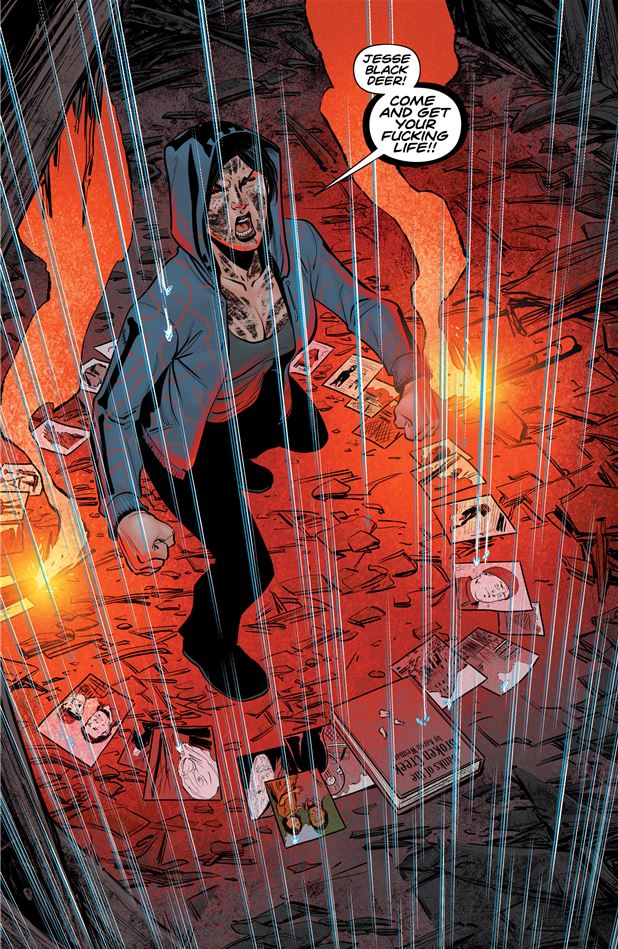
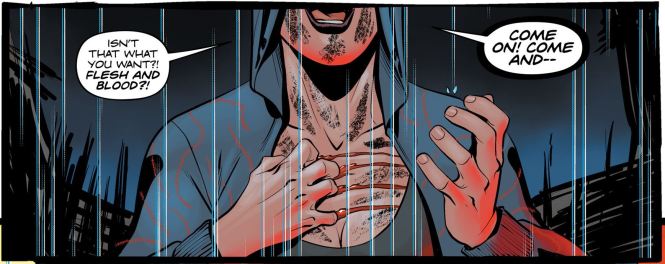
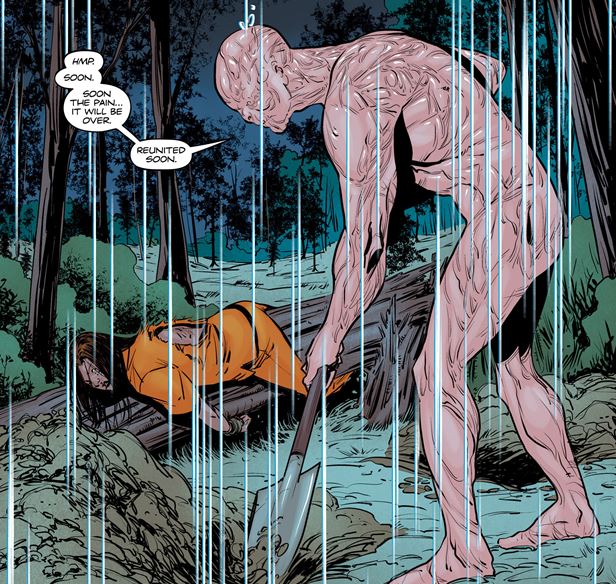
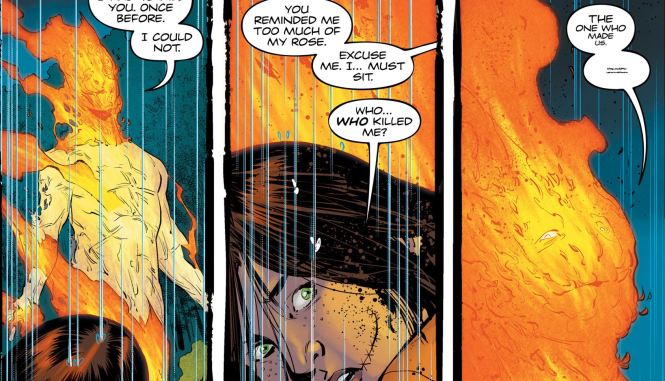
John Doe, or Jesse Blackdeer, has been one of the more formidable enemies of Revival, a highly skilled assassin with a perfect cover: because he was revived during his cremation he is kept in a coma to combat the terrible pain of continuously burning nerves. In the previous issue, John Doe was told to take out Em Cypress despite the fact that she reminds him of his recently deceased daughter Rose. Before he can decapitate Em and bury her body parts separately, he is stopped by a battle mad Dana, who has lured Jesse’s soul into reuniting with his body.

Revival 35 03

As is the case the Revivers, the reunion of body and soul results in the destruction of both, presumably a freeing experience.

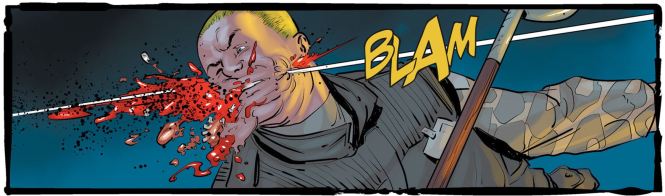
For some time, however, it has been clear that John Doe was simply a key asset for a higher power with an unknown agenda. In fact, the backup asset nearly gets the best of Em before Dana shoots him in the mouth.

Revival 35 07

The next asset in line, unless I have been misreading the situation, would be Dana’s on-again off-again lover, the CDC Agent Ibrahaim Ramin, who has already been tasked at taking out Dana Cypress by some higher authority. The second act of Revival has made one thing clear: things are getting both messier and cleaner, messier in the sense that a lot of blood is being spilled, and cleaner in the sense that loose ends are getting tied up.

Revival 35 05

All of that said, I am happy that the tragic figure of Jesse Blackdeer can finally rest in peace. I try not to imagine what his existence must have been like.

Who Killed Martha Cypress?

Revival 35 06

Everything is up in the air, and yet Dana Cypress continues to have enough of her wits about her to keep asking, “Who killed my sister?” Before Jesse Blackdeer passes, he gives us our best response to date. Em was killed by the same person who created all of the Revivers.

Prior to Aaron Weimar’s death, much of this revelation was already implied. When Aaron returned from India, he attempted to repeat a formula for immortality in Wisconsin that he had learned there. It is unclear what the process was like, but we know that it happened at the abandoned grist mill, that it required a sacrifice, and that Aaron presumably brought some sort of arcane being back with him in order to complete the process. I think it is safe to say that the murder of Martha “Em” Cypress was the sacrifice needed in order to satisfy the dark entity, but it remains unclear who carried out the sacrifice.

Aaron Weimar was the best suspect for some time. After all, he was the one who started the whole thing. However, in a flashback we learn that he seems to be unwilling to go through with what the entity demanded of him. My knee-jerk reaction was that the being simply made the sacrifice itself, but I don’t think this is likely either. A dread god such as this would require the sacrifice as a symbol of devotion. The question is, “Who do we think this mysterious being could convince to do its bidding?” Right now, I think my prime suspect is Dana Cypress’s husband Derek Hinch. I am not certain what his motivation might be. Maybe he thinks that Em is responsible for he and Dana breaking up. Maybe it was an accident that just happened to bring about the Revival. There are two reasons I’m looking at Hinch: 1. it is clear that he is an important character but he’s been sitting undeveloped for a pretty long time, and 2. he and Em both go to the same college. This may not be enough for the rest of you to zero in on him, but I’ve watched enough movies that these two facts seem pretty incriminating.

Guantanimo Two

The incident at the detention center made national headlines somehow, and this is a big deal. Some people are calling for stronger security at the compound while others are putting pressure on the authorities to explain why these Revivers are still being detained. I would love to say that the next step will be the liberation of the Revivers, but if I know anything about politics it is going to get a lot worse before it gets better. Campaigns of understanding don’t show the immediate and proximal results that reactionary citizens crave, so I expect that security is going to get worse, the Revivers are going to be treated more harshly, and things in general are going to get ugly.

Revival 35 09

As a side note, did anyone notice that the feds used Dana’s blitz on the detention center as a cover-up for what they did with Jeannie Gorski? That’s some shady work there.

Get Yourself a Cooler and Lay Yourself Low

Revival 35 08

Very little about what Officer Dana Cypress did to save her sister was what we would call legal. Throw in the fact that if either are brought in by the authorities it is more than likely a death warrant being served by our mysterious villain and it seems pretty clear that Dana and Em need to disappear. It is difficult to imagine what it must feel like for Dana to abandon her son, but I understand her motives. What I think is going on is that Dana cannot trust herself as the defender of her family after the way she has treated her sister Em over the years. This is the tragic flaw of one of the most positive characters in comics today. Dana needs to prove to herself that she can take care of her sister. I think the ultimate test is going to be a circumstance where Dana can either learn the identity of Em’s killer or act to keep her sister from harm. These are two separate motivations. I just hope Dana makes the right choice.

* * *

Invincible Iron Man 02 02

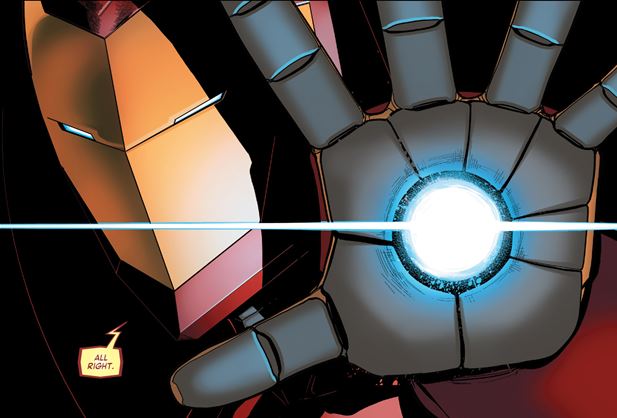
Since the dawn of Iron Man, Tony Stark has been a difficult character to relate to. In the early years, the real charm was the adventure factor, which fueled his comics until he became an Avengers support figure. The greatest leap forward was the 2008 film Iron Man where Robert Downey Jr. brought Tony Stark right off the pages. Well, it’s been seven years since that movie was released and Tony Stark / Iron Man is certainly in need of another boost. This is where Brian Michael Bendis and his new series Invincible Iron Man come in.

In order to rehabilitate an Iron Man comic, you need to accentuate the positive and eliminate the negative. The former comes easy for Bendis. A master of dialogue-driven stories — I remember loving the issues of Ultimate Spider-man comprised mostly of Peter Parker just talking to his schoolmates — Bendis is able to take advantage of Tony Stark’s fast-talking humor to the fullest. Meanwhile, David Marquez does a great job delivering fantastic stills of the Iron Man armor and highly energized action scenes.

Invincible Iron Man 02 04

As for eliminating the negative, that takes a little more finesse. To make Tony Stark easy to relate to — which he almost never has been — Bendis takes it slow, sanding down his edges by introducing a love interest that he really seems to want to do right by and reinforcing it all by his earnest desire to help people in need.

Invincible Iron Man 01 03


One thing I’m particularly excited about is how Invincible Iron Man fits in with a couple of the other series in the All-New, All-Different Marvel imprint that are really working right now. After a meeting with an all-new, all-different Dr. Doom, Stark brings a trans-dimensional Wand of Watoomb to Doctor Strange, who is currently featured in a self-titled series by Jason Aaron and Chris Bachalo. The most recent issue features Mary Jane Watson, straight out of the pages of Dan Slott’s The Amazing Spider-man. We’ve talked a few times about the need for smaller crossover events like that between Slott’s The Amazing Spider-man, Mark Waid’s Daredevil, and Greg Rucka’s Punisher, and I wouldn’t mind seeing Aaron, Slott, and Bendis follow a similar formula with their current titles.

Here’s my pitch: Mephisto has returned in The Amazing Spider-man, and Spider-man enlists the help of Doctor Strange (Doctor Strange) and his trainee Illyana Rasputin. Mephisto manipulate’s Tony Stark’s girlfriend (Invincible Iron Man) into curing Illyana of her mutant teleportation powers to take her off the board.

Invincible Iron Man 01 02

Ultimately, the team overpowers Mephisto, and when they do there’s a strange side-effect: May Parker drops dead and Peter and Mary Jane remember their history and their marriage. Epilogue: Pete and MJ start a new chapter in The Amazing Spider-man, Illyana becomes a full-time student of the arcane in Doctor Strange, and Tony Stark has to deal with the consequences of the public knowing that mutants can be cured in Invincible Iron Man. Boom. Hire me, Marvel!

Invincible Iron Man 03 02

Next week, I’m looking forward to getting caught up on Extraordinary X-Men, which reminds me… I have another pitch for Marvel: a series following the first mutant born after Decimation and written by the current writer of All-New X-MenHope by Hopeless. What do you think? Also, tell me what you think about this week’s comics, your favorites, the let-downs, whatever. Let’s talk shop. Comic shop.

How to Get a Promotion Starting With Day One

Business dressing Ideas – How to dress like a gentleman ?

Some of you are probably asking, “Is it necessary to start so early when looking for a promotion?” I ran the question by one of my highest performing co-workers, and he said, “Well, yeah. If that’s what you want.” If it is your goal to move up at your company, no time is too early to start working toward that goal.

Here are some suggestions of things that you can be doing as soon as day one in order to get that promotion you’ve been looking for.

  1. Dress for Success

It is unlikely that I am the first source you have heard this advice from, but you always want to dress for the position that you want. Similarly, you want to make sure that you conduct yourself in a way that parallels the quality of your clothing. If you want to become a supervisor, for example, the best thing that you could do would be to make it hard to distinguish between you and your supervisor.

Is it possible to dress too nice? Clearly, this is a matter that probably deserves some discussion. I posed this question to a group of co-workers and the response seemed to be, “You don’t exactly want to wear a tucsedo to work.” There weren’t any clear reasons why you shouldn’t. My personal inclination is that you don’t want to dress too nice because it could either make it seem like you’re trying too hard, trying to cover something up, or making fun of the whole process.

For some of us, dressing and acting differently sounds quite a bit like conformity. The sad truth is that sometimes you have to make some sacrifices in order to get what you want. That said, I don’t think you have to throw away your entire identity to move up in the world. If you really feel confined, purchase a Batman tie clip or some Millennium Falcon cuff links. You should never sacrifice who you are in its entirety, because that is the person that your company hired. You are not some empty suit.

  1. Make Your Goal Clear

It never hurts to announce your intentions to your direct supervisor. A good supervisor will look out for opportunities where you can prove yourself to HR and management, give you guidance regarding the process of moving up, and explain to you their own experience moving up in the workplace. All of these are valuable. You can always talk to other supervisors, managers, anyone who has had an experience with climbing the corporate ladder. Even if they went through the same process as your direct supervisor, their own story will never be exactly the same simply because they are different people who observe different things.

I shouldn’t need to say this, but alas, it needs to be said. You need to have a good work ethic for this tip to have any value. If you don’t, and you still think you deserve to get a promotion, you are, as a co-worker of mine once said, “a chump.” This is another area where your direct supervisor can be a resource to you. If you are not meeting performance expectations, it is basically your supervisor’s job to help you get back on track. People who respond well to criticism are in many ways better than people who were doing everything right to start with because they know how to become what they need to be to get the job done. In fact, this attitude toward feedback is so important, I originally gave it a category of its own in the first draft of this article. While it is never too early to start working toward a promotion, it is never too late to become skilled at responding to criticism.

  1. Always Strive to Better Yourself

A good friend of mine is always telling me, “It’s a marathon, not a sprint.” Of course, when he says it he is responding to my cocky feelings about the Dallas Stars doing better than the Detroit Red Wings during the first month of the season, but this lesson also applies to your job. At just about anywhere you work, there is going to become a point when your job gets easy because it becomes second nature. Some call this “the plateau” and in my opinion this is the most dangerous time in your career because it will become easy to become bored, disenfranchised, or unmotivated. For some people the only option is to get another job and quit before you get fired, but since we’re talking about getting a promotion we will proceed by assuming that the termination route is not on the table.

There are many options for bettering yourself while at work. You can focus on gaining additional knowledge about company processes, you can help others who are still learning, or you can work on improving morale and effectivity. When it comes to this last idea, keep in mind that it pays to be proactive. I used to work with a woman who was highly skilled with sales and just an all-around well-organized leader, but she spent a lot of her time either waiting for ideas from our supervisor or waiting for permission to move forward with them. While I don’t fully agree with the whole “it’s better to ask forgiveness than permission” philosophy, you need to keep in mind that if you are not proactive you are actually putting more work on your supervisor’s shoulders. This doesn’t prove that you’re worthy of a promotion. All it proves is that you’re stressing your supervisor out.

There are also plenty of options for bettering yourself outside of work. Many employers now offer educational sponsorship worth $5250 per year to qualifying employees who are taking college courses pursuant to a degree that could be directly used to benefit the company. If this isn’t an option for whatever reason, many communities have a variety of different non-university training programs, some expensive, others cheap, some often free, and ranging from advancing typing skills to becoming an effective leader. Last, but certainly not least, is the wisdom you can learn from library books. If I had was given a promotion for every person I’ve seen reading Dale Carnegie’s How to Make Money and Influence People, I think I would be a CEO by now.

The main thing that bettering yourself does to defeat the power of the plateau is to freshen your experience and give you a new perspective. You are no longer simply an employee. You are a leader in training. You have effectively reinforced your motivation and reached escape velocity. Your promotion is much closer than it was when you were thinking about putting out resumes, and it shows.

  1. Don’t Complain

If you study the stock exchange then you know there are people called “noise traders” who act erratically and destabilize the system. At every business there are also noise employees who spend all of their time complaining. In their own heads, they feel like they are seeking justice but in truth they are doing the same thing as the noise traders. Complaining is a perversion of a natural inclination to seek out and correct weaknesses in a system. The best way to express feelings of discontent is to identify the problem, understand the conditions that create it, and generate plans to overcome the issue. People don’t get promoted because of poignant complaints. They get promoted because of elegant solutions.

  1. Don’t Butt Heads

You may be competing for one open position, but the total time that you’re competing with your co-workers spans less than a week, the amount of time between the first interview and the ultimate decision. The total time that you work together is usually going to be a minimum of 6 months to a year. This means that you are allies more than you are adversaries.

This might just be my squishy, hippy-oriented side, but I really believe that you succeed more the more you help others to succeed. The Empire would have found and killed Luke Skywalker before his training on Dagobah was over and completed their oppression of the galaxy if his friends hadn’t kept Darth Vader’s attention playing cat and mouse in an asteroid field. Voldemort would have conquered the whole world if Harry Potter hadn’t valued all of his marginalized friends, magical creatures, and the like. The true power in this universe shows up in web form, not in a single point. You are only as good as the people you gather around you, and you gather better and better people when you don’t throw them under the bus.

Every co-worker is a potential future recommendation, and this process works both ways. Every co-worker you alienate is a burned bridge toward your future.

  1. Sell Yourself

If we’re talking in economic or art terms, what you want to do is build a portfolio of your professional value to your company. If you’re more inclined toward medican analogies, we are talking about identifying chronic and acute symptoms of success. Examples of chronic symptoms of success are general qualities, attitudes, or habits whereas acute symptoms are times when you were the best at something, the most of something good or the least of something bad, or unique incidents when you went above and beyond. In general, you want to identify times when you have made or saved the company money. Issues of quality are important, but if you can quantify the benefit you bring to the business it makes you much easier to promote. What sounds better to you? “Justin has a winning personality,” or “Justin increased profits by 20% in his first year with the company.” In many situations, your superiors will already know what you bring to the company, but you want to go into this as if they do not. You can make fun of the fact that I am an Eagle Scout, but I always prefer to err on the side of being more prepared than less.

* * *

I didn’t really include anything about creating a fantastic resume or wowing everybody with a  great interview because we already spent some time with that on the previous post. That said, if you have any specific questions about resumes and interviews, lets get them on the table. All of these suggestions are based on my experience and ratified by my previously mentioned high-performing co-worker, but if you have other experiences we can certainly benefit from them.

CW’s The Flash and the Fight Against Fate

HM_HG_v01_r02a-718x1024

If you’re watching CW’s Arrow and The Flash, then you know they have recently introduced Hawkgirl and Hawkman as two reincarnated lovers doomed to be killed time and time again by the immortal assassin Vandal Savage. Savage has replaced the Hawk-family’s arch-nemesis Hath-Set who, in the comics, was eternally reincarnated alongside the two and driven to repeat the cycle of love and murder, and this convenient re-imagining of this ancient trinity sets the stage for the Arrow/The Flash spin-off Legends of Tomorrow which debuts on the CW on January 21, 2016.

An unfortunate side-effect of the intertwined nature of Hawkgirl and Hawkman is that it makes it impossible for viewers to get emotionally invested in the romance between Cisco Ramon/Vibe and Hawkgirl/Kendra Saunders which has been developing in the past few episodes of The Flash and all but fizzled in the latest episode of Arrow. This narrative issue plagues many television shows based on popular source material like Game of ThronesThe Walking Dead, and Gotham as well. The source material represents an impenetrable wall, a playbook for all possible actions, something that limits rather than frees up the writers for these shows. It is fate and it ought to be resisted.

The first season of The Flash posed a similar problem. Despite an epic lack of chemistry between Grant Gustin (Barry Allen) and Candice Patton (Iris West), we witness a newspaper headline from the future written by Iris West-Allen which suggest that Barry and Iris get married between now and 2024.

screen-shot-2015-04-28-at-12-34-53-pm-133730

If we were basing the future on who has the best on-screen chemistry, it would be Gustin and Danielle Panabaker (Dr. Caitlin Snow) during the first season or Gustin and Shantel VanSanten (Patty Spivot) during the second season.

flash-season-1-episode-12-barry-caitlin-karaoke-e1423164335286

If you introduce the certainty of an Allen-West union as soon as the first season, you are doing one of two things: 1. setting up a battle between fate and free will, or 2. setting up a series of boring melodrama that prolongs the inevitable so long as ratings are still high enough. The latter almost certainly seems to be the way of the world with network television, but I still hold out for the former. I side with Fantasy author Patrick Rothfuss, who writes of his belief that children and young adult fiction should actually be held to a higher standard than adult fiction. So, what can we do to remedy this problem?

One of the things that pulled me into DC Comics after being a long-time Marvel junkie was the Green Lantern stories where Hal Jordan spat in the face of fate left and right, always throwing a wrench into the machinations of the universe. If Hawkman and Hawkgirl weren’t being set up just to be ported over to Legends of Tomorrow, then Kendra’s relationship with Cisco could be framed as an exercise of free will against the indomitable force of destiny. This wouldn’t be unheard of. In fact, there is a precedent for this lateral move in the comics. Prior to Blackest Night, Hawkman and Hawkgirl ignored their destiny as a power couple and Kendra Saunders even ended up dating Red Arrow for a while. Because the two Hawks didn’t fall in love, Hath-Set couldn’t find them and kill them. Of course, this didn’t last forever, but it proves that DC Comics has dealt with this issue in the past. The Hawkman and Hawkgirl fight against fate would be a seasonal arc, but it would frame the series-long arc of whether one newspaper headline means Barry and Iris must end up together.

When I run this idea through the standard comic book rubric of, “Will it sell and will it bring in new viewers?” it actually passes fairly easily. New viewers aren’t going to care if Barry and Iris end up together. Some will root for Barry and Iris (Barris?), while others will root for Barry and Caitlin (Baitlin?) and still others will root for Barry and Patty (Batty?) and nobody will be able to bully them by saying, “Nuh uh. That’s not how it happens in the comics.” The postmodern separation of the television show and the source material as free will and fate will make for more compelling stories and unpredictable endings. In other words, you’re not going to lose viewers because the show becomes dry and formulaic, and you’re certainly not going to lose viewers because The Flash is just a watered-down Smallville.

It is a little too late to keep the Hawkman/Hawkgirl/Vibe love triangle at full-strength, mainly because it is just too hard to support ongoing chemistry between main characters from two different TV shows (Hawkman and Hawkgirl from Legends of Tomorrow and Vibe from The Flash), but it is not too late for The Flash to take the risk. In fact, with an Iris West who is more than simply Flash’s girlfriend/future wife, Candice Patton might be written into some more interesting situations. She certainly seems more central this season, at least when she’s actually on the screen, but I’m thinking some more Blechdel-friendly solo development couldn’t hurt. Ultimately, I’m not saying that The Flash shouldn’t even consider bringing Barry and Iris together in the end, but it would certainly be refreshing if they presented a real alternative.

The New Bucket List

From the Old Bucket List: "Do a Spider-man kiss with a female, preferably while raining."

From the Old Bucket List: “Do a Spider-man kiss with a female, preferably while raining.”

Updated: Sunday, April 10, 2016.

If you’re friends with me on Facebook, you probably didn’t even notice that I deleted my Bucket List. It’s not like you’re a bad friend — I would never suggest that — but Facebook has done everything it can to phase out the Notes app other than, well, phasing out the Notes app.

Just as Thomas Jefferson said, “The tree of liberty must be refreshed from time to time with the blood of patriots and tyrants,” so also must one’s Bucket List, especially as you transition from a lonely, nomadic twenty-something obsessed with TV and film memes — I honestly though that, before I die, I needed to hide in a barrel from someone pursuing me! — to a thirty-something adult with responsibilities.

There are two things in common between those two dudes with bucket lists — I am still going to die some day, and there are still plenty of things that I want to do before I do. Here’s the new (and improved?) bucket list:

[ ] Get a second tattoo.
[ ] Send out a Christmas card with a photograph of my family.
[ ] Make an ant hill casting.
[ ] Attend a Dallas Stars playoff game.
[ ] Order the Creature Feature at Stella’s Lounge each month I live at Half Century.
[ ] Use a bicycle as my primary mode of transportation.
[ ] Learn to ride a motorcycle.
[ ] Visit a net zero community.
[ ] Become an expert at driving a manual transmission automobile.
[ ] Brew a batch of ginger ale.
[ ] Attend a Renaissance Festival.
[ ] Eat a giant roasted turkey leg.
[ ] Attend an Of Montreal concert without leaving early.
[ ] Become proficient at skiing.
[ ] Read Herman Melville’s Moby Dick.
[ ] Eat barbecue in Kansas City.
[ ] Conduct an EVP experiment.
[ ] Visit all 50 states.
[ ] Acquire a “Spocked Fiver.”
[ ] Go scuba diving.
[ ] Compete on a game show.
[ ] Use Aeris’ ultimate weapon and limit break in Final Fantasy VII.
[ ] Write and record a solo album.

As with the original, I am going to update this as the muse strikes me. (Does a muse strike? Or possess? Or what? What do muses do?) Furthermore, I abide by the rule of “pictures or it didn’t happen,” so this post will slowly get more and more visual as I knock ’em down.

UPDATE, Monday, January 11, 2016: Because of the death of David Bowie on Sunday, January 10, 2016, I removed “[ ] See David Bowie live” from the Bucket List.


Star Trek: The Original Series Season One Highlight Reel

star-trek-logo-star-trek-original-series-19173893-1440-900

#TrekWithUs is a group that my friend Josh and I started on Facebook dedicated to re-watching every Star Trek television series and film in order, one episode/film per week. One of the things we were hoping to do as a result of this re-watch was to generate some quality posts about our favorite episodes and important issues in Star Trek history. Josh completed his first review much earlier than I did, but I figured better late than never.

Here’s my highlight reel from the first season of Star Trek: The Original Series (TOS).

NOTE: If you’re new to TOS, there are a couple of things that you might want to know before doing your own re-watch. The first is that Star Trek was originally envisioned to be a discontinuous series like The Twilight Zone but with a continuous crew. As such, stories do not build from episode to episode and characters do not have a clear arc of growth. The second thing you should know is that there are big differences between the production order and the order in which the episodes aired. For example, two episodes (“The Man Trap” and “Charlie X”) aired before either of the series’ two pilots (more on that later) saw the light of day. If you do end up doing your own re-watch, you want to make sure everyone is clear about which order you are using and whether or not you are including the original pilot. With #TrekWithUs, we viewed the episodes in the original airing order (with the addition of “The Cage”) but I have reviewed the episodes in the production order.

THE CAGE

c

The original pilot for TOS was an episode called “The Cage,” and it featured Captain Christopher Pike as the commander of the USS Enterprise. Because of a surprising turn of events on a planet overcome by political unrest, Captain Pike lost many of his crew members, and the experience scarred him. When me meet him, Pike is a tragic figure, an officer who probably ought to retire but who cannot seem to escape his duty. After this episode, we will not see Pike again until “The Menagerie: Part I” and “II,” where the captain is confined to a machine that is half-iron lung and half-wheelchair. Pike has been crippled in a terrible accident, and a devoted first officer Mr. Spock puts his neck on the line to abduct his former commander and bring him to Talos IV, where a group of cone-headed telepaths can grant him hallucinatory escape.

“The Cage” is one of a couple TOS episodes that gives us an idea of what has happened in the years between the narrative setting and the setting of the current viewer. A picture is painted of a utopian Earth where even the Mohave desert has been terraformed into a new-age Eden. Presumably, all differences of race, class, and gender have been overcome, though the writing often doesn’t reflect the latter. But in space, the rules that keep the peace on Earth don’t necessarily hold true. At one point Pike and the ship’s doctor Phillip Boyce discuss alien slave trade as a legitimate retirement source of income. It makes you wonder if there are any laws in space or if it is a free-for-all for anyone bold enough to travel outside of Earth’s atmosphere.

The most interesting part about “The Cage” might be the story behind it. When Gene Roddenberry first presented the pilot to NBC they rejected it, essentially cancelling Star Trek before it ever begun. However, Lucille Ball (I Love Lucy,The Lucy Show) took notice of this fledgling series and became its biggest supporter. The network would not air “The Cage,” but Ball used her influence to get Roddenberry an airing for his second pilot, something that is basically unheard of in the industry. The episode he presented featured a brand new crew (save for Mr. Spock alone) and sported the title “Where No Man Has Gone Before.” The rest, as they say, is history.

WHERE NO MAN HAS GONE BEFORE

wherenomanhasgonebeforehd833

“Where No Man Has Gone Before” is the first episode to feature James Tiberius Kirk as the Captain of the Enterprise. From the beginning, Kirk is a well of courage, and he is going to need every ounce of it for what lies ahead of him. His good friend Lieutenant Commander Gary Mitchell has accidentally contracted godhood and its sudden onset has transformed him into a dangerous enemy. Kirk has just been introduced, and already an impossible sacrifice has been demanded of him: he must take the life of someone dear to him, the deity who was once Gary Mitchell.

11542089_10203278410040617_7053375458291137023_n

This is my dog Tiberius. We named him after Captain James Tiberius Kirk. That woman holding him is my beautiful wife Amy.

This second pilot is a gut-wrenching descent into the heart of darkness where Kirk is forced to face his own mortality.

180px-james_r_kirk_tombstone

It’s James *T* Kirk, not James R. Kirk.

In later episodes, stories like this might end with a smile and an off-color joke, but the second pilot doesn’t pull any punches. “Where No Man Has Gone Before” proves that TOS is unafraid of leaving you vulnerable at the end of an episode. The ensuing discomfort stimulates your imagination, and it apparently saved Star Trek from TV oblivion to boot.

THE CORBOMITE MANEUVER

mondo-corbomite

In “The Corbomite Maneuver,” we witness the best that early Trek has to offer: first officer Spock, whose immaculate logic makes him the clear brains of the operation; Dr. Leonard McCoy with his bleeding heart for moral issues; and James T. Kirk, the only one with the guts to keep this diverse crew alive. Kirk himself has gotten a bad name in the years since these original episodes first aired, but I think this is unfair. I’ve heard him described as a reckless womanizer who would make a terrible commanding officer, and yet his devotion to the Enterprise, her crew, and her mission are never more clear than in this episode. There is no better captain than Jim Kirk, and no better crew than the people who follow him every week into the unknown.

Years later, the film Star Trek II: The Wrath of Khan will introduce Star Trek audiences to a training test known as the Kobayashi Maru which trains Starfleet Academy cadets to deal with the lose-lose situation. “The Corbomite Maneuver” features an early precursor to this concept, as an invincible alien ship counts down the moments until the Enterprise’s total destruction. Just as he reprogrammed the Kobayashi Maru so he could win, Captain Kirk saves the day in this episode by changing the paradigm. In other words: “Not chess, Mr. Spock. Poker.”

THE NAKED TIME

14032007494517371612080912

The Half-Naked Time.

It doesn’t get much more fun than Hikaru Sulu swashbuckling with his shirt off, but “The Naked Time” is more than just an hour long giggle fest. While every other character is busy transforming into a caricature, Lieutenant Joe Tormolen is busy having a paranoid breakdown. For Tormolen, the Federation’s outreach mission is overreach, hypocrisy even. His rants speak more clearly than any synopsis: “We bring pain and trouble with us, leave men and women stuck out on freezing planets until they die. What are we doing out here in space? Good? What good? We’re polluting it, destroying it. We’ve got no business being out here. No business.” This rings true with the situation in “The Cage.” If the Earth has been rid of its sins, then those same sins have been banished into space. There is an active slave trade, unsupervised would-be-Mengele’s, and debris from discarded colonies and destroyed vessels. Tormolen’s questions trouble the waters. We glorify discovery, but is it always worth the price? Why did we leave Earth in the first place? Was it due to overpopulation issues or were we just too curious for our own good? Was it the necessary end result of science and technology? Was somebody looking to expand the sphere of human influence? Tormolen’s fears give us a metric for judging the moral content of future Star Trek episodes — was the crew of the Enterprise doing a good deed or were they overstepping their boundaries? What were the consequences?

CHARLIE X

charlie_x-e1346677255202

There are few things more perilous than dealing with a god who is going through puberty. Do you remember what it was like when your hormones were surging and your body was transforming and your emotions were out of control? Try throwing the limitless power to create and destroy into the mix, and you can imagine the threat posed in “Charlie X.” We have seen how far Kirk will go to defeat a god who threatens his crew in “Where No Man Has Gone Before,” but in this episode Kirk takes a more nurturing pose. The role of father seems strangely natural for the Enterprise’s Captain, and it feels as if Kirk’s influence might be enough to stabilize Charlie and turn him into a force for good. This is where the episode takes a turn for the worse. Against his will, Charlie is taken from his new human family by the very alien force that granted him his powers in the first place. Earlier in the episode we might view this as a foreign power taking responsibility and diffusing a nuclear weapon, but by this point it feels much more like kidnapping an innocent child from his own people. The crew becomes one with the at home audience. Charlie X is abducted against his will, and we are all forced to watch.

BALANCE OF TERROR

Capture

In this Cold War allegory, the Romulans are revealed as the Federation’s intergalactic rival much like the Russians were understood as the enemies of the United States for the original viewing audience. Years of blind battle between Federation and Romulan ships reminds us of underwater battle between nuclear submarines. Though the civilizations involved in this ongoing war are in the dark, the audience gets a rare glimpse into both sides of the conflict. On one side is Captain James T. Kirk, an amazing force for good in the universe, and on the other side is the unnamed Romulan Commander, perhaps the most noble opponent Kirk has ever faced. Working together, these men could bring peace to the entire universe, but they were born into civilizations at war and their efforts will always be adversarial. The Romulan Commander is like Hector of Homer’s Iliad, perhaps the kindest soul and greatest leader involved in the Trojan War. Like Hector, this Romulan’s only fault is that he is on the wrong side of history.

“Balance of Terror” also presents one of the most unambiguous criticisms of racism in the science fiction canon. When the Romulan Commander is first revealed, he has pointy ears and bushy eyebrows much like the Enterprise’s own first officer Mr. Spock. The resemblance goes even further for die-hard fans of Trek who know that the same actor (Mark Lenard) plays both the Romulan Commander (“Balance of Terror”) and Spock’s father (“Journey to Babel,” et. al.).

balanceofterrorhd213

This similarity is too much for Lieutenant Stiles, a crewman who lost family in the Earth-Romulan War, but Kirk is fast and firm with his support for the Vulcan science officer.

While it might seem offensive that a white male (Leonard Nimoy) becomes a figurehead for racial justice, it is important to understand this in the context of Gene Roddenberry’s vision. The diverse crew of the Enterprise is the result of a utopian Earth where people of different backgrounds have finally overcome their backgrounds. Despite the fact that we might be impressed by the inclusion of Uhura (a black woman) and Sulu (a Japanese American) on the Enterprise’s bridge, nobody else on the bridge bats an eye. This has been the norm for over 100 years. TOS tackles the next frontier of social justice, the issue of how one welcomes a neighbor from another planet.

THE ALTERNATIVE FACTOR

27-The-Alternative-Factor

Between the enigmatic Lazarus with his costume beard, the psychedelic color inversions during the reality quakes, and Lazarus’s Jetsons-style vessel, “The Alternative Factor” is one of the campiest episodes in TOS. This should not mask the fact that it has some of the best science fiction of the first season, delving into the frontier of inter-dimensional travel. I honestly didn’t know whether I loved or hated this episode until the very end, but it certainly holds a special place in my heart.

SPACE SEED

4687210802_bb62230854_o

What “Space Seed” lacks in terms of a strong story and gender equality, it makes up for with the sheer power of Ricardo Montalban’s portrayal of Khan Noonien Singh. The writers did manage to deliver a compelling story behind the story. Khan is one of a handful of tyrants who carved up the Earth into territories during the third World War of the 1990s. He and his crew are super-soldiers in an ancient ship with primitive technologies of propulsion and suspended animation (from Kirk and company’s POV). It is interesting that Roddenberry and crew had such generous expectations for our future technology. If I’m not mistaken, the most heralded technologies of the 1990s were flip phones, SMS, and Terminator 2: Judgment Day, not hybernacula and interstellar flight.

“Space Seed” might just be the most important episode of TOS. This is because it serves as a prequel to the film Star Trek II: The Wrath of Khan, which might just be the greatest moment in Star Trek history. My wife will attest to the fact that I cannot even discuss the last act of this film without welling up with tears, much less listen to “Amazing Grace” on bagpipes or drive by a vehicle with one of those photon torpedo-esque car top carriers on it.

THE CITY ON THE EDGE OF FOREVER

city-on-the-edge-of-forever

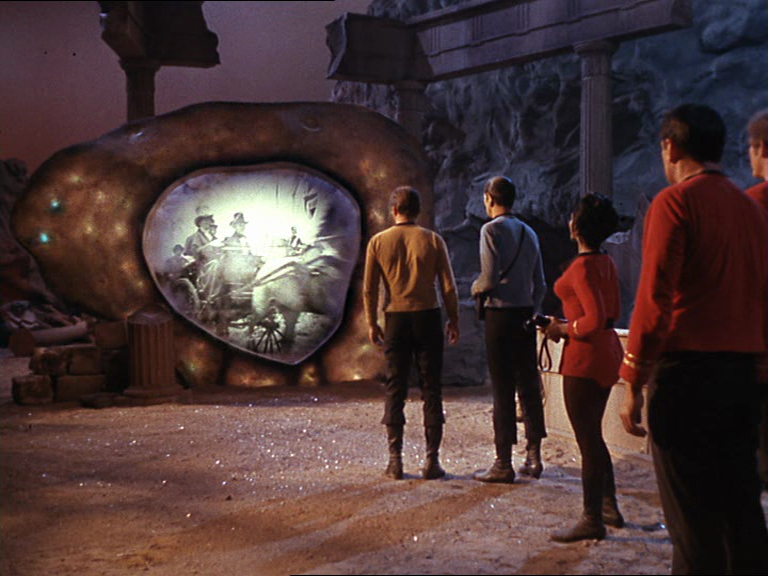
In the 1930s there was a woman named Edith Keeler who started a peace movement so powerful that the United States committed to never warring again. As a result, the United States stayed out of World War II and Hitler’s Third Reich conquered the entire planet. The utopian Earth we’ve been talking about — that never happened. Neither did the United Federation of Planets, and without the Federation there is no USS Enterprise. There is just a handful of starship officers from a reality that no longer exists stranded on a far off planet with talking stone arches. To get back everything they’ve ever known, peace activist Edith Keeler must die. I’m just going to leave you with that one.

* * *

#TrekWithUs has come a long way in just over a year. A couple of weeks ago, we started the third and final season of Star Trek: The Original Series. If you’re interested in joining our re-watch, just let me know and I can add you to the group. I don’t know exactly how to do so if we’re not already Facebook friends, but I’d be willing to give it some research. It can’t be too difficult. Also, I expect to roll out a Season Two Highlight Reel shortly, so keep your eyes open friends of the Federation.

star-trek-behind-the-scenes-9-mad1

Comic Recommendations: November 25, 2015

DC published Frank Miller’s most recent homage to his own previous Batman work with Dark Knight III: The Master Race #1; IDW delivered another solid build-up issue of Teenage Mutant Ninja Turtles; as if Thanksgiving weren’t enough of a holiday, this week was the return of Saga (Image Comics); and Marvel hit hard with Guardians of the Galaxy #2, Silver Surfer #15, and the continuation of “Vader Down” in Darth Vader #13.

UNSPOILED

  1. Silver Surfer #15 (Marvel Comics), Unspoiled Edition.

Silver Surfer 15 01

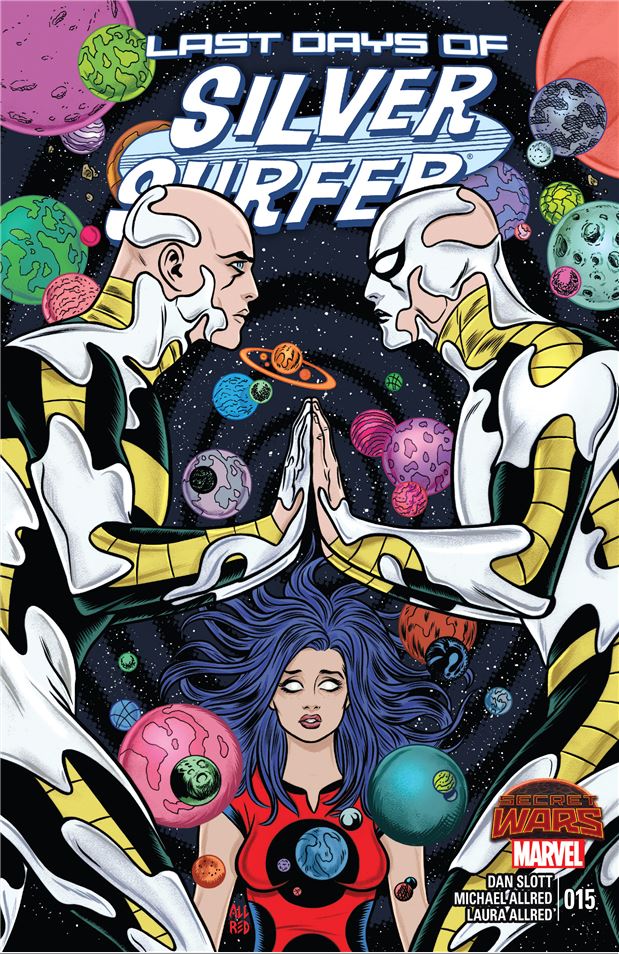
It is difficult to bid farewell to Dan Slott and Mike Allred’s Silver Surfer, but much less difficult knowing that a new volume is starting in 2016. Norrin Radd, Dawn Greenwood, and Toomie have survived the end of the Multiverse at the hands of Dr. Doom. Now, they are faced with an even more complex problem — deciding between an ideal universe and a real universe. This may sound a little heady, but trust me, Slott’s Silver Surfer #15 promotes just as many feels as it does thoughts.

SPOILED

  1. Silver Surfer #15 (Marvel Comics), Spoiled Edition.

Silver Surfer 15 02

All-New, All-Different Marvel has been the standard for a few weeks now, but we still know very little about what exactly this new universe is and how it has come about. Silver Surfer #15 gives us a rare glimpse into the construction of the new universe when it refers to the consequences of Secret Wars #9. To give you perspective, Secret Wars #8 will be released — AT THE EARLIEST — two weeks from now, with an optimistic estimate of December 23 for the event’s conclusion. Considering the first issue came out in May, this means that we have waited over six months for the conclusion of Marvel’s summer event!

Silver Surfer 15 03

What does Silver Surfer #15 tell us about the future of Marvel’s continuity? The universe is largely the same as it was before Secret Wars began, but there are small differences.

One small difference is that series like Dan Slott and Mike Allred’s Silver Surfer were forced to halt their forward momentum in order to deal with this new universe. Slott’s decision to have Norrin and Dawn witness the end of the multiverse and have the choice to create a brand new universe was an interesting offshoot of this decision, but the comic started taking longer and longer to come out. From the publication of Silver Surfer #1 in March of 2014 to the publication of Silver Surfer #13 in July of this year, the comic averaged 40 days between issues, or just over five weeks. Considering the fact that Slott was putting out two issues of Amazing Spider-man during this entire time and plotting Marvel’s most successful crossover events at the same time, one week over the monthly comic release can be excused. However, after the release of Secret Wars, the release dates got more and more spaced out. There was 35 days between #12 and #13, 49 days between #13 and #14, and a whopping 84 days between #14 and #15. Compared to the previous average of 40 days between issues from Silver Surfer #1-13, issues #13-15 averaged 67 days between issues. In other words, there was approximately four weeks between the expected release date and the actual release date.

I don’t think this is the fault of Slott and Allred. I think there is a basic fundamental error with these giant, multiverse-encompassing event comics. Personally, I would rather see smaller events that encompass a handful of titles and doubling down on support for Marvel’s TV shows and movies. I think this is a good intermediary that satisfies the long time fans who HATE these giant events while exciting younger crowds who use Marvel’s multimedia empire as a gateway to its comics. Whenever these two crowds are happy, Marvel makes money. Perhaps more important, though, is the fact that this decision will give creators more freedom to tell longer, uninterrupted stories with fewer gimmicks or scheduling problems. The stock shares can keep going up while preserving the integrity of the stories being told.

Silver Surfer 15 04

Silver Surfer returns in 2016. I am looking forward to it.

* * *

After a few weeks of intensive reading, I have finally caught up with Tim Seeley’s Revival (Image Comics). The story takes place in the Wausau environs of Wisconsin, a completely believeable snapshot of the Great Lakes states. The community is plagued by an unsurprising lack of diversity, a seemingly everlasting winter, and dead who come back to life. When I say “come back to life,” I mean life in its fullest sense, or at least moreso than the shambling beasts of most zombies stories. “Revivers,” as they are called, are almost indistinguishable from the living, but nobody knows why they have returned. Our main characters are Officer Dana Cypress and her younger sister Martha, who goes by the nickname “Em.” One of the more memorable moments in recent comics happens when Dana takes her sister along to investigate an incident and Em takes a sickle to the chest… LIKE A PRO, revealing that she too is a Reviver.

Revival 01 01

Because this is a comic book about zombies, we have to ask ourselves the obvious questions: Why should I read this comic book? Why not just read The Walking Dead again? The only things that Revival and The Walking Dead have in common are zombies, intensely human drama, and Image Comics. Revival has much more in common with David Lynch’s Twin Peaks or the Coen Brothers film (and later FX series) Fargo. Seeley describes the series as rural noir, and as much as I love a good noir story, I think Revival is a little too big for this description. It may be what Seeley imagined, but it is not what he delivered. As I mentioned earlier, Seeley’s zombies are almost indistinguishable from living humans. They may be slightly uncoordinated, but not in any major way — one of the more entertaining Revivers is a fairly skilled skateboarder. Whenever a Reviver is injured, even by a classic shotgun to the brain, they are able to regenerate completely. They are also described as fearless, but that is only in reference to physical harm. The unique contribution of Tim Seeley’s Revival is that we actually learn more about ourselves as humans from the perspective of the zombies themselves. This stands in stark opposition to the traditional zombie setup, best represented by the mall setting of George Romero’s Dawn of the Dead, where we learn just how mindless we can be from living characters who witness the mindless activities of zombies.

In previous recaps of comics that I overlooked, I have written quite a bit about series that haven’t even started a second story arc. I could certainly recap every issue of Revival and have a blast going through it once again, but in this circumstance I think brevity might be better. Revival #35 should be coming out next week if I’m not mistaken, and if it is as good as some of these issues have been we’ll spend a lot more time with it. Despite the fact that I have rarely read a solo Iron Man comic that I have enjoyed, I should have something to say about the most recent volume of Invincible Iron Man next week.  At the rate I readRevival, it shouldn’t be too hard to get through the four issues of the series that will have been released byDecember 2. Until then, please hit me up with any questions or comments you have. We can talk about the comics I have written about or we can talk about the comics that are on your mind. Whatever we do, let’s just talk about comic books.

Better Base Pay: The Fastest Way to Leave Your Debt Behind?

wpid-increase-income

A few weeks ago, I announced that I had targeted debt and debt liberation as my main research focus. As of the beginning of this month, I have moved on to the second phase of my own personal debt emancipation plan. Whereas Phase I involved setting up a budget, reading popular resources about personal finance, and cutting expenses where possible, Phase II emphasizes researching peer-reviewed resources, conducting a top-down review of new revenue avenues, and carrying out a complete audit of all banking activity. As part of my monthly bank statement review, I have identified base pay rate  (not including overtime, shift differential, bonuses, or on-call, special assignment, incentive, holiday, vacation, or sick pay) as the first topic I want to analyze. There are circumstances where base pay is considered by itself, like debt-to-income calculations that require a current pay stub rather than a previous year’s W2, and your base pay can affect major life events, like securing a mortgage loan for a house. In other words, the topic of regular wage earnings is not merely academic.

The most common ways people free up money in their budgets to pay down debt are increasing income and decreasing spending, although I would add education and social action as debt solutions of equal importance. Though the idea of increasing your base pay fits into the income bolstering part of the equation, I would like to caution readers against adopting a belief that increasing revenue alone is the solution to financial woes. If that were the case then every time our nation’s GDP increased the ratio of national debt to GDP would decrease, but that hasn’t happened once in the past 15 years. Similarly with personal finance. If you increase your family’s income without also making changes to your spending habits, you run the chance of spending all the extra money you’re taking in. This is something to keep in mind during the discussion ahead.

There are four basic options for increasing base pay, and I have listed them from most to least comfortable. All of these choices assume you have a full time job. If this is not the case for you, feel free to skip forward to the section dedicated to part time and temporary jobs.

1. Request a pay raise at your current job.

There are a lot of life hack articles online that will tell you that getting a pay raise is easy if you are bold enough to ask for one and smart enough to provide clear examples of extra work you have done and ways you have saved the company money. For many of us, this is not actually an option. Within many corporations, the review process has been streamlined into a yearly process, assessment is conducted by managers who have little to no interaction with you throughout the year, and while general criteria for pay increase may be available in handout form there is usually little transparency regarding specific reasoning behind management’s ultimate decision. There are even businesses out there where employees are penalized with up to and including termination for discussing pay rate with another employee. As it is, the single most effective means of securing a pay raise is to simply wait.

Is this portrait I have painted of pay raises accurate in your experience? Whether you answer yes or no, please feel free to contact me either publicly or privately with your thoughts. Please accompany your story with details about your employment situation and whether or not you feel comfortable with me using this information in future posts.

Raises do happen, but they seldom happen on your schedule and they rarely increase your pay to your satisfaction. They benefit those patient enough to wait, but for many of us standing still is not an option.

2. Request a promotion at your current job.

In many ways, requesting a promotion is much like requesting a pay raise: it is usually a great way to increase your base pay rate (unless we are talking about horizontal “promotions,” which are not really deserving of the name), and it is usually not as easy as lifehackers will have you believe. While both require a certain budgetary allotment from the company, the additional complication for getting a promotion is that, unless business is booming or your employer is sitting on a pile of savings, higher paying positions usually only become available when current positions are vacated.

If you have applied for a promotion, there are a few things that you can do that will give you an edge in the competition. In many companies, management will speak to supervisors and other senior employees to get an idea of the internal talent pool, so if you can lock down a supervisor’s recommendation this can go a long way. Often, this begins by expressing your desire to take on extra responsibilities and move up the ladder early on. A good supervisor will recognize your intentions and give you opportunities to prove yourself. The other half of the equation involves having a great resume / application, but we will cover this issue in more depth in the next section.

job interview 4

If / when you are set up with an interview, you want to dress to impress and give a great performance. While I do agree that you have to be yourself, you also need to sell yourself. This starts with knowing your audience. Does your interviewing manager believe personal expression benefits the team or does he / she favor strict adherence to prescribed behaviors? The answer to questions like these will help you to determine how to present yourself in the interview. You will need to be able to answer fundamental questions (What makes a good leader? What is your leadership style?), but you also need to answer situational questions as well. When doing so, keep your answers grounded in specific examples. With each answer you want to identify a problem, explain your solution, and describe the consequences. Finally, you need to prove you’re skilled at time management. While the interviewing manager may express a desire to hear an exhaustive list of your questions — and you should make sure that you’re actively asking questions in any interview! — you want to be just as punctual with leaving as you are with arriving. If the interview is scheduled until 10am, you want to make sure you are wrapping things up at 9:55.

It is unfortunate, but there is a chance that you won’t even get an interview. In the past decade I’ve experienced a shocking trend of employers expressing preference toward external candidates over internal candidates. If this is the case with your employer, you may want to seek outside training and / or certification to make yourself more competitive, or you may want to get a job somewhere else at a company that values developing from within.

  1. Get a new job.

In my experience, the most effective method of increasing your base pay is getting a new job. There are many resources out there — Craig’s List, Indeed, etc. — but they are often impersonal, and I’ve found that these “opportunities” tend to be dead ends. Your most important resources are your friends, family members, and former colleagues. These are the people who can see if their own employer is hiring, guide you through the idiosyncracies of the application process there, make sure your resume is looked at by Human Resources, and recommend you for positions. They paint a picture of you as a person, which is nearly impossible to do with a resume alone.

You also want to research the business and position that you are applying for. If it is a large enough corporation, you can start with their Wikipedia entry, but otherwise the company’s web site, news searches, the Better Business Bureau, and Glassdoor are probably your best resources. You want to know what this company is all about and what you’re potentially getting yourself into. Regardless of how desperate for extra money you may be, you need to go into this with the attitude that the business in question needs to convince you they’re right for your needs just as much as you need to convince them that you are right for theirs. This will be perceived as confidence in an interview and confidence tends to work in your favor.

Your resume ought to be targeted rather than broad and all-encompassing. If you are an experienced sales representative looking to get a sales job, you need a sales resume. If you are changing from one career field to another, you need a resume that shows this. It doesn’t hurt to know someone in HR who can help you with a resume, but a Google search will do in a pinch. Instructions and examples for any type of resume are available immediately so long as you are typing in the right keywords. When you get down to typing out your resume, your wording ought to mirror that of the company’s mission statement and the verbage you see on the onling job posting. This is especially important as many larger companies have begun to screen their applicants with a keyword search, so you can lose a possible opportunity simply for excluding “integrity,” “teamwork,” or “excellence” from your resume.

As we discussed in the previous section, you want a great interview, but it is worth discussing here since there are some key differences when you are interviewing with a new company. First of all, the people at this company do not know you, so be prepared to explain any shortcomings in your resume like periods of unemployment or reasons for leaving previous jobs. Second of all, despite all of your research, you effectively know nothing about this company. You need to know how much you will make, what the hours are, what the day-to-day expectations will be, what the benefits will look like. You want to make sure all of your questions have been answered to your satisfaction before you say yes. You cannot assume anything.

The best tip I can give you is, if you want to be employed, you must already be employed. For example, if you are looking for a job in accounts recievable it would be better to do so while already working part/full time at McDonalds or Subway than it would be if you were unemployed for an extended period of time. You will have less time out of the day to look for jobs in this situation, but your resume is going to look better to anyone who picks it up. Despite what we hear on the news about unemployment rising or new jobs plummeting, there are always jobs out there. In 2008, amidst the country’s economic crisis, I was working at a fast food fried chicken restaurant in Texas, and my manager once said something to me that really stuck. He said, “I don’t know what they mean when they say there are no jobs. I have more job openings than I have people to fill them.”

There is no shortage of unfair or predatory practices when it comes to hiring, but I feel strongly that the biggest obstacle to a new job is you. Maybe its too much work for a new job or you’re secretly afraid of change. Perhaps you have some insecurities about putting yourself out there or you’re worried that your next boss will be worse than the last. Whatever is going on in your head, you need to get over yourself. It is the only sure fire way to get a higher paying job.

  1. Social Action

McDonaldsProtest052515

The only public movement I know of that is attempting to tackle the issue of raising wages is the nationwide protest for a $15 minimum wage or, as it is often called, a living wage.

If you know of other instances of social action where the participants are attempting to help others gain a better wage please share your wisdom. Furthermore, if you have protested on behalf of a Living Wage or any other similar movement please drop me a line and share your experience. My beliefs align with many of these causes but I am remarkably inexperienced with oranizing and protesting, so I am really going to need to lean on a few of you for this and future discussions.                       

The idea here is that it is unethical that the cost of living should continue to go up in price without the minimum wage increasing at the same rate.

It should come as no surprise that the financial sector has come out in opposition to this little bit of policy with claims that it would be detrimental to the economy and the very people that it is meant to benefit. This strikes me as a conflict of interests, as many of these money gurus are the very same individuals who have benefitted the most from this nation’s income inequality. It does stand to reason that there would be some short-term negative consequences. However, if I have learned anything about American economics in the 20th and 21st centuries it is that the path to recession and depression is paved by those who are only looking at quarterly gains and losses. A living wage is an investment in infrastructure that strengthens the middle class and makes our economy more fluid, and  moreover it is a long needed dose of ethics into our economic system.

We ought not be divided about this issue. I have heard too many people badmouthing the idea that some “burger flipper” should get $15 an hour as if the McDonalds employees who have come out as the leaders of this movement don’t deserve to be able to take care of their families working 40 hours per week. This is how the wealthy keep money out of the hands of the poor and middle class, by turning us against one another. If you are living — burger flipper or otherwise — you deserve a living wage.

These four suggestions for improvement are quantitative and practical, but behind them lurk some issues that are qualitative and theoretical. This is certainly not an exhaustive list of issues associated with the search for a higher base wage. They are merely the first four discussion topics that I brainstormed in outlining this post.

  1. Meaningful Employment

6_meaningful-work-100581270-gallery.idge

Most of us spend more time with our co-workers than we do with anyone else in our lives, and many of us put in more hours working than we do sleeping. If our life stories are defined by the things that take up our time, then we are more our jobs than we are anything else.

What are we doing while we are at work? Many of us are just wishing we were somewhere else. We spend all day looking at the clock, counting the minutes until we get to go home. We love our weekends, but at some point on Sunday night (or the equivalent for people working atypical schedules) our blood goes cold and we start dreading the unstoppable force that is Monday. There is nothing healthy about keeping our minds forever in the future, especially because it means that we never truly get the chance to enjoy the present. Why do we even go to work in the first place? There is a parable about a boy who got a job to save up some extra money, but he needed a car to get to work. He ended up spending all of the money from his hard work paying for a car that he only ever used to drive to work. This is an exaggerated situation for most of us, but at least a few of us fee like we’re in a situation with a zero net gain. We need to find a way to break the cycle.

Ultimately, we need to find a way to make our work meaningful in itself. Furthermore, we need to find a way to spend our money in a meaningful way. How we do this is going to vary from person to person, but I’ve found that it is important to value the people you work with. Have a real concern for their lives and cherish the opportunities to engage them in conversation. Try to have some pride for what you are doing. If you’re in sales, you’re going to have to do some predatory things quite often, but you can also help people with their concerns at other times. If you’re good at getting your sales numbers up, there’s no reason you can’t also be good at being good. Just because you are stuck somewhere doesn’t mean you can’t find joy.

How do you live in the moment while you are at work? If you’re currently “working for the weekend,” what can you do to enrich your workday? Do you feel like there is a spiritual side of work? How can we activate that sense of peace while at work? I am looking for real examples and practical suggestions to these questions, but I also think further philosophical discussion has its own value. Let’s have a conversation.

  1. Temporary Work

The history of American labor reached its pinnacle when basic rights were established for all full-time employees in the United States. This movement was hundreds, if not thousands of years in the making, finding inspiration in the sabbatical legislation of ancient Jewish scripture among other precedents, but it was ultimately defeated by the concept of the temporary employee. With temporary employees you don’t have to guarantee benefits, fair wages, or fair hours, and at the end of the day if you don’t like the cut of their jib you can just let them go. All of a sudden, we have a class conflict between real employees and a shadow group who come and go. Not only is there division among employees who are supposed to be working toward a common goal, but there is a massive leak in the wage delivery system. Temporary employees tend to get paid very little, despite their relatively high cost. Not only does the employer usually have to pay a temp service for providing on-call temporary labor, but each company that makes use of a temporary workforce loses massive amounts of money training employees who will not be around long enough to show a substantial return on investment. (This is not always the case: sometimes employers will just skip the training process and lose money due to inefficiency and error.)

Temporary employment is one of the biggest evils of America’s current economic situation. It devalues the people who make up our workforce while reinforcing economic shortsightedness. When you work in sales, they say that you are never actually selling a product or service; every sale requires you to sell yourself. When you run a business, your product is only as good as the culture of your factory, warehouse, showroom, or office. If you are not willing to invest in a long term workforce, then you are selling yourself short. We need to stop seeing these deeply ethical problems merely as statistics. I strongly believe that if we start with the human concern, the numbers will follow. You just have to have a desire to make it work in everyone’s favor rather than in the favor of the select few.

  1. Deferred Compensation

deferred_compensation_plans

While we are certainly going to cover many portions of this topic in later posts, it is worth taking a moment to talk about deferred compensation. By this, I mean additional benefits such as retirement savings, pensions, and stock options, things that you are generally going to enjoy not immediately, but later (hence deferred). During a discussion of regular pay wages, one has to wonder whether we might be better off simply getting a higher rate of pay than getting money that we cannot enjoy immediately. If we received higher wages instead, we would be more likely to qualify for mortgage and other loans and we could potentially pay debt down quicker. The downside is that we might have to pay higher tax rates on the extra money and we might spend all of the money instead of saving for retirement.

This section is clearly lacking. If you have any knowledge about the financial implications of deferred compensation, I could sure use your help. In fact, if you have any good links about this topic these would be helpful as well. As is, I have no reason to suggest that the current prevalence of deferred compensation needs to be changed, but it never hurts to raise the question. Let’s have a discussion.

  1. Small Businesses

If the situation with increasing our rate of pay is so problematic, why aren’t we all starting small businesses? I think there are plenty of excuses. Massive student loan debt keeps most young people from starting their own business, thus preventing economic stimulus and job growth. Health insurance also isn’t a walk in the park for small business owners. In many industries, there are further difficulties with competition. Many large businesses are able to avoid taxes altogether through loopholes for multinational corporations and lax enforcement of tax laws for too big to fail companies. Furthermore, many goods can be acquired online for cheaper because online goods are not always taxed the same as those bought at brick and mortar stores. If new business is such an important part of kick starting a struggling American economy, we have to wonder why so many things stand between intelligent, savvy, and driven young adults and job-creating businesses.

I know that many of you actually own a business. In your opinion is it better to start your own business or work for someone else? How are these things affected by debt, be it consumer, educational, or medical? Would you be better off in terms of health care if you worked for someone else? Is competition from larger corporations and online businesses a real threat to your business? We would all benefit from your input as business owners.

* * *

At the end of the day revenue alone is not enough. It is only through the combined forces of revenue and discipline that you will get anywhere financially. We will deal with both of these things in the upcoming months.

Just in writing this post, I have brainstormed quite a few options for future posts. Forthcoming are articles covering people’s experiences with small business and asking for raises, preparing for a promotion starting with day one (or earlier), some well-researched pieces on the living wage movement and deferred payments, and posts that expand the discussion into all of the other components of your average paycheck.

The Strike Debt Collective raises the question of what we owe and to whom, suggesting that our responsibility is, first and foremost, to one another, in our families, groups of friends, and our community. We may have different opinions about how to solve micro- and macro-economic issues, but we are in this struggle together. This means that we need to lean on one another, and the easiest way to do so is to engage in a constructive conversation. I value whatever you choose to contribute, so long as we can hold to a code of mutual respect. Let’s get this conversation started, people. I think we can really help one another.


Journey to the Force Awakens: The Star Wars Rewatch

Star-Wars-The-Force-Awakens-Images-07820

On November 15, I finally re-watched all six Star Wars films in one sitting. Not only that, but I got to re-watch them in what I call the Godfather order. We started with Episode IV: A New Hope and Episode V: The Empire Strikes Back, which take young Luke Skywalker from a moisture farm on the desert planet of Tatooine to a lightsaber battle at the Cloud City of Bespin in which Luke finds out that Darth Vader is his father, the former Jedi Anakin Skywalker. From here, we flash back to Episode I: The Phantom Menace, Episode II: Attack of the Clones, and Episode III: Revenge of the Sith to learn of Anakin’s fall from grace. Finally, with both our hero and villain fully fleshed out, we conclude with their final battle in Episode VI: Return of the Jedi.

The order that you watch the original and sequel trilogies is an important component of any re-watch, because you will notice different things depending upon the sequence. I chose the Godfather order (IV, V, I, II, III, VI; there is also a variant where I is excluded), but there are two other lineups which are much more popular, the Cinematic Release order (IV, V, VI, I, II, III), and the Numerical order (I, II, III, IV, V, VI). If I were to have another Star Wars marathon, I would be more likely to watch them in the Numerical order, and this is because the viewer is rewarded for sitting through the prequel trilogy by getting to watch the much stronger original trilogy. With any movie marathon, motivation is key, which is why I would want these cornerstone movies closer to the end of the schedule.

After watching all six films, I came up with a fourth re-watch option. I call it the Parallel order, alternating original and prequel films (IV, I, V, II, VI, III) to reveal similarities between the first (thirty plus minutes before we meet Luke / Anakin), second (Millennium Falcon / Slave 1 use an asteroid field for evasion), and third (Ewok / Wookie doing a Tarzan yell) installation of each trilogy.

As I mentioned earlier, your re-watch order will affect the meaning of the films. Here is a brief summary of what I gleaned from the Godfather-style marathon.

A NEW HOPE

star-wars-episode-iv-a-new-hope-original

Who is the main character of A New Hope? My knee jerk response is to say Luke Skywalker. However, at the request of Master Yoda (“You must unlearn what you have learned.”), I thought I would leave behind my preconceptions and approach the series with a beginner’s mind. My first thought was that the droids R2-D2 and C-3PO were co-leads. It was a huge risk, after all, to spend the first thirty minutes of this film following a pair of robots — only one of which actually speaks a decipherable language! — but to the credit of George Lucas and company, they really pulled it off. The droids are two of the most dynamic and engaging characters in the entire original trilogy, but they are not the main characters. As the story develops, it feels like we have an ensemble piece with multiple main characters, each with an interesting arc: Luke Skywalker is the whiny teen who wants to see the universe, Leia Organa is a rebel leader trying to escape the clutches of the Empire’s finest soldier, and Han Solo is a cocky smuggler who is in too deep with the wrong people. Even Darth Vader has a meaty story, trying to prove his worth in a military that values technology over his outdated religious order, and yet none of these people are the main characters of A New Hope.

From Aunt Beru’s fortuitous request for a droid who speaks Bocce to the magic missile Luke casts into the darkness of the Death Star’s hull, the key character of A New Hope and the invisible hand behind all that happens therein is The Force. This is not the case for Episode V and VI, which closely follow Luke Skywalker on his hero’s quest, and this is largely because Episode IV presents a theology of The Force different from all of the following films. It is a personified element that is with you moreso than a tool that is wielded by you. The choices and actions of The Force are the same coincidences that the uninitiated make fun of, the imperial soldiers who uncharacteristically allow an unmanned escape pod to launch, for example. In this way, The Force is like Shekhinah of Jewish Kabbalah or the Holy Spirit of Trinitarian Christianity. It is the god among us. The reason Luke appears to be the protagonist of this episode is because he has been chosen by The Force to serve as its actor. That’s right. I’ve taken a side. Luke, not Anakin, is the chosen one prophesied to bring balance to The Force.

As the trilogy unfolds, you can see that each of the original films presents the chosen one, the new and only hope, Luke Skywalker, with a new teacher, each unique in his approach, each meeting his death shortly after teaching Luke one final lesson. Obi Wan Kenobi is a wizard of the Tatooine desert and he is also Luke’s first teacher. Years of isolation and a natural proclivity toward recklessness put Kenobi at odds with the traditional teachings of the Jedi order, but I would argue that they make him more receptive to the workings of The Living Force. Kenobi’s choice to take on Luke as his apprentice is radical — the kid is much too old to begin learning the way of The Force — but Kenobi’s submission to his fate here, and then once again in his final battle against Darth Vader, gives Luke an object lesson in destiny. One of the true wonders of the Star Wars trilogy is whether or not Obi Wan Kenobi had a vision of the exact moment of his demise the instant Luke arrived in the canyons surrounding his cave. Either way, it is Kenobi’s death at the hands of Vader that finally brings home the idea of the personified Force. Obi Wan says to Darth Vader, “If you strike me down, I shall become more powerful than you can possibly imagine.” In his death, Kenobi becomes the mouthpiece for the greatest power in the universe, The Force that, until that moment, voicelessly moved its constituents about like pieces on a chess board.

THE EMPIRE STRIKES BACK

5-things-you-might-not-know-about-empire-strikes-back

In The Empire Strikes Back we are once again thrown into an unfamiliar situation. Our heroes are on the snow-covered planet Hoth where they appear to have assembled a new base. Months have clearly gone by since the Battle of Yavin as witnessed by changes in the relationships of Leia Organa, Luke Skywalker, and Han Solo: Leia and Han have developed quite the spark between them whereas she and Luke seem to have an even stronger intimacy, and despite the tension this must have caused, Han has come to value Luke’s friendship so deeply that the normally selfish scoundrel risks life and limb on scant evidence that young Skywalker may be missing in the tundra. The news reel gimmick of the later CG animated TV series Star Wars: The Clone Wars seems appropriate here, as we find ourselves quickly ensconced in a battle between imperial AT-ATs and AT-STs and Rebel T-47s. There is a clear choice here to shun weighty political discussions in order to focus on the feelings of the characters wrapped up in the struggle for freedom, and the pay-off is one of the most unique films of all time.

The reason that The Empire Strikes Back is so impactful is because George Lucas dared to make a movie where the good guys lose. On the tail of A New Hope, one would think that the Rebellion would have the momentum to turn the tides of battle, but Vader responds like a wounded animals — with his teeth, not his tail. From the get-go, tragedy is the main theme. Vader’s instincts regarding a missing probe put the Rebels on their back heel, with initial casualties hitting close to home with the death of Luke’s own rear gunner Dak Ralter. Evasive maneuvers allow the fleet to launch before their base is destroyed, but the imperial Star Destroyers become their shadows through space. Just when things start looking upward, Han’s old buddy Lando Calrissian betrays his guests, selling the Rebels out to Darth Vader and his newly hired Bounty Hunters. Han Solo barely survives being frozen in carbonite, C-3PO is torn to shreds, and Luke Skywalker escapes his first battle with his life but without his right hand.

I have to wonder if this victory for the dark side is meant to coincide with a new prevailing interpretation of The Force as a tool that is wielded by the force attuned. Empire Strikes Back shows us Darth Vader throwing inanimate objects with The Force or choking people from afar. Luke uses it to pull to himself his light saber from the floor of the Wampa’s lair. Yoda lifts an entire X-Wing out of a swamp with it. The Force is less an invisible being who walks beside you as it is a means for power, and with the situation framed this way it is not hard to see why The Sith are winning. If The Force is merely an implement for a Jedi’s will, then Obi Wan Kenobi is not its voice. He is no longer more powerful than Darth Vader can imagine. In fact, the more frequently we see the Jedi ghost of Kenobi, the more easy it is to realize that he is not a transcendent being. He is just as flawed as anyone else. Even Yoda, arguably the most powerful Jedi of all time and the second of Luke’s three teachers, is not without his imperfections. His lesson of discipline preserves Luke just long enough for him to meet his third teacher in Return of the Jedi, but he is ultimately wrong with his judgment that Luke’s decision to abandon his training and save his friends will end in ruin. I attribute this to Yoda’s strict adherence to the code of the Jedi Order which has served to distract him from the actual workings of The Force.

Luckily, Luke followed his own compass, because otherwise we would never get to see him battle Darth Vader in Cloud City, which is probably my favorite part of either trilogy.

THE PHANTOM MENACE

still-of-ewan-mcgregor,-liam-neeson-and-jake-lloyd-in-star-wars--episode-i-the-phantom-menace-(1999)-large-picture

The Phantom Menace is equal parts overwhelming political talk, cinematically pretty fluff, and fodder for future video games, one of the most epic anticlimaxes of all time. The long awaited prequel to the original Star Wars trilogy suggests that George Lucas threw away all that made him great — his masterful storytelling skills and attention to detail — in search for the idol of better visual technology. In many ways, his own descent into darkness and obsession makes for a better story than Anakin’s escape from funny, happy, silly slavery on Tatooine. The crowning victory of The Phantom Menace is the confrontation between Obi Wan Kenobi, Qui-Gon Jinn and a double-bladed lightsaber-wielding Sith apprentice named Darth Maul.

Obi-Wan-vs-Darth-Maul-obi-wan-kenobi-20389081-1600-1200

Between the action choreography and the force field gimmick that kept the fighters from all being in the same room at the same time, I think my jaw was dropped for the entire span of the battle. At the conclusion of this film, I had a new hope: that Attack of the Clones would cheer me up, or at the very least keep my attention.

ATTACK OF THE CLONES

Padm-Anakin-star-wars-attack-of-the-clones-34312135-1920-1080

The second installation of the prequel trilogy shares in many of the faults of the first. We are still drowning in politics, and both films are all over the place structurally, but Attack of the Clones also has its redeeming qualities. Because this trilogy was created during the era of instant Internet feedback, we get to enjoy a film with much less Jar Jar Binks, fewer instances of aliens speech sounding like racist stereotypes, and absolutely no pod racing. It is also during Attack of the Clones where it becomes hard to tell if George Lucas intends for this trilogy to be about Anakin Skywalker’s transformation into Darth Vader or Obi Wan Kenobi’s struggle with leadership. There are easy answers to this question. We could say that it was always intended to be both of their stories or Lucas always intended for the trilogy to represent Kenobi’s perspective on Anakin’s fall from grace, but I think what this comes down to is the fact that Ewan McGregor stole the show and George Lucas decided to run with it in order to save face.

Anakin Skywalker is a brooding young Padawan who has gone from zero to evil in the span of one movie. There is no subtlety to his character development. He simply wants to do terrible things and nobody seems to see the problem before their eyes. This kid is expressing some clear signs of corruption even before Palpetine gets his mitts on him. What he lacks in characterization he lacks even further in narrative development. The story of Anakin Skywalker and Padme Amidala on Naboo is basically a montage lacking its proper ’80s pop soundtrack and rife with horrible CG like the impossible body angles of Anakin riding the beast in the field or the amateur visual effects during the scene where the Jedi plays fruit ninja with The Force. Meanwhile, Obi Wan Kenobi is a multi-faceted action hero from the moment he dives out the window of Amidala’s Coruscant suite in pursuit of an assassin’s drone. We are intrigued as he attempts to unravel the truth behind the clone production on the ocean planet of Kamino (a mystery that is completely dropped, only to be resurrected years later during the series Star Wars: The Clone Wars). We are spellbound by the footrace, battle, and space pursuit between Obi Wan and Jango Fett, and boy were Jango’s sonic bombs cool! Moreover, while everyone else is killing time, it is Obi Wan who brings us to the climactic battle between the Republic and the Separatists on Geonosis. Stepping back, Obi Wan Kenobi also had the only remotely interesting dramatic arc in The Phantom Menace, transforming from Padowan to Master with the death of Qui-Gon Jinn.

Though Revenge of the Sith will provide further positive tweaks, like a much more balanced Anakin Skywalker (ironically), Attack of the Clones is probably the high point of the prequel trilogy.

REVENGE OF THE SITH

Revenge-of-the-Sith-star-wars-revenge-of-the-sith-29322631-2560-1698

One of the most interesting things about the prequel trilogy is its artful inversion of the original trilogy. Where the original touts A New Hope, its shadow The Phantom Menace shows its face. The villains win in The Empire Strikes Back just as the Republic gains a critical advantage over the Separatists in Attack of the Clones. Finally, we experience, on the good side, the Return of the Jedi, and on the bad side, the Revenge of the Sith. If corruption is the intention and Anakin Skywalker is the protagonist, then the three mentors become inverted as well with Darth Maul in Episode I, Count Duku / Darth Tyrannus in Episode II, and Senator / Chancellor / Emperor Palpatine / Darth Sidious in Episode III. It becomes difficult to understand what perspective we ought to adopt in response to this inversion. Are we supposed to feel sorrow that a once great co-mingling of planetary of authority has been toppled or are we supposed to actually view the Jedi themselves as the enemies?

There is something to be said for this latter, more controversial, interpretation. As I mentioned in the section about The Empire Strikes Back, I firmly believe that Yoda was distracted by the power of the Jedi Order to such an extent that he ignored the workings of The Force. I think the prequel trilogy proves that this bias was prevalent on the Jedi Counsel. How else would they be so blind to Palpatine’s deception? How come the secretive origin of the clone army was not put to further scrutiny? Why wasn’t action taken against Anakin’s obvious dark side leanings? I believe that the Jedi became cocky, believing that the Dark Side could never again amass enough power to be a threat. I believe that a combination of systematic teachings and political power distracted them from the working of The Force, especially in their emphasis of selfless utilitarianism over the directives of human emotion. With the simple mathematics of practitioners and power, the prequel trilogy predicts that bringing balance to The Force will not benefit the Jedi. If that balance intends the destruction of dualism so that selfless tendencies can be balanced by selfish tendencies, then the massive Jedi machine is the biggest thing standing in the way. As we hope to bring balance to The Force, we realize that the Sith must first put an end to the hypocrisy of the Jedi. Even suggesting this makes me feel dirty, though, so let’s move on to the final movie in the marathon. I’d much rather talk about the end of the Sith Lord’s rule and the destruction of the intergalactic empire.

RETURN OF THE JEDI

han-solo-return-of-the-jedi

The Ewoks were a fun, if controversial, distraction — some people really hate those fuzzy little guys — but the truly original contribution of Return of the Jedi is the dialogue (and ensuing action) between Anakin Skywalker / Darth Vader, the protagonist of the prequel trilogy, and Luke Skywalker, the protagonist of the original trilogy. Put bluntly, Anakin wants to bring Luke over to the Dark Side, Luke wants to redeem his father, and, as per usual, Palpatine is behind it all.

The motivations are much more complex. Much of what makes Darth Vader easy to control is the implied death of his wife Padme and the child she had carried inside of her. Vader learns of the existence of his son Luke in the aftermath of the Battle of Yavin. He realizes that the only way he could keep his child safe from the Emperor would be to prove how valuable an asset the powerful young boy would be to the Empire. Though the prequel trilogy gives conflicting accounts of what ultimately pushed Anakin Skywalker over to the Dark Side, I think the Jedi Order’s rejection of a Jedi Knight having a family played a strong part. Like any father, Darth Vader simply wants his boy by his side. On the flip side, Luke has become incredibly powerful and incredibly cocky. As he dances closer and closer to the line between the Jedi and the Sith, he becomes more and more confident that he can save his father from the Dark Side. All of the stories he grew up on emphasized that Anakin Skywalker was a good and noble soldier for the most positive force in the universe, possibly the strongest individual the Light Side had ever seen, but it is possible that none of this matters. Anakin Skywalker was his father, and there are few things more powerful than a boy’s love for his father. I have faulted Yoda, and to some extent Obi Wan Kenobi, for ignoring the workings of The Force and being blind to the possibility of Darth Vader’s redemption, but it is very likely that the only one who could possibly see the good in this fallen man is his son.

Ultimately, Luke’s suffering at the hands of the Emperor reawakens the good in Darth Vader. The same thing the Jedi Order saw as a weakness is what ultimately brought down the Sith. Anakin Skywalker creates and solves the problem simply because he loves his family. With Luke’s help, he enacts the second step in restoring balance to The Force — putting an end to Palpatine’s Empire. In so doing, he also affirms his position as Luke’s third and final teacher, the one who teaches him the value of emotion. If he hadn’t taught Luke anything, I don’t think they would have let him join the Jedi Ghost party with Obi Wan and Yoda overlooking the victory party on the forest moon of Endor.
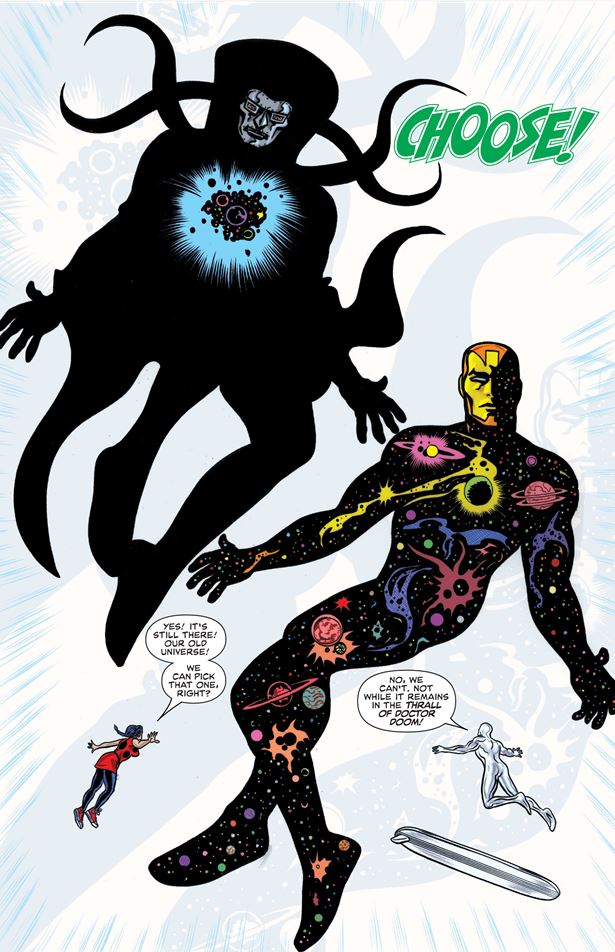
* * *

The reason everyone is re-watching the original and prequel trilogies, regardless of the order, is because Star Wars Episode VII: The Force Awakens debuts in theaters on Friday, December 18, 2015. This is the first film to be released since George Lucas sold the rights of his franchise to Disney, and with it is the promise of a new way of doing things. This is seen as both good and bad. After all, many people think Lucas punted it when it came to the prequel trilogy. There is good reason to believe that this is because he took too much of the creative process on his own shoulders. What would have happened if Lucas had focused on general story and trusted everything else to the most skilled people in the business? Maybe this is what is going to happen now that Star Wars is in the hands of Disney. On the other hand, there is a strong anti-J.J. Abrams movement on the Internet, with people faulting him for his lens flares and other issues. You can watch all of the US and International trailers and TV spots, buy all of the merchandise, and read every article you get your hands upon, but will that tell us what to expect when it comes to the new Star Wars film? Probably not.

Here is what I think we can expect. Say what you will about J.J. Abrams, but the guy does his research. There are few people out there who are as dedicated to delivering an experience consistent with previous franchise work as J.J. Abrams. What I think we can expect from him is a continuation of many of the parallels between the preexisting films. Already, The Force Awakens delivers a similar title when compared to A New Hope and The Phantom Menace. Each of these titles suggests that something was lacking from the world and in a very small way it has just appeared. Where A New Hope introduces an up-and-coming Jedi in world dominated by the Sith and The Phantom Menace suggests that the Dark Side of the Force has found a crack in the Jedi world order, The Force Awakens promises that the power behind both the Jedi and the Sith is returning to a world that has forgotten it. Does this mean that The Force itself inverts both its light and dark side? Are we to believe that the primordial power of the universe wishes for something other than that represented by the Jedi and the Sith? I think (or maybe hope is a better word) that Abrams’ vision, and possibly George Lucas’s original vision as well, is that the dual nature of The Force needs to be overcome. This is what is meant by balancing The Force. We got a sense of what this would look like with both Anakin and Luke Skywalker who, each in his own way, embodied the balance of impartiality and concern. How will J.J. Abrams embody a balanced approach to The Force that shuns both Light and Dark? Who will represent the next generation of Jedi? Is it Luke Skywalker our protagonist’s first mentor, and if so, does this mean Luke is going to die in Episode VII the same way that Obi Wan died in Episode IV and Darth Maul died in Episode I?

the-force-awakens

Personally, I don’t trust anyone who isn’t excited for The Force Awakens, but you’re all entitled to your own opinion.