Genesis 1: A History of Nonviolence

Genesis 1 tells a story of six days in the life of the creator of Earth. On the first day, our main character, the one called God, creates day and night by separating the light from the darkness, and yet this is not a day, at least, not how we know days. The great light that rules the day (presumably the sun) doesn’t get created until the fourth day, which rules out the traditional measure of a 24-hour period of time, and the atomic clock won’t be invented for, well, for another couple days, so what are we talking about here? It seems like the only real point of reference we have is that a “day” is the space (for lack of a better term) for rising and falling, for development, that on the first of these days God created time. How much time is there in a day? It appears that there is just enough time to complete a great work.

If time is created on the first day, and God swept over the face of the formless void like a mighty wind “before” (time words become more difficult in a time before time) creating time, then this is not exactly the story of the creation of all, of everything, of the cosmos. This is the beginning of history. And everything else – the formless void, the darkness, the face of the deep, the wind and the water – all of that is pre-history.

On the second day the atmosphere is created in order to separate the terrestrial waters from the extraterrestrial waters. The third day brings the separation of earth and the seas, and with the introduction of Earth we meet one of the first co-creators, for it is Earth who brings forth plants and trees and fruit and seeds, all the vegetation of the world. I already mentioned that the sun and moon and stars poke their head in during the fourth day to assist in human measure of time and direction, but I’m getting ahead of myself by even saying the word human. On the fifth day, the world was populated by sea and sky beasts, including the “great sea monsters” [Gen 1:21 NRSV]. I wonder what these horrors of the raging waters must have looked like so near the beginning of time. The sixth day introduces humankind (“male and female God created them” [1:27]), and with humankind, violence.

To be fair, the violence comes later – it is something I talk about because I’ve read this story before – but as of this moment, this day, this moment of great works, we see a brief respite from violence, a hypothetical time of nonviolence before the popular Christian concept of “the fall” into violence. I can’t help but to think of a series of Tweets I read recently from comic book writer Justin Jordan (Green Lantern: New Guardians) about theme parks / lodgings created to mimic the actual conditions of so-called Golden Eras.

The implication of these Golden Aging camps is that the actual conditions and way of life would be so difficult that people wouldn’t even want to stay there if it were rent-free.

On a side note, Jordan also referenced the Biblical days of the week in a Tweet shortly after this particular rant:

For all intents and purposes of the narrative, the golden era before the advent of violence is just as unreal as the good times of old that Jordan talks about. I imagine that the Genesis account is a tale told from a parent to a child at about the time of the story that unfolds surrounding Moses and his people in the book of Exodus. Some of these people have experienced enslavement and oppression in Egypt, though not, I imagine, the child actively listening while on a seemingly never ending walk, all of them have experienced the destructive forces of nature while wandering on their way, and many the age of this child will have to witness and participate in horrible acts of violence that put the previous ones to shame during the conquest of the land that was promised them at the end of this road. These former slaves, now nomads, have known nothing but violence, suffering and death, but in their stories they imagine this present existence is bookended by peace, the peace that was in the beginning and the hope of peace to come.

For these people nonviolence is order in the midst of chaos, a first mover who transforms the formless void into a world that follows patterns and can be understood by the human mind. It is collaboration, a world populated by the fruits of some divine force working alongside the earth and the sea, plants with the seeds of the next generation, animals commanded to fill the land, sea, and air with their offspring, and humankind who are created to be creators (“God created humankind… in the image of God” [1:27]). Every “plant yielding seed” and “tree with seed in its fruit” [1:29] is given over to the animals of the land (present company included) for food – not the meat of animals or even the portions of plants that will result in their death; no flesh, only the food that can be regrown with little effort, the fruit offered as a gift freely given. This paints a picture of radical pacifism – thou shalt not kill humans, animals, or eat of plants in such a way that brings about their destruction. Humankind is given dominion over life on earth, but in this context it feels less like the power to dominate than it does stewardship, a duty to promote the proliferation of all life.

Of course, this dominion might also be the first in a series of flaws in the ordering of this universe that prove deadly in later chapters. When I look back on the years I attended Grand Valley State, I grow more and more fond of the Marxist/feminist counter-culture there, of the one or two students in each of my favorite classes who vexed me at the time but who warned of the dangers intrinsic to placing one person above another in terms of power. Is this what is happening in Genesis 1? Adam and Eve (not named, as of yet) have made little more than a cameo and we may already be seeing the peace they were born into unraveling at this early juncture. How horrible!

As anyone who has been tuned-in to current events for the last few lifetimes can tell you, this particular passage is constantly embroiled in controversy. It is a key piece of evidence for the religious persons on the side of creation being taught in schools alongside or at the expense of evolutionary biology, big bang cosmogony, and many facets of science in general. If you ask me, most of the people involved in this argument are talking past one another. The original audience of this text was almost certainly pre-scientific just as the current audience is almost certainly not, but for both the idea of time espoused is rhetorical. The time serves the poetry and the poetry serves the moral and the moral is nonviolence. This, the first story for some people, is a story about how we as a people have experienced peace before, a long time ago, and we called it Eden, or delight. I cannot read this prologue without the hope popping out at me that, maybe, through our actions, we can return to this original state, that we can plant the seeds for the return of peace. And maybe that is where this story belongs, alongside the parents teaching their child in the hopes that the next generation can live without the taint of violence, can escape the wilderness and establish a peaceful way in the promised land.

Spoiler Alert. That is not how the story goes down, but hope is a resilient bugger, not so easy to extinguish. Hope is a funny thing. It doesn’t really rely on the outcome of a series of actions, but emerges as a quality of a person’s character. Some find poets like John Lennon fools for wasting their lives preaching of peace with little to no measurable results, but that does not make his words any less true: “War is over if you want it.” Though everything else may be imaginary and fleeting, a nonviolent way is possible. Genesis holds it as a hypothesis; may the future hold it as a law.

Further Reading:

Letter to a Confused Young Christian at Political Jesus
The Quest for the Historical Eve & Adam at Political Jesus

A Dream Achieved, Cover A Professional Sports Team

An empty Van Andel arena.

An empty Van Andel Arena.

I’ve always enjoyed writing. It may have come as a bit of a shock to my parents when I switched from a computer science major to a writing major, but to me, it seemed like a fitting change.

When I was a kid, I wrote in a journal like the Nickelodeon character Doug did in the self-titled cartoon. I often wrote reviews for my favorite video games mimicking those I would read about in Nintendo Power or Electronic Gaming Monthly.

My love of sports led me to an easy career choice: sports journalism. However, making it as a sports journalist is anything but easy. Think about how many people like sports. Tens of thousands of people fill football stadiums every Sunday and millions more are watching from the comfort of their home, and that’s just one sport and not even the most popular sport in the world.

Now think about how many of those people are die-hard fans who want to share their love of the sport with other people through writing. That’s why I say it’s not an easy profession to make it big in. The majority of guys (and a good portion of females as well) watch sports or at least have a vested interest in sports, and a good chunk of those enjoy writing about it. It’s a highly competitive field.

And now, with blogs such as SB Nation, Rant Sports, Yahoo Contributor Network, FanSided, etc., it gives people the opportunity to write who may not even want to pursue a career in sports journalism. My sports journalism career is still fairly new. I work at MLive Media Group covering high school sports. Obviously, not my ideal career path. However, everyone has to start somewhere.

The Journey

In addition to working at MLive, I’ve worked the gambit of freelance opportunities. I started out with Suite101.com, where I did reviews for South Park and The Office. It was a paid opportunity, but I was making pennies every couple months, as I wasn’t getting very many page views and people will normally go to the bigger outlets for TV show reviews.

Despite the lack of pay, I still enjoyed writing the articles, and it was good practice. I also wrote the occasional sports article, usually opinion articles on various topics. A former ESPN writer noticed my writing and offered me a job writing for a fantasy sports site he was starting, The World Cup of Fantasy Sports. This position was not paid, but there was the promise of compensation down the road if the site flourished.

A former ESPN writer wants me to write for his site? Is this real life? That was a huge confidence boost. I had never written about fantasy sports. I had played them quite a bit, but wasn’t an all-star by any means. I’ve won one hockey title and finished last a number of times, but I figured if the site took off, it could be a foot in the door toward bigger and better opportunities.

My assignment was to write a weekly article highlighting the hot and cold players of the past week in the Western Conference. It worked well for me because that meant I got to do research on my favorite team, the Detroit Red Wings.

I had a lot of fun writing those articles, and I learned a lot about studying trends and new players in different systems. However, the site folded a few months after it started, so I was back to square one. The site owner promised the writers he would keep us in mind if other opportunities came up, but I haven’t heard from him in years. For all I know, he isn’t even writing anymore.

Eventually, I decided to follow in the footsteps of my friend Justin Tiemeyer and start my own blog. It wasn’t going to get the page hits the fantasy site could have received, but it gave me the freedom to write whatever I wanted, and it could wind up on the computer screen of a sports editor looking for writing help.

In November 2012, I found a paid writing position with Yahoo for the Yahoo Contributor Network. It was still freelance work, so I wasn’t an employee of Yahoo, but it was a perfect opportunity to put my work on the top sports site in the world. Millions of people come to Yahoo for their sports news, and thousands of people would find their way to my articles. It was a big step toward finding a permanent position.

Of course, like every other writing opportunity, this one fell through as well, and I was left searching for a new home to write for. I had quite a few conversations over Twitter with John Evans, a writer for FanSided’s Octopus Thrower during my time with Yahoo. I asked if Octopus Thrower was taking new writers, and sure enough, I had found my new (and current) home a month after leaving Yahoo.

FanSided isn’t paid, but it offers what many blogs cannot offer: media credentials. I simply had to fill out a form, send it to my NHL editor, and if it was approved, I could contact the appropriate organization and cover a game in-person. Live coverage was the one thing that was missing from my resume. I had done live coverage of high school sports, even state title games, but it isn’t the same as covering a professional sports team.

By the time I found out I was allowed to cover live games, the Red Wings had already been eliminated from the playoffs. The next best thing was to cover their AHL affiliate, the Grand Rapids Griffins. The Griffins won the Calder Cup last year, and had just reached the second round of the playoffs this year. As luck would have it, Game 4 against the Texas Stars was a home game, and I had the night off from MLive. The stars had aligned, no pun intended.

I had covered the Griffins once for MLive last year, but it wasn’t covering the game so much as covering the atmosphere of the arena. I went to Game 4 of the Calder Cup final, the first game the Griffins had the opportunity to win the Calder Cup, and my assignment was to talk to fans and get their reaction of the atmosphere in the building, as the Griffins attempted to win their first championship.

It was fun. I talked to a guy who was a season-ticket holder since the Griffins’ very first season in 1996, and I found some casual fans who were just excited to have the opportunity to witness history. However, my assignment didn’t allow me to talk to the players and coaches after the game, so I felt a bit cheated. I understand the game story/column is the beat writer’s job, but I felt so close to my ultimate goal, yet so far away.

A Dream Comes True

A year later, my dream finally came true. I walked into Van Andel Arena on May 14, 2014, full of excitement. However, I had to curb that enthusiasm, as I was there to do a job and I couldn’t act like a kid in a candy store, which is exactly what I felt like. I made my way up to the top floor of the arena to the press box. I arrived a half hour early, but I was perfectly content watching the pregame warmup. Plus, I wanted to get set up on Twitter and give people time to figure out I would be covering the game live.

Within 10 minutes of sitting down, who should walk by but Red Wings general manager Ken Holland and former Red Wings grinder Kris Draper. On the inside, I was awe struck. I wanted to talk to Ken and Kris. I wanted to ask Ken what his plans for the offseason were, I wanted to ask Kris what he thinks of Grand Rapids, I wanted to ask them if they like early Beatles music or late Beatles music, anything to start a conversation with two people vital to the Red Wings’ success. On the outside, I acted as if they were just beer vendors. The 13-year-old inside of me sees Kris and remembers the Grind Line and the Stanley Cups he helped bring to Detroit. The 27-year-old reporter has to act professionally and do the job he was sent there to do.

It was tough. It sucked, but I wasn’t there to gab with Ken and Kris, I was there to cover a game. Plus, being apart of the media, I doubt either Ken or Kris would want to open up very much. I’m sure they get bombarded on a daily basis, and the last thing I want to do is make a bad first impression.

The game ends, and the Griffins are victorious. The part I was looking forward to the most was coming: talking to the players. It’s a crucial part of being a sports journalist. You have to ask the right questions to get the right answers, and the right answers can be the difference between a boring story and an eye-catching story.

I made my way down to the locker room area, and the stench of sweaty pads filled my nostrils. It wasn’t overwhelming, but it brought me back to my playing days. It was calming, and it brought me back to a place that felt comfortable.

I enter the locker room, and that excited feeling I got when I saw Ken and Kris before the game, it fills me up again, as I see Mitch Callahan sitting at his stall after a hard-fought game, Luke Glendening, who is back in his hometown after his season with the Red Wings had finished, standing next to him in a suit and tie, goalie Petr Mrazek walks to the back area of the locker room, a section that appears to be off-limits to members of the media.

These were the guys I saw play on TV throughout the season, and they were standing mere feet away from me. This is what I have been working for. This is why I jumped from freelance opportunity to freelance opportunity to get to this very spot where I stood. That night reaffirmed my decision to become a sports journalist.

I’ve had my fair share of doubt. I’ve had a part-time job for the past five years with MLive. I thought about quitting and getting a more stable job with higher pay so I could go on long vacations, buy expensive toys and enjoy my nights and weekends with my friends and family. But that moment right there, that moment of being surrounded by players I watch and cheer for as a fan, that was the moment that confirmed why I wanted to be a sports journalist in the first place.

I didn’t ask any questions, the other reporters took care of any questions I would have had, but it was an experience I will never forget. I listened as Andrej Nestrasil talk about coming back from a 2-0 deficit to tie the series at 2-2 against the top-ranked team in the Western Conference. I listened to coach Jeff Blashill — who I’m convinced is a clone of Mike Babcock’s that was named Jeff Blashill, seriously, listen to the two of them speak, it’s eerie how identical it is — talk about his team’s resiliency and repeatedly tell a reporter he knew nothing of the status of injured forward Tomas Jurco.

Below is a video I took of the interview with Andrej.

I left the locker room to make my way back up to the press box to write my story, and I saw more former Red Wings as Kris, Chris Chelios and Kirk Maltby were talking outside the locker room. Again, the urge to stop and discuss 1990s Red Wings hockey was overwhelming, but it wasn’t the time or the place.

My dream had been achieved, and I want that feeling again. I will do anything to get that feeling again.

Would You Go All the Way for the USA?

As if the epic gravity of the fact that you were at the most highly attended hockey game of all time or the fact that you have probably never paid this much money for tickets to a sporting event weren’t enough, Winter Classic coordinators decided to deliver an added bonus for those brave enough to stay until the very end of the January 1st showdown between the Detroit Red Wings and the Toronto Maple Leafs. (If you guessed that Nick Fury inducts Pavel Datsyuk into the Avengers after the credits, you are incorrect. Romanoff never trusted the guy.)If you hadn’t already been carted away in an ambulance after suffering symptoms of severe hypothermia, you had the option to experience the supreme treat of hearing the exclusive live announcement of the 2014 US Olympic Men’s Ice Hockey Team.

I went to the Winter Classic with my buddy Tom Mitsos, a die-hard Detroit and Team USA fan, and had he been able to feel his toes he would have made me stay through to the end of the announcement. As it was, he’d forgotten what toes were like, what they were used for, and how it might feel to wiggle them. While sitting in Ann Arbor traffic for a matter of hours, I found the time to look up the Men’s Hockey Team using my phone’s browser. Red Wings goalie Jimmy Howard was joined by Maple Leafs forwards Phil Kessel and James van Riemsdyk and a long list of current American hockey royalty. There was no shortage of talent on this team, but there was an unsurprising lack of my guys.

In order to unpack this phrase, “my guys,” we’ll have to flash back a few years to when I waited out the toughest three years of the recession living in North Texas – Denton and Fort Worth, to be specific – and in the process became a lifelong fan of local NHL team the Dallas Stars. While in Denton, my brother Micah and I would walk down Fry Street, which at the time was considered the best bar scene in the area, over even Dallas’s Deep Ellum area, and over to Riprocks (or “Rips,” as Micah called it) to watch the Stars battle their foe-of-the-week on a TV tuned to Fox Sports Southwest. My brother’s love of the team was intoxicating, and fairly virulent, but there was something about this team that was bigger than just sharing a deep love with my brother. I’d watch hockey games while nursing a Ziegenbock and chowing down on a burger and when I looked up at the screen it was as if the Stars were the only team broadcast in color. Even the Detroit Red Wings, the beloved team of my youth and of my home town, only played in grey-scale. The other teams were Kansas and the Stars were Oz. I’d only had that feeling two other sports teams in my life, and both for only a year: the first was with the Dallas Cowboys during Terrell Owens’ last year with the team, and the second was the year the Detroit Lions looked like they might go undefeated, before most of the team had been arrested for drug crimes or otherwise. As of the 2013-14 hockey season, if my calculations are correct, I’ve been a Dallas Stars fan for a full seven years.

After looking over a Team USA roster devoid of Dallas Stars, I started to peruse the line-ups for some of the other contenders for Gold in the Olympics Men’s Hockey tourney. Dallas goalie Kari Lehtonen had joined Boston’s Tuukka Rask and San Jose’s Antti Niemi as goalies for Team Finland, up-and-comer Valeri Nichushkin was playing for Team Russia, and captain Jamie Benn joined head coach Lindy Ruff on the roster of a star-heavy Canadian Olympic Team. Just prior to the Olympic break, I remember staying home sick from work, the only thing keeping me both warm and comfortable enough to sleep through my illness being the outdated Brenden Morrow Stars jersey Amy had bought me along with Valentine’s Day tickets to a Detroit-Dallas game at the Joe Louis as Christmas presents a previous year, and posting a selfie on Facebook just prior to a Stars game reading, “Go Stars! Go Canada! Go Finland! Go Russia!”

Exhibit A. Full, original Facebook caption: "Home, sick, but staying warm Micah-style. Go Stars! Go Canada! Go Finland! Go Russia!"

Exhibit A. Full, original Facebook caption: “Home, sick, but staying warm Micah-style. Go Stars! Go Canada! Go Finland! Go Russia!”

I hadn’t followed Olympic hockey in previous years – it was always over before I realized it had even started – but I had always assumed, in the current world climate, that the way I’d chosen which Olympic hockey teams I would support was the same way everyone chose which team they’d root for. For example, fans of Henrik Zetterberg would be fans of Team Sweden and fans of Pavel Datsyuk would cheer for Team Russia. This was not the case. In the days to come, I was bombarded by people horribly offended by my Facebook status simply because I was not rooting for Team USA to win the gold medal for ice hockey at the 2014 Olympics.

Don’t get me wrong. Some of these people had good arguments. There were those who said that I am merely a “contrarian,” choosing opposing teams simply to act as a devil’s advocate, and to some extent they are right. I have a lot of trouble joining in the actions of a mob, and one of my greatest fears is the tyranny of the majority. I was also called a “troller,” which is equally accurate. I do like to put things out there so we’re not silent about possible sources of oppression. I even have a friend who is known to refer to me as an “iconoclast,” but in a post-Nixon world of pedophile priests and human rights sacrificed for the sake of fleeting public security, what remains unspoiled to be placed atop a pedestal? The annoying part of the dialogue that followed my post was not being called these names that I clearly have little problem with being called. The annoying part was when people would act like there was a moral imperative to root for Team USA, like my choice to support any other team was simultaneously killing Tinkerbell along with all of America’s deployed armed forces and the American public as a whole. When George W. Bush was deposed of, I thought I’d see an end to McCarthyist accusations wherein ones opponent is labeled a terrorist, but that thought went up in smoke when I ended up on the wrong side of sports.

And this is the point where my good friend and fellow Winter Classic attendant Tom comes into the conversation, at exactly the wrong time. As one might expect, things got explosive. Before you all start lecturing me on the value of tact, I want to let you know that tact is overvalued in our society. It is not tact, exactly, that is the problem, but the thing that people parade around as tact. People prefer to be dishonest, to avoid conflict, and to be generally spineless, a series of vices that they define as a virtue, and as a result we see rumor-mongering and passive aggressive cold wars popping up left and right. Tact is downright useless in today’s moral climate. What it ought to be replaced with is understanding that effective communication requires a particular type of argument coupled with a particular type of delivery, both of which vary according to the circumstance. What follows is a good argument that I managed to attach to a terrible delivery, and the explosive consequences that I mentioned earlier.

THE ARGUMENT

While these are not the words that I exchanged with the my various angry interlocutors, they are the foundations of my perspective on the subject. If you’re looking for my response to my good buddy Tom, you can feel free to skip this section and jump ahead to “The Delivery.”

One of the current trends, alongside gluten free and non-GMO, is the buy local movement, but there was once a world where you had little choice but to buy locally. If you couldn’t grow or make a product at your own homestead or with the help of your kith and kin, you would bring your excesses to market and trade them to other people. This myth is both true and false. For many people, all of life took place within a thirty mile radius from birth to death, and yet even some of the earliest civilizations – the pre-Greek Minoans and Myceneans – were known for vast shipping networks, with suggestions of boat routes from Ancient Greece and Turkey all the way to Great Britain. For most, if not all, of recorded history, humankind has been cosmopolitan by nature.

We are more cosmopolitan now than at any other time. While for most people cosmopolitan means a drink or a magazine, it generally means that you are at ease in one country as much as in any other country. It derives from the Greek “cosmos,” or world, and “polis,” or citizen, suggesting that a cosmopolitan is a citizen not of any particular sovereignty, but of the world. There are some who are going to argue, “I am not cosmopolitan. I’ve only ever lived in America. I’ve never even traveled overseas. I did go to Tijuana on Spring Break once, but that doesn’t count.” I challenge these people to look at the nationality of the people who read their blogs, of those who post your favorite YouTube videos, or to simply check the tags on their clothing for their country of origin.

Some might argue that the Olympics was created not to fan the fire of petty local vices and feuds with ones neighbor, but in order to create a greater citizenship, a kindred spirit with people of different regions that might prevent future warring and trade disputes. Whether or not that is the case, I have a lot of difficulty finding any sporting event where you will find something purely American going up against something purely Chinese or purely Latvian. The main threats in the Olympics Hockey tournament were, as always, USA, Canada, Russia, Sweden, and Finland, and we have expected this to be so for some time simply due to the fact that these teams are loaded with highly skilled NHL players while many of the other teams are not. Now, players for these teams don’t simply stick to their home country and wait for the Olympics to come back again. These NHL players spend nearly all of their time practicing, playing, and making money for teams that are located only in North America, US teams like Philadelphia and Washington as well as Canadian teams like Montreal and Toronto. The majority of the players for the Dallas Stars may be Canadian by birth, but they are paid by an American team and in turn make money for the same American team, have houses or apartments in America, buy food and drinks from American drinkers, and bring their cars to American auto repair businesses when they break down.

The time when the purely American team or individual could be found has long been over, and that is assuming it ever existed in the first place. The original European settlers had nothing in common, no unifying language or national origin, and the American identity was defined in the negative, as not-British, not-French, not-Dutch, and they had even less in common with America’s original human settlers, the so-called Natives who traveled across land bridges from Eurasia long before any settlers accidentally stumbled upon the continent. Everyone is tainted, by this country or that country, through coaching, sponsorship, family, friends, financial support, media support, merchandising, or ancestry, and this is exactly as it should be. As a result, our thinking about who we want to support in any sport is rich and complex, allowing us to express our freedom to choose not only through popular vote for US public office but also by rooting for another nation’s Olympic team for reasons as simple as liking their story.

This is the argument that my beliefs on the topic stemmed from…

THE DELIVERY

…and this is how I delivered those beliefs.

When Tom came at me with a “home team trumps everybody else” [Tom, a text] argument, I hit him back with three incredibly long texts explaining a series of questions that complicates the idea of “home team,” asking whether a goal by Tomas Tatar (Detroit Red Wings) or a win for Team USA is better for Michigan, and suggesting that the American revolution was fought so people wouldn’t have to be “guilted into liking the most popular [team]” [me, a text].

Shortly thereafter, I started a guerilla attack on Tom via Twitter. Tom wrote an innocuous statement that perfectly fit his post as a sports writer and Detroit Red Wings blogger / podcaster, a Valentine’s Day tweet reading, “Today is the worst, not because it’s Valentine’s Day, but because Zetterberg pulled out of the Olympics” [Tom, Twitter]. I implied that because of Tom’s position regarding Team USA, he must want Zetterberg to die because his efforts are not for the glory of Team USA and also that Ryan Kesler, Phil Kessel, Max Pacioretty, James van Riemsdyk, and Blake Wheeler should “be hung for traitors” [me, Twitter] because they play for un-American teams in Vancouver, Toronto, Montreal and Winnipeg during the regular season.

One week later, when Team Canada won the gold medal qualifying game with Dallas Star Jamie Benn scoring the game-winning-goal, the entire thing came to a head. We exchanged angry texts for the entirety of the morning, and it only stopped because my fiancee said that I was being a dick and should apologize to Tom. What happened next was unexpected, and did a lot to change my perspective about petty arguments. We’ll get into that soon, but first a flashback.

Several years ago, I was living in New York City. I spent a lot of my free time on AIM – little did I know, but it would be my last year using the program – listening to my brother talk about this great hockey team called the Dallas Stars and explaining their virtues and victories, and yet this was before I was even a Stars fan myself. I was in a band called Get Stop Ticket with my three friends Becky, Elliot, and Fiona, who had also relocated from Grand Rapids to NYC. We never played any gigs, but we certainly made the rounds of the Brooklyn and Manhattan (and sometimes even Queens) night life. One weekend, another Michigan compatriot and fellow musician, a DJ named Jon came to visit us. We attended a concert at Studio B – I think it may have been the electronic band Modeselektor, and if that is the case then my brother was there in attendance as well for this story – and I remember Jon checking in every couple moments to tell me something about the music or to crack some joke. I remember feeling really annoyed that the experience was peppered with this side-commentary and creating this unfair perspective of Jon as a pest that evening. Later, however, we went to a bar, and Jon started to unload some things about his past that I didn’t really know. We had gone to the same high school and I’d always seen Jon as much more popular than me and having a wealthier family, but I had never bothered to wonder what was going on in his life. That evening at the bar I began to feel for Jon more than ever before and to this date I believe that we are kindred spirits in ways few others are. I respect Jon and value him as a human being and a friend. The lesson I learned that night was like that of the classic parables of ancient history.

It was a lesson that I hadn’t learned well enough to treat Tom with the dignity that he deserved during our Olympic-sized battle. As soon as I backed down from the offensive, Tom felt safe enough to admit that his father had been in the hospital and he was terrified that things might go poorly for him. It’s not my place to tell Tom’s story for him, but it is my place to point out that this was an instance of the same lesson. I spent so much time attempting to meet the teams and players involved in Olympic Men’s Hockey where they are, loving them despite national affiliation, that I had forgotten to meet Tom where he was. Tom was in a scary place and he needed a friend, and what I brought to the table was yet another enemy.

Eventually Tom and I got on the same page, and I think we’ve put this dispute in the past. We’re both firm in our beliefs and I think we respect one another. To Tom’s credit, he was quick to share the blame for the series of events that had us at one another’s throat. In the end, we were two people who held different opinions, both with completely understandable and positive reasons for holding those different opinions (The Argument), and yet we clashed like Titans because of how we decided to let those opinions play out in public discourse (The Delivery).

Children are concerned with fairness, but only insofar as they gain from it. As a child I believed it unfair that my brother got presents on my birthday (Christmas) but that I didn’t get presents on his, so my parents would get me a present on February 4th. People on Facebook speak up for justice, but only insofar as their own cause is served. Tom and I, along with all of the others embroiled in the Olympic controversy I’ve written about, valued the concept of respect, but not in its fullness. We wanted people to respect our own opinions, either before or at the expense of offering the same respect to their opinions. Respect was at best a compromise and at worse a battle won or lost. If I had been able to see past the delivery and even past the argument and noticed the human being behind it all, a lesson I had claimed to learn after the incident with Jon, I would have seen another person who suffers through the difficulties of life just as I do. I would love that person for exactly the right reasons and I would have nothing but respect.

I’ve learned this lesson before, but I haven’t figured out how to live this lesson. Some would say this is the ultimate message that the people of the book (Jews, Christians, and Muslims) profess in unison, the same set of words uttered in different tongues by Confucius and to some extent – to lay individuals – by Lao Tzu and Buddha. As for me, I know that I am often presented a chance to prove that I have become the embodiment of this concept of respect, and that I can think of two times when I have failed. My fear is that I won’t get that many more chances.

(Oh, and by the way, Tom’s dad made it through that difficult time, and we were all pretty darn happy about it. We love you, Mr. Mitsos!)

Campaign Stories: Waiting for the One Who Comes

Jean Baptiste sat with the githzerai.  The crimes he had committed, the crimes his son was committing, were grave.  Without question, they were worse than any that Jean Baptiste himself had ever committed, but the druid’s past was not clean.  Far from it.  Staring into the fire, Jean Baptiste’s mind traveled back, far, far to his own past.


The moment of happiness is always so fleeting, Jean Baptiste thought to himself as the whore took his money and exited the room. It was good while it lasted, at least. But as soon as it was over, he again felt unfulfilled. He leaned over towards the bedside table and picked up the tankard that sat there, hoping to find fulfillment in a glass, but when the tankard is empty, fulfillment is impossible. Jean sighed.

Jean was young, not even fifteen yet. His father had money, and so Jean Baptiste spent it. His father believed that one day the business would pass on to his son, yet Jean was unsure if working for a living was something that appealed to him; though to be honest, as of yet, nothing really appealed to him. Jean wondered if the woman was so far from the door that he couldn’t call her back to fetch him a refill from the bar downstairs so that he wouldn’t have to go himself. He glanced towards the door and nearly fainted in fright and surprise.

Standing at the foot of his bed was what could only be described as a monster. Its torso looked like the fiercest of minataurs, yet it stood tall on a horse’s body. Sheathed (thankfully) at its side was the largest and longest sword Jean had ever seen.

“Greetings, prophet,” it rumbled in a deep voice.

“What…. who…. wh….”

“Be not afraid. I am not here to harm you, prophet. I am Ravpos, a member of the Great Hunt of Trithereon. I come to tell you that my god, Trithereon requires your services. Indeed all the gods require your services. You have work to do.”

“I’m just a child,” stammered Jean, trying to get out of this without the monster drawing that ginormous blade. “I work for my father.”

Ravpos laughed. It was horrendously frightening.

“You only work at spending your father’s money on things that do not last. The work you have ahead of you will offer you true fulfillment. Go to the Shining Citadel. Go to the Monastery of Trithereon. Tell the guard at the gate that you have cake to deliver to Herp.”

“Cake?” This might well be, thought Jean, the strangest encounter with a monster that had ever occurred.

“It’s just a code, prophet. You don’t actually have to bring cake.”

“So, the cake is a lie?” Jean asked, confused.

“Who knows, maybe someday Herp will get his cake.”

And with another frightening laugh, the monstrous creature disappeared. It was as if he was never there. Jean looked into his tankard wondering if somehow his drink had conjured such an odd vision, yet it remained as empty as it had before.

“What the hell…, it isn’t as if I had anything else to do.” Jean Baptiste rose from his bed and began to dress himself, resigned to the journey he had before him.


The guard was young, as young as Jean himself, younger in fact. He appeared to be unarmed, unless the flute strapped to his back was a weapon. He stood before the door. If he was going for menacing, he was failing.

“I am here to see Herp.”

The guard, if indeed that’s what he was, looked at Jean with a sad and confused look on his face. “Then I fear you are five years too late, traveler. The dragon born has left this plane of existence.”

“But the bull-horse thing told me….”

The guard, or perhaps door-man, put his hand out to stop Jean Baptiste from continuing. Excitement, wonder, and disbelief warring across his young face. “You saw Ravpos!?”

“Yes, that is the name it gave. It told me to come here and say I had cake for Herp.”

The young boy’s eyes opened wider. The disbelief was gone. “Well, that isn’t what you said. You should have started with the cake! Then I’d have known what you were talking about. Going on and on about Uncle Herp like he was still here when in actuality you were supposed to be using the entrance code. Herp isn’t really my uncle, you know. I just call him that. He and my Grandpa were best friends. The Champion sure picked a strange person to send a message through. Did he have Ginormo with him? That’s his sword. Well, it’s the heavenly representation of his sword now, I guess. The real one, the one he used when he was mortal is in Grandpa’s office. Grandpa! You gave the entrance code. I’m supposed to take you to Grandpa. Well, really he’s my great grandfather, but that’s awkward to say. Neither my grandma, who is his daughter, or my dad, who is his grandson, joined the Trithereon order, but I did. Almost as soon as I could talk…”

Jean Baptiste stood there as the young boy continued to go on about things that made absolutely no sense to Jean. He looked longingly at the door behind the boy as the journey had exhausted him. Luckily, the young boy seemed to notice that exhaustion.

“Oh, listen to me prattling on and on while you wait to get inside. Stupid, Douglas, stupid.” The young boy slapped his own forehead. “Come on in, and let’s get you to Grandpa so you can tell him whatever Ravpos wanted you to tell him and then we can get you some refreshments. Uncle Herp always wanted cake, but I like ice cream. What’s your favorite flavor of ice cream? Have you ever had ice cream? Grandpa says ice cream is rare and that not everyone has actually had ice cream. I can’t imagine not ever having had ice cream…”

As Douglas continued to prattle on about gods know what, he opened the door and led Jean into the monastery, past the elaborate entry chamber, and through a small side hallway. Finally, they came through an ordinary looking door into an office that was almost sparse. Sitting at a desk was a very old man. He looked to be in intense thought, although his fingers absentmindedly played a hauntingly beautiful melody on a lute. He stopped playing and looked at the door when Douglas ushered Jean into the room.

“Hi, Grandpa. This is…. Um, I don’t know his name, but he said he had cake for Uncle Herp! Also, he saw Ravpos! Isn’t that incredible!”

The old man smiled at the insufferable young man. He raised a finger and the boy, blessedly, stopped talking. “Thank you, Douglas. That will be all for now. Head back to the door for the rest of your duty.”

Douglas gave a serviceable bow and, as proof that there are miracles throughout the world, departed without another word.

“Hello, Jean Baptiste.”

Jean’s jaw dropped in surprise.

“My name is Zayne. Although I might not look like much, I am the Abbot of the Trithereon order. Well, most of it, anyway. After Kylantian died, not everyone approved of my appointment, but that’s neither here nor there. You’ve travelled a long way. Have a seat.”

Jean set in the comfortable, if worn, chair that Zayne had indicated.

“Comfy, isn’t it.”

As Jean nodded in response, an apparition of a dragon-like humanoid drifted through the wall. “Cake?” it asked longingly.

“Soon, Herp. Soon,” the old man answered. The apparition nodded and continued through the other wall. Zayne watched the ghost depart with a smile, “Even though he’s dead, he still has work to do, as do we all, and he wouldn’t get anything done if we actually gave him that cake.” Zayne looked back at Jean Baptiste, who no longer felt that his encounter with Ravpos was that odd. Things had only gotten stranger since then, after all.

“Um, sir, why am I here?”

“Yes, you must have a lot of questions, Jean. For instance, how do I know your name. Well, that’s simple enough. Trithereon told it to me. You’re also probably wondering how old I am. 94. I probably don’t have much time left on this plane, but I still have work to do, and like my friend Herp, might still have work after I pass on as well. As to why you are here, that is part of the work I still have to do. I am going to let you know your purpose, Jean. You’re young. Younger than I was when I discovered my purpose, which happened the first time Herp died, but that’s another story.” Zayne smiled. “You’ll have to forgive me, telling stories is something I’ve always been rather fond of, so getting to the point can occasionally be a little difficult, although I’m much better at it than my great grandson. Anyway, you have a great purpose. Your purpose is important and so it wouldn’t surprise me if you have probably felt a desire to get to work on that purpose, even if you weren’t sure exactly what it was.”

Jean looked up at the old man in wonder, as the truth of that statement made itself known to him. “I have always felt that nothing I did was what I should be doing. Everything I tried left me wanting.”

“That is it exactly. It is because you have a destiny. You are meant to prepare the way for a great hero. A great messiah, a teacher, a revolutionary. Someone that the world sorely needs, or at least, sorely will need once this person arrives. You will mentor this person, help to guide this person towards their destiny. History might not place as much importance on you, if they remember you at all, but the person that history recognizes, that person will always be indebted to you. And as a person that stood alongside, or at least got to watch the people history remembered, that isn’t a bad destiny to have, I can tell you.”

“How will I do this?” Jean asked, wonder and acceptance coursing through him.

“First you must learn, then you must wait. Your training can begin here, although other gods desire you to study amongst them as well. Ultimately, I have no idea where this task will take you. I’m sure I won’t be around to see how it all turns out, but I will be there at the beginning if you will accept this task.”

“Where do we start?” Jean asked, standing, feeling the stirrings of what might just be fulfillment. It felt like a long desired piece of cake.


Jean Baptiste looked at the forlorn man next to him.  He could almost feel the pain that radiated off of him.  “Redemption can be yours, Willikin.  The gods want us to change; they want to redeem us.  My life was one filled with sin, perhaps not to the extent that yours was, but I can not claim to have led a blameless life.  The gods had a purpose for me, and they have one for you as well, if only you are willing to give yourself to them.  I have seen you in action.  You are trying to atone.  Let the gods help you, guide you.  Let them grant you that redemption you desire.  It isn’t too late, my son.  Trust me, the gods don’t let time stop them from having you work towards the good.  They don’t even let death stop it.  Work towards your redemption, my son.  The rewards will be vast.”  Jean Baptiste smiled, “Even better than cake.”

Campaign Stories continues in Wiliken 16.

Campaign Stories: Wiliken 15

When Wiliken had desired the company of his wife, the sun on his face, the fresh air in his nose, and the conversation of a friend, he was locked away. Naturally, as soon as he had contented himself with solitude, he began getting visits from one of his captors.

It was not as if the githzerai had been left completely alone. There were the people who brought his meals, three times daily, and more ample than the dinners his own wife prepared for him. His trays were picked up shortly after he had finished, and his latrine was emptied often. He had been put up not in a dungeon but in a fairly nice barracks room. His was more the life of a soldier than the life of a prisoner, and he’d never had much difficulty with the life of a soldier in his youth. His bed was supportive but not too comfortable, and the people of Felshore were keen on making sure he had clean bedding as well. He always had a candle for light, and if he’d asked Wiliken had no doubt he’d be granted scrolls to read or a quill and parchment to write on. People shuffled in and out of his room, but when Jean-Baptiste arrived, it was the first time anyone had spoken with him.

Wiliken remembered the first time the old man had visited him. The first thing he said was, “How many means of escape have you figured out?”

With the heightened focus the githzerai had gained from his peaceful meditation, Wiliken had learned to see the room for what it actually was. While most would be fooled into believing that the linens from a bed are meant to keep you warm in the night, Wiliken understood that the true purpose of his bedding was to be twisted into rope. Everything had a different purpose, from the utensils he used to eat to the bucket he emptied his bowels into, but the names and the familiar uses disguised these things from the mind. After six weeks of solitary confinement, Wiliken wondered how many people had lit a candle without considering the utter devastation that can be caused by its flame.

“Thirteen,” Wiliken responded. Jean-Baptiste smirked. The others were intelligent, but the gristly man of the wilderness who stood before him was wise. “Eighteen, if you decide to let your guard down.”

The githzerai and the human laughed together.

“You seem more… attuned than previously,” Jean-Baptiste said.

“A githzerai is measured by the calm of his mind,” Wiliken said. “I have lived as a man for many years, concerned with wages and possessions, with bantering for the sake of alliances and pandering for power. I cannot remember the last time I put my distractions aside and retired to my inner dwelling.”

“Your awareness has expanded.”

“You are keen to notice,” Wiliken responded, somewhat disturbed by how well Jean-Baptiste could read him. “For the last few days I’ve had the sense that my bow is located in the next room over, leaning against our shared wall, near the doorway.”

Jean-Baptiste looked over as the githzerai pointed to the approximate location of his weapon. “Indeed. That is the case.”

When Wiliken worried about nothing more than the ease of his morning commute to work, he would see elderly men gathering together in parks in order to play simple games or share a hot beverage. For these men, there was nothing else to life. Their meetings helped them to keep a schedule, to remember to get up in the morning and shave, to remember how to be human. Wiliken had viewed these rituals as foreign, and yet it seemed that this is exactly what his relationship with Jean-Baptiste had transformed into. Over time, the githzerai wasn’t quite as sicked by this insight about their meetings. The familiarity was warm. It was refreshing. Jean-Baptiste brought news of the outside world, or at least the small time-displaced portion of it that his battle allies occupied in the Shining City. He told of Jurgen disappearing shortly after they escaped from Valgaman’s Menagerie, of Morgan building an orphanage for the would-be sacrifice victims, of Grace’s Pelorite church and its unexpected growth.

Jean-Baptiste never mentioned Douglas, and Wiliken never asked.

One evening, Jean-Baptiste arrived with a dark look in his eyes. Some beast was eating away at him, asking questions that he did not want to be entertaining. Wiliken had sensed it building, despite his kind manner during their get-togethers, and he expected that it was only a matter of time before this secret got the best of Jean-Baptiste.

“I know who you are,” Jean-Baptiste said, grimly.

Wiliken had often suspected that their interchanges were not quite so light as they had seemed, but this was the first time he’d felt frightened by his friend.

“If you are referring to the Iuzian greys I wear, I assure you that not every citizen of the empire is a villain like Valgaman,” Wiliken said.

“It’s not your clothes,” Jean-Baptiste responded, irritated.

“Then my son – ”

“Stop,” Jean-Baptiste said. “I know who you are. I have not told the others. We’re old soldiers, yes, but you and I fought on opposite sides when the big terror went down. If rumors have value, and in this case I think they do, then you weren’t just a spectator. You had a role to play in the would-be-destruction of this city. A role bigger than most.”

Wiliken was quiet. Not only was he in a make-shift prison, but he was caught, and that was worse. Baseless mistrust was one thing, but certain guilt – that was something else. There was no sense playing games with Jean-Baptiste. From here on out, things were serious. Neither the human nor the githzerai spoke for some time, and it was Wiliken who finally decided to break the silence.

“Where do we go from here?” Wiliken said, because he honestly did not know.

Campaign Stories continues in Waiting for the One Who Comes.

Campaign Stories: Wiliken 14

On the other side of the teleportation portal, Wiliken was met with the splendor of the Shining Kingdom of old. He’d heard some of his allies speak of the Felshore having been transported through time just at the moment of its destruction, but the githzerai hadn’t believed it. In the years since the destruction, he’d heard songs where the good people of the Shining City were spirited away from some god or other just before everything was obliterated. He’d never imagine that he’d see the place with his very own eyes. In that moment, Wiliken felt that he could put down the burden he’d carried for all those years, that he could be forgiven for his hidden sin.

In the moment that followed, the githzerai was captured by a motley group of soldiers in mismatched armor and dragged off.

In the holding cell they’d fashioned for Wiliken, the githzerai spent all of a week in a rage. He raged about his wife, who would be in harm’s way without their intervention. When his guards had begun to fear for their own safety, Douglas had showed up to explain that they didn’t have any means of communication with the outside world, that the normal methods would attract the wrong kind of attention to a city that is not supposed to exist. He further explained that the only mode of transportation was teleportation, and that all requests had to go through the wizard Jenkins. Every word that came from the human’s mouth sounded like a lie to Wiliken, and he raged thinking that Douglas enjoyed the githzerai’s misfortune.

Slowly, the githzerai was able to keep his anger in check. Sense suggested that his wife was not in very much danger. His father-in-law was a very influential man. As such, anything that happened to Wiliken’s wife would call down the terrible justice of the empire. Furthermore, while Wiliken’s own son was clearly a dangerous adversary, the githzerai could not imagine that the boy would kill his own mother…

With these calming thoughts, Wiliken was able to turn to meditation, spending the next few weeks doing little other than sitting cross-legged in a state of keen focus. He meditated on the recent past, on the ways in which his recklessness had nearly killed him and his one-time friends. In time, his thoughts drifted to the present and there they remained, until the object of his thoughts was a small sliver of a moment.

There had been rumors that someone adept at meditation could gain extraordinary powers. Wiliken had seen monks move objects, not with arcane rituals or devices, but strictly through the exercise of their own minds. With his focus turned inward to his own mind, he began to feel the boundaries of his consciousness expanding. At first, he felt a great existential fear of this expansion, but in time even this subsided.

After six weeks in a makeshift prison, Wiliken found peace. It was short-lived.

Campaign Stories continues in Wiliken 15.

Project Karamazov: Pronunciation Guide

For those of you who wish to know the proper Russian pronunciations of the names featured in The Brothers Karamazov, I’ve pieced together this pronunciation guide. Special thanks to Tatiana Uglova for her tutorial on AllExperts.

Note: Capitalized letters denote which syllable is emphasized.

Adelaida – ah-dellah-EE-dah
Alexei – ah-lick-SYAY
Dmitri – DMEE-tree
Fyodor – FYO-daur
Fyodorovich – FYO-daurau-vich
Ivan – ee-VAHN
Ivanovna – ee-VAH-nauv-nah
Karamazov – kahrah-MAH-zauf
Mitya – MEE-tyah
Miusov – mee-OO-sauf
Pavlovich – PAHV-lau-vich

As of right now, I only have the names featured in the first chapter, but more are forthcoming.

Project Karamazov

‘How Do You Know Until You Try?’ Life Lessons Hockey Taught Me

It’s no secret sports can teach you some big life lessons. From leadership to working as a team, coaches from the high school level to the professional ranks use sports to teach athletes about basic fundamentals of life.

One of my biggest life lessons came from my dad when I first started playing hockey. It wasn’t my dad who got me into hockey — he wasn’t even a fan when I first started playing — but it was a friend of my dad’s who had three boys whom all played hockey.

I remember the first time I watched my dad’s friend’s kids play hockey for the first time. I was hooked. I don’t know what it was about the sport, maybe the thrill of scoring a goal and everyone cheering for something you did, or maybe it was because I tried every other popular sport and none of them clicked with me like hockey did.

I did tee ball, baseball, basketball, soccer and they were all fun to play, but I got bored with them or had no desire to get any better.

Then I found hockey. Hockey is a very expensive sport. Not only do you need to buy all of the equipment just to play, but you need to pay for lessons to learn how to skate. Then once you do that, you have to pay fees to be on a team, which include ice time for practices and games. Then you need to pay gas money to play in different cities. I was never on a travel team, but my house teams would still travel to Holland, Muskegon, Traverse City and other places across the state to play other house teams.

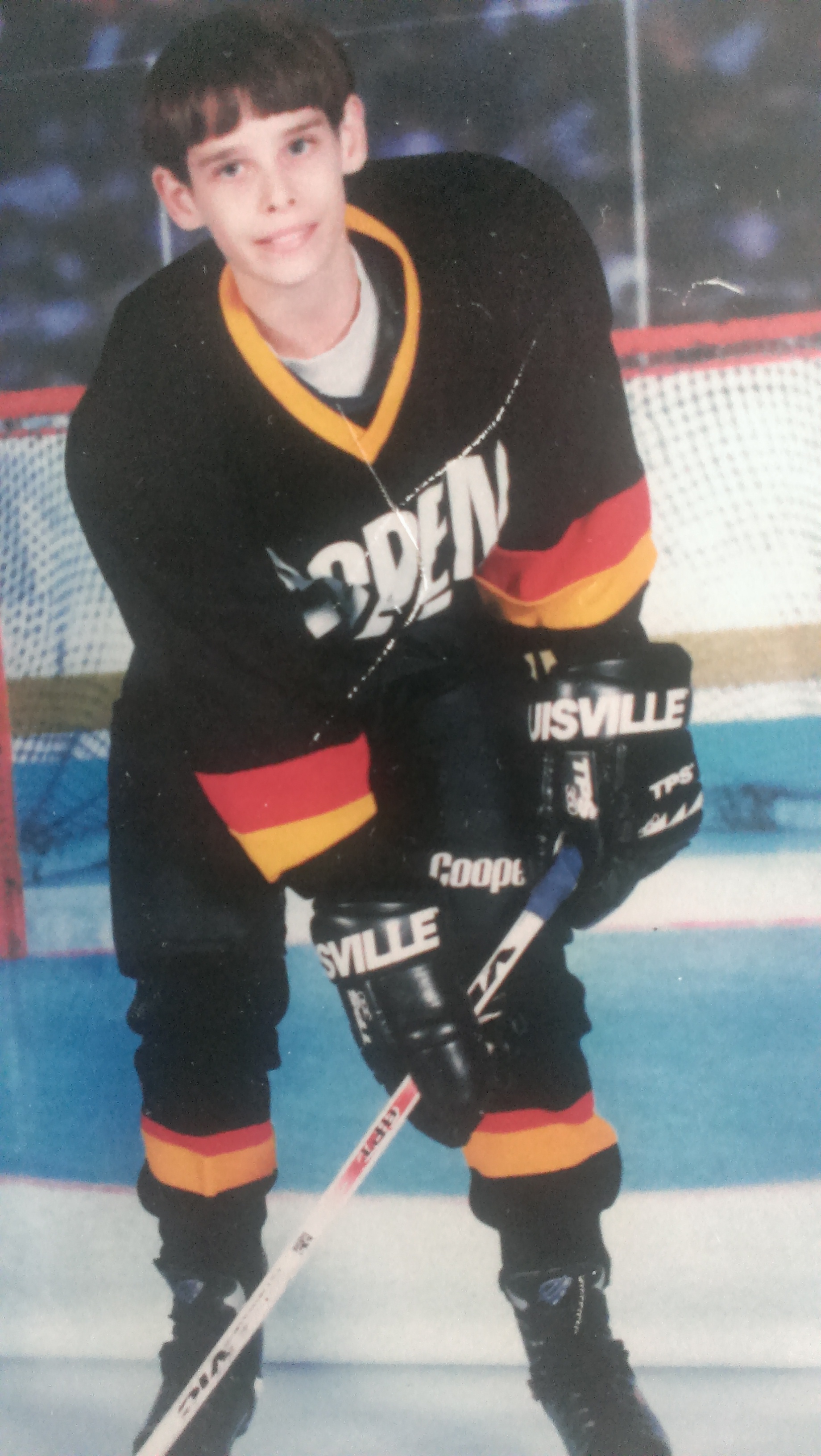
This is me as a Pee Wee at 12 years old.

This is me as a Pee Wee at 12 years old.

One of the biggest challenges I faced whilst learning how to skate was learning how to stop. Because I was afraid of falling down and being made fun of by my peers, my three strategies for stopping myself were to crash into the boards, slide into a slow stop or turn sharply. None of these strategies are ideal for a game-type situation, but who wants to be made fun of for constantly falling down? I was getting into the game late as it was — most kids start skating when they are around 3 years old, I didn’t start until I was 7 — and I needed to catch up to the other kids without being the laughingstock of the team.

I remember telling my dad “I can’t stop, I’m never going to be able to do it.” For whatever reason, I thought being able to stop was something you were able to do or you weren’t. There was no ability to learn it — you either had it, or you didn’t.

My dad’s response to this was one of the greatest life lessons I still value today: “How do you know until you try?” Of course, like every kid that age, I brushed it off thinking I knew better than my parents, and mostly because knowing that isn’t going to make it any easier when my teammates are laughing at me because I can’t do a simple thing like stop. I continued to struggle with stopping, while all of my peers could stop on a dime.

It was frustrating. But I slowly started to realize that not everything is going to come naturally to me. The only way I could improve my game was to continue to work on my weaknesses. I practiced and practiced, and I don’t remember specifically falling a lot, but I’m sure I did. And I’m sure a few guys snickered at me, but everyone had weaknesses.

The first time I stopped without falling was a monumental achievement. I remember the snow spraying up on the boards as my skate blade dug into the ice surface. I stopped, and I didn’t need the boards or friction to slow me down.

Of course, my dad was the first one to say “See, you don’t know until you try.” He was right. How would I ever know I couldn’t do something unless I tried it? Simply saying I can’t without trying is already admitting defeat.

This lesson has served me in other areas of my life, most notably, in my relationships.

Last year, I met a girl at a party who I became instantly attracted to (side note: That usually isn’t hard for me, but this girl was captivating). She was way out of my league, and I figured she probably wasn’t interested in me, anyway. With a face and body like that, she could get any guy she wanted.

But then the words of my dad echoed in my head: “How do you know until you try?” He’s right. Maybe she doesn’t like pretty boys, maybe she’s not into jocks. Maybe she goes for quasi-nerdy, awkward guys like me. How will I know unless I try?

So I gulped down some liquid courage and started talking to her. We probably talked for a good two to three hours at the party. Even when I left her to go talk to my friends, she continued to follow me around all night. I never had a girl follow me anywhere — I was always the one doing the following.

We hung out a few times and stopped talking to each other after about a month (translation: I started getting feelings, and she probably recognized that so she bailed), but I don’t regret spending time with her at all. Sure, there were a lot of red flags from the start, and I could have avoided some heart break by never speaking to her again after the party, but I had a good time with her and it gave me confidence knowing that not all girls are unattainable, even if their looks dictate otherwise.

It’s also served me well in applying for jobs, discussing work issues with my bosses and just about every other facet of life. Assuming doesn’t get you anywhere in life. And you know what they say about people who assume, you make an “ass” out of “u” and “me.”

Yeah, I ended my post with a lame saying. Deal with it.

The Longest Windiest Winter (Classic)

Of the thirty-one years I’ve spent on this Earth, I believe this year has been the longest, coldest, snowiest, stormiest winter I’ve experienced. In many regards, this is not just a subjective hunch of mine, but an objective, measurable fact. The winter of 2013-14 was quite a bear to make my way through, and even more so because I walked to work every single morning through the frigid, frosty winter wonderland of Lowell. Because of a streak of bad luck with a pair of Ford Tauruses (Tauri? Taura? Taurs?), both of which ending up totaled after all of the repairs added up, Amy and I found that we were once again a one car family. She had been working in Kentwood, which is much too hefty of a walk, so I ended up putting more miles on my feet than any other season I can remember.

There is a widely spread myth that languages in the Eskimo-Aleut (Eskaleut) family have hundreds of words that they use to describe snow. Even if this is not the case, I could understand why it would be so. Every morning I walked to work – and the amount of snowy days I walked to work had to be nearly 100 – was a different situation. I remember embankments of snow pushed together by plows. (I like big buttes and I cannot lie…) I remember when the Huntington Bank near my apartment turned its overflow parking lot into a 30 foot high snow dump simply because there was nowhere else to put the snow from the main lot. Children would play atop the piles with the same vim and vigor they exhibited when they played on the toxic sandbag sand disposed by the city in a grassy green field down the road from my apartment after the flood of 2013. I remember shoveled sidewalks protected by a four-foot wall of snow on either side. I remember even more sidewalks that weren’t shoveled. At one point there was word that Governor Snyder was warning people not to even go outside to shovel your sidewalk because of how dangerous the cold had been, but there were still those who got up and scraped out a path for me every morning by 6:15 AM. There were times when I had hiked in knee-deep snow for so long that when I got to a patch of shoveled sidewalk I nearly cried, vowing to someday buy a gift basket for those who put in the effort to make my commute easier.

Making my way through the heavy snow made my legs stronger, and I finally felt like I might be able to keep up with my fiancee Amy the next time she decided she wanted to take a summer hike to through Fallasburg Park. It was the ice that was the real menace. What you don’t realize when you drive to work in the winter is that the roads are always, with no exception, in better condition than the sidewalks, and it makes sense because the nation depends on the transportation of goods and automobile slip-and-falls can be much more deadly than pedestrian slip-and-falls. I remember one day when everything was covered in ice. I had traversed carefully across the ice for about a mile before this indescribable terror set in – I had spend so much energy keeping my balance, but that energy was running out. At one point, I stepped on someone’s driveway and, like Gumbi on some invisible skateboard, just kept slipping until I was across it. I didn’t fall that day, but I can remember two times when I did. The first time I exercised every precaution, planned every step, and still managed to fall flat on my back my first step off of my porch. The second time was when, like Moses, I glimpsed my final destination – Litehouse, the promised land of my morning walk – only to plummet to the ground the first moment my foot touched the parking lot, backpack and all. There was ice like a glaze or candy coating on the snow, ice with water underneath it that bubble-danced about as you stepped on it like coy in a pond, and sometimes I even became part of the ice. I could always tell when the temperature was circling around ten below freezing, because my eyelashes would begin to freeze together.

In the break room coworkers would say that they saw me in the flurries and morning winter storms as they drove in to work. Soon they began to pity me, offering me rides, and eventually I put my pride aside and let an electrician named Eric drive me home. But when those same people talked about how terrible it must be to have to make that walk every morning, I must have seemed like such a stereotypical “manly man.” I’d say something like, “Nah. That walk was nothing. You should have been at the Winter Classic.”

Photo Jan 01, 11 12 20 AM

The Big House as viewed from our seats before the Winter Classic.

The NHL Winter Classic is a tradition established in 2008 where two professional hockey teams, usually teams from the North and usually on or around New Years Day, match up in order to play an old time outdoors hockey game. This year I spent the first day of the year with my good friend Tom watching the Detroit Red Wings take on the Toronto Maple Leafs, two teams with a decent potential to underachieve their way out of a playoff spot, at the Big House in Ann Arbor. A friend at work would later express how awesome it must have been to see Detroit greats like Gordie Howe and Steve Yzerman, but we didn’t end up seeing them. The alumni game, which usually precedes the Winter Classic, was held on the previous day in Detroit, making it much harder to attend both events.

While I was born and raised in Michigan, people who know me might have wondered why I even went to the 2014 Winter Classic. As a Dallas Stars fan, I really didn’t have a dog in the race, and while I love hockey it is the other Tiemeyer brother that people usually associate with the sport. My buddy Tom was a Wings fan, so his attendance made sense. Amy had been a Leafs fan ever since she first saw players like Tyler Bozak and Jonas Gustavsson while watching a Stars/Maple Leafs game on NHL GameCenter, but she had decided to step back and give me some bro time with Tom. I was excited to be a part of such a big hockey event. I had once attended a Red Wings/Stars game in which Detroit broke the record for most consecutive wins on home ice in a season, but this Winter Classic was expected to break an even bigger record. According to ticket sales, it was boasted that this would be the most highly attended hockey game in the history of the NHL.

One of the cuter pre-departure photos I took. That's Tom on the left and me on the right.

One of the cuter pre-departure photos we took. That’s Tom on the left and me on the right.

While January 1 was the day I would be part of hockey history, it was also my first day of documenting as much of 2014 with my camera as humanly possible. I am looking forward to getting married to Amy in September and I want my family – Amy and all of our little potential kids – to have access to the events that preceded our marital fusion. To this end I took photos of pre-departure, pictures on the road, pictures of everything I could. As we were walking up to the stadium, surrounded by a sea of red (Wings) and blue (Leafs), it became more and more painful to take off my gloves and capture the moment with my camera phone. This was the first sign of the trouble to come.

The Ascent, or, In Which We Realized it was Too Cold to Take Pictures Anymore

The Ascent, or, In Which We Realized it was Too Cold to Take Pictures Anymore

In our excitement, we arrived in Ann Arbor over two hours early for the game, which gave us the time to walk around the Big House more times than we would have liked. The first lap was to check out what was going on in and around the stadium. Every subsequent lap was an attempt to keep our bodies from freezing in place, never to be thawed again. We encountered some interesting things on our adventure in the cold. There was a film crew from CBC (Canadian Broadcasting Company) that had gathered a crowd of Wings and Leafs in a semi-circle to shoot an adversarial promo for the event, there was a giant Bridgestone Winter Classic billboard that we took the time to pose in front of, and best of all, a generic hot dog that ended up being my favorite dog ever simply because it injected a little bit of heat back into my body. First, my extremities had gone numbed, and then the wave of cold had encroached upon my core, so that little bit of stolen heat was like manna from heaven.

Tom of the Franzen Jersey and the heaven-sent hot dog

Tom of the Franzen Jersey and the heaven-sent hot dog

The snow had started falling as soon as we entered the stadium, so when we returned to our seats after the walk our collectible seat cushions were covered with powder. The game hadn’t even started and I colder than I had ever been, colder than the time I slipped down a snowy hill into an icy river in the back of an elementary school friend’s house, colder than at any Polar Bear camp out I had attended in the Boy Scouts, colder than I could imagine cold to be. This was a really big game for Tom and we had paid a lot of money for the tickets, but if Tom had asked my honest opinion at that very moment I would have told him that I wanted to go home before the players even hit the ice.

I didn’t ask Tom to take me home, and we still survived the experience. As more people started filing into their seats I started getting hopeful that they might share their warmth, but the heat didn’t seem to be able to survive the minute gap between one person and the next. My scarf kept slipping from my face, revealing my bare skin to the elements. At one point, I took a big risk, unraveled my scarf, and re-applied it tightly over my neck and face, but it had turned around in the process making my neck wet and cold from the ice that had formed on the fabric. My thoughts drifted to the emergency medical stations established throughout the stadium and how warm they must be inside. If I could just walk over to one, perhaps things would be better. But I couldn’t leave Tom on such a big day. I just couldn’t. To this day, I wonder how many people ended up needing medical attention at the most attended game in hockey history. I would gird myself against the elements and tell myself that I could make it, but then I would see someone wipe snow off of a seat cushion with their bare fingers and something deep inside me would scream – THIS IS DEATH!

The Wings and the Leafs were pretty balanced that day on the ice. Neither team ever got more than one point ahead of the other. Though I estimated more Leafs fans in the bleachers, the audience of the game was fairly balanced as well. Many of the Wings fans were acting like frat boys and being really inhospitable to their rivals from across the lake, but after a while that feeling of Canadian friendliness began to take over. One of the most powerful moments I can remember was when the chants of opposing fans began to weave together like verse and chorus of the same song: “Let’s go, Red Wings. Go Leafs, Go. Let’s go, Red Wings. Go, Leafs, Go.

But that was merely an interlude in the burning coldness that lead to complete numbness. At one point I remember feeling like a huge block of ice had formed within my boot. I’d try to move my toes and push it away from my flesh, but it wouldn’t budge. Later, when we got to the heat of Tom’s car I would come to understand that the block of ice was the outer layers of my own foot as perceived by the portions that still had some feeling left in them. During both the first and second intermission, we escaped to the refreshments stand in order to pick up expensive hot chocolates. Tom cradled his in his hand for a long time, sipping and enjoying the feeling of the hot cup on his cold fingers while I gulped down my drink, hoping that the spark on the inside of me would re-ignite the fire in the rest of my body.

When we returned to our seats and I felt just as cold as I had before the hot chocolate, I started having a guilty thought. I knew I was supposed to be rooting for the Red Wings – after all, that was Tom’s favorite team, and the guy had just driven me across the state and I’d gotten into the event with a ticket that I hadn’t even paid him back for – but in honesty my one hope was that the teams were not tied at the end of regulation. I didn’t want to sit through overtime. I didn’t want to sit through a shootout. I wanted to leave as soon as possible. When Amy’s favorite player Tyler Bozak scored the goal that put Toronto ahead, I cheered on the inside while grieving with Tom on the outside, but when Michigan native Justin Abdelkader tied it back up I did the reverse. The game went into a scoreless round of overtime before Bozak struck again and won the game for Toronto.

I may have seemed like Mr. Endurance to the people at my work who shivered from just walking from their car to the entrance, but if they had heard me complain for hours like a little child I am certain they would have thought differently of me. As it was, I gained something much more valuable from the Winter Classic than Tom did. When Tom got back behind the wheel of his car he was forced to sit for hours in post-Winter Classic Ann Arbor traffic while thinking about how the Toronto Maple Leafs spoiled this momentous occasion for him. Amy had been watching the game from her parents’ warm living room on NBC and when she sent the inevitable text gloating about how her boy Bozak brought ruin to Tom’s Red Wings, I wished that I could have seen the cellular signal as it zipped across the state and intercepted the communication. I just couldn’t see more sorrow befall my buddy. Tom gained an experience that his friends couldn’t claim, but he also gained his fair share of sadness and remorse. As for me, I gained confidence in the resilience of my own body that would last me years.

As I prepared my life for the wife and children that seemed to be barreling straight for me, neither stopping to rest nor waiting for me to be ready, I imagined a day when I would take my children on a winter hike through the woods. I would be leading the pack, and they would be dragging their feet saying things like, “Can we go home yet?”, “I’m hungry,” or “I HAVE TO PEE!” It would be sunny outside without so much as a breeze and they would start complaining about how cold they were. I would stop, turn around, and I would say, confidently, like the crotchety old man I already feel myself transforming into, “You think this is cold? Let me tell you a story about when me and your Uncle Tom went to the Winter Classic in ’14.”

And the story wouldn’t end there, because this blog isn’t called The Longest Wind for nothing.

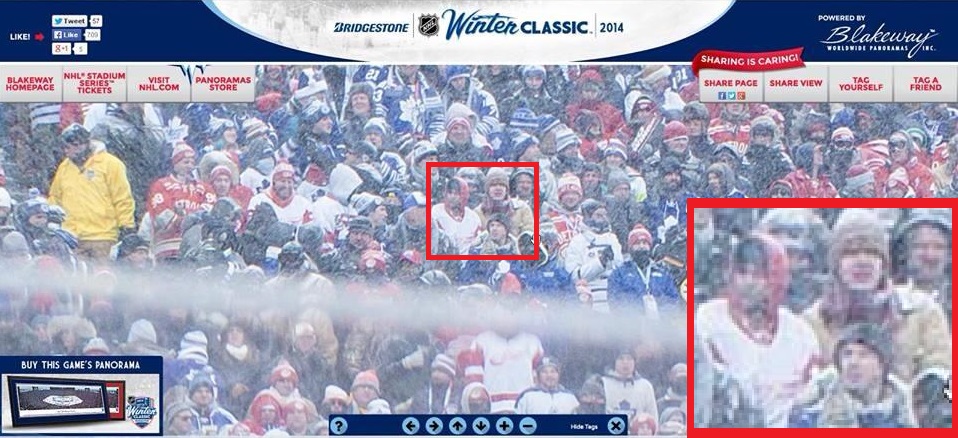
Tom and I were captured on the official HD Panorama. Don't we look excited to be out in the cold!

Tom and I were captured on the official HD Panorama. Don’t we look excited to be out in the cold!

Epic Fail: A Tale of Steven Tyler and His Terrible Thumbs

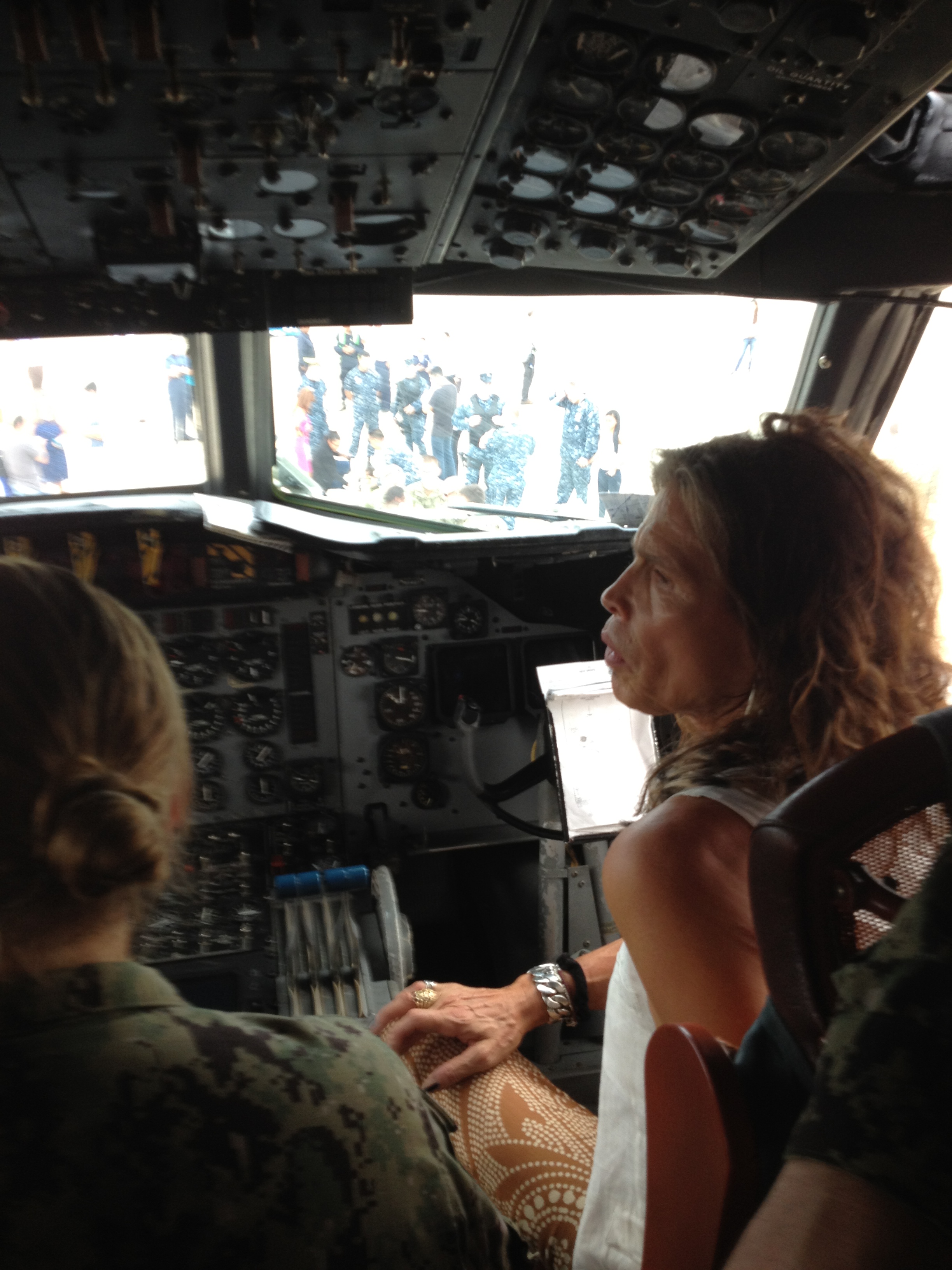
If the phrase “Epic Fail” was ever truly warranted for a situation (with the exception of Katy Perry lyrics of course), then it would have to be the time Steven Tyler of Aerosmith “fat fingered” the record button on my Apple iPhone.

I was finishing my final weeks of a six-month military deployment in El Salvador during the fall of 2013. I was stationed there to fly counter-drug operations as a Navy P-3 Orion pilot. Life on deployment was reduced to the bare essentials – eat, sleep, workout, guitar, video games, and a whole lotta of flying. In short, deployment basically ruled. This particular deployment, however, ruled even more when a band of rock ‘n roll legends showed up to my workplace.

I was lifting weights in the small on base gym, dubbed “The Boneyard”, when one of the other pilots asked me if I heard that Steven Tyler was visiting the base in two days. I of course had no idea, and immediately assumed he was pulling my chain since I had earned a reputation as a diehard lover of 80s music. He said he was serious and that he overheard base security talking about preparing for his arrival. Skeptical, I checked the tour list on the Aerosmith website and sure enough, Aerosmith had an upcoming concert date in downtown San Salvador in four days. My initial skepticism was dissolved when my brain connected this fact with the facts that 1.) Our base was attached to El Salvador International Airport and 2.) Steven Tyler is a complete publicity whore (meant in the nicest way possible). My pupils dilated and heart started racing – I was going to meet Aerosmith.

Giddy like a schoolgirl, I raced to Facebook to consult my two closest Aerosmith confidants – Micah and Justin Tiemeyer. I was introduced to #ProjectKaramazov when Justin requested that I record Steven Tyler reciting a passage from Dostoevsky’s The Brothers Karamazov. For any other celebrity I would of thought twice, but with Steven Tyler, the bizarre task actually seemed plausible.

In the two days leading up to the supposed visit, I noticed base security started to beef up. On the day prior to the Aerosmith concert, the base scheduled an unusually late “Quarters” (military version of a large scale meeting). Typically Quarters is held in the morning, so it was very unusual to have it so late in the day- but this only confirmed my expectation of the awesomeness that was about to unfold. It was a typical afternoon in El Salvador with grey skies and thunderstorms building in the distance. I show up at the hangar for Quarters in my flight suit and I notice some of the permanent staff had brought their wives and girlfriends. They all had lots of makeup and had their hair done up nicely. They basically looked like groupies. I could feel the rock concert aura already brewing. I was beginning to feel anxious. Would I even be capable of having a coherent conversation with the band? Would I be too overcome by reverence and awe to carry out the solemn task Justin had charged me with? My self-doubt was building with every passing minute…

Before I continue the story, let me take a moment to properly address the importance Aerosmith in my life. I was formally introduced to rock music at the age nine by an older neighborhood friend. It was 1994 and he gave me my first mixtape (an actual cassette tape) consisting mainly of Green Day and Offspring tracks. I listened to this mixtape guiltily in my bedroom because of all the swearing. I felt like such a rebel. I have many fond memories of going to his house and listening to tapes for hours, the likes of which included 90s greats such as REM, Bone Thugs-n-Harmony, Rage Against the Machine, and Cypress Hill. It was here that I had my first experience with Aerosmith when I listened to the tape with the cover of the weird dummy head pierced with nails – the “Livin On The Edge” single. I couldn’t remember the song, but I always remembered the crazy ass cover. It would be another four years (which seemed like an eternity) before I would discover Aerosmith in earnest. Every Thursday after school I would go to a church youth group with my best friend Micah. My friend Mike Burns from church offered to sell me his three Aerosmith CDs, Permenant Vacation, Pump, and Get a Grip. I had a strange falling out with music during the last year, mainly because I associated people I hated from Middle School with late 90s pop that played every day on the schoolbus (Aqua, Chumbawumba, Sugar Ray, etc). But it was when Micah wisely advised me to buy these Aerosmith CDs that my life changed forever. I spent hours and hours in my room listening through “Get a Grip”. I felt like a bona fide badass. I knew the words to every track. I felt enlightened and superior to all the posers groveling over pop music. I simply could not get over the power and rawness of Steven Tyler’s vocals and lyrics. The fire and venom behind the guitarwork of Joe Perry and Brad Whitford utterly blew my mind. Pop music in 1998 was shamefully bereft of proper rock ‘n roll, and Steven Tyler was like the angel Gabriel trumpeting me into musical heaven. Finally, music that made me feel cool. This music made me feel like I could conquer anything. These three Aerosmith albums planted the seed of rock ‘n roll in my soul, and I never looked back.

So fast forward to the military base in 2013. Aerosmith, in the flesh, casually strolls through the hangar door and my childhood heroes are standing before me. The band looked a lot shorter and more haggard than the photos, but Steven Tyler was in good spirits as always. He made a few opening statements thanking us for our service, and then the band split up and walked around to meet us. I knew that 90% of the crowd had only superficial knowledge and love for Aerosmith, but I on the other hand, understood them. Unmarried at the time, Tyler had his latest squeeze shadowing him everywhere- so rock ‘n roll! While my primary task was to talk to Tyler, I was personally far more interested in talking to lead guitarist and all-around-legend, Joe Perry. My heart racing at the sheer surreal-ness of what was happening, I find the courage to approach Joe Perry. He was answering some generic questions about his age and signing autographs when I clarified that he first played in The Jam Band in the 60s. Perry broke his stone face and cracked a smile at me- he immediately knew I was an actual fan. As a guitarhead myself, I went straight for the jugular and started talking guitars with Joe Perry. He told me about his first guitar (a Silvertone acoustic) and his preference for Marshall amps. I told him he should play Fender guitars more often, and he laughed and said he tries to play all his guitars equally. Steven Tyler clearly had the biggest crowd following him, so I expected a long wait before I could approach him.

IMG_1141

We all moved outside for a photo op with our P-3’s. “The Get Your Wings” references ran abound in my mind, and I desperately craved the presence of Micah and Justin to share this mind blowing experience with. After 30 minutes or so, the allure began to wear off and people started dissipating. I couldn’t fully comprehend why people wouldn’t want to spend every second in Aerosmith’s presence, but then I remembered that 99% of the crowd probably didn’t understand and love Aerosmith the way I did. I’m pretty sure half of my peers only knew Steven Tyler from either two things- the loud judge from American Idol or Liv Tyler’s dad. The band eventually requested a tour of our P-3 Orion airplanes and I, along with a handful of other crewmembers, happily obliged. I started with Brad Whitford who spoke quietly, but had a lot of genuine questions about the plane. What are all these holes in the bottom of the plane for? What’s that long phallic object protruding from the tail? I almost felt like I was explaining my plane to an old World War II vet (no offense to Whitford as he still has killer blues guitar chops that no one knows about). Having nothing else to autograph, I gave him a patch from my flight suit. I walked him up the ladder toward the inside of the plane. I met up with Tyler and Perry and showed them all the highlights from our ancient airplane. Whitford had fun playing around with the joysticks. Tyler and Perry sat down in the cockpit and started asking lots of questions. I had to keep pinching myself as my two great childhood dreams were fusing in perfect harmony – Aviation and Aerosmith – this was too perfect. The band whose albums I jammed to while playing flight simulator games on my computer were right here before me- in MY airplane. I desperately wanted to stop talking about my job and start talking details about Aerosmith, but Steven “loudmouth” Tyler kept getting distracted and asked too many questions about the cockpit. I was super surprised to discover Joe Perry was a pilot himself, having received his basic pilot’s license. Speaking in a quiet, monotone Boston accent, Joe told me about the time he almost crashed into a power line buzzing Steven Tyler’s Massachusetts home. He said he has a little over 25 hours flying little single engine planes and that he uses the same airport diagrams that we use in our P3’s. The Toxic Twins eventually exited the cockpit and I felt intimate enough with them to start asking about their music. “So, Steven I heard you were the one that wrote Seasons of Wither?” (one of my favs). He casually confirmed this and elaborated that he wrote it during a cold Boston winter on an old acoustic guitar Joey Kramer found in a dumpster. I giddily asked if they could play Seasons of Wither during their show tomorrow but I don’t think they heard me. I was beginning to feel like protagonist from Almost Famous.

IMG_1147

Aerosmith gathered by the main cabin door for one last photo op with the crew, which is when I found the nerve to ask Tyler to read the Karamazov excerpt. I told him it was for a fan project and I was terrified he would go all Prince on me and decline due to copyright reasons. Having seen and experienced all the weirdness of the 70s, 80s and 90s, there was not a request too weird for Steven Tyler. He didn’t talk back and acquiesced to my demand with a straight face as I handed him my iPhone. I told him to “just press the red button” and read the excerpt. I didn’t verify the recording until Aerosmith departed the tarmac in a long convoy of white minivans. It was then that I discovered the absence of the Karamazov recording, and a colossal wave of disappointment washed over me. I felt like Darth Vader at the end of Episode III – NOOOOOOO!!! I never found out why it didn’t record, but I suspected it was because Tyler either fat fingered the ‘record’ button, or pressed the OTHER button on the Voice Memos page. Epic fail.

Note for all future celebrity voice memo recording: PRESS THE RECORD BUTTON YOURSELF, prior to handing it over to the celeb. I eventually forgave myself for this failure, and had a blast at the concert the next day. The show was made even better when Joe Perry smacked my squadron’s sticker on his turquoise Strat and gave a shout out to the “47 Group”. No Seasons of Wither unfortunately, but a killer concert nonetheless. While I realize the unfortunate truth that Aerosmith has become irrelevant in this day and age, they can still play better, louder, and with more balls and swagger than bands 1/3 their age. Long live rock ‘n roll. Long live Aerosmith.

IMG_1165