Sunday Roundup: Party Philosophy, Petr Mrazek’s Fate, and Selma

It’s Sunday and it is time to catch up on the best the internet had to offer during the past week. If you have any article suggestions for the Sunday Roundup send me a tweet @tbone1225.

Andrew WK tweet of the week

https://twitter.com/AndrewWK/status/564369809476190208

Straight up zen!

You can never have too many goalies

“I’ve said in the past that Mrazek has done all that he can in the AHL. He has more than 50 wins and backstopped his team to a Calder Cup during the 2012-13 season. He has nothing left to prove at that level.” Tom Mitsos discusses goalie Petr Mrazek’s likely fate after head goalie Jimmy Howard returns in his article “Has Petr Mrazek Played His Way Onto Red Wings” at The Hockey Writers.

It’s a good time for social justice cinema

“It’s no laughing matter to see enslaved Black persons being beaten on the big screen. These social justice films are enjoyable, but I would not say that they are entirely pleasant experiences. We’re not talking about rom-coms here.” Rod Thomas of The Resist Daily shares his critical observations about the Ava Duvernay film Selma in an article titled “5 Takeaways from #Selma @SelmaMovie.”

Miracle: the Russian perspective

“[I]t was Tarasov’s love of the game and big-hearted nature that helped the Soviet Union players fall in love with the sport.” Tom Mitsos reviews ESPN’s new 30 for 30 hockey-umentary “Of Miracles and Men” for The Hockey Writers.

From Becky to Bechdel

https://twitter.com/Krinkle8/status/564714914263339008

Comedy gold.

Defense fails Mrazek in Red Wings loss to Penguins

“Mrazek most likely played his last game in Detroit for a while, now that both Howard and Jonas Gustavsson are healthy.” After a difficult loss to the Penguins, Tom Mitsos laments Petr Mrazek’s relatively short season as goaltender for the Red Wings in his article “3 Observations from Red Wings’ Loss to Pittsburgh” on The Hockey Writers.

The hypothetical cost of Kessel

“It’s a very solid lineup for sure. Kessel on the top line with Pavel Datsyuk and Justin Abdelkader is a dream lineup, and the possibility of Henrik Zetterberg taking Abdelkader’s spot on the wing only makes the line that more dangerous.” Tom Mitsos weighs the pros and cons of the Red Wings trading a big chunk of their roster for Toronto’s Phil Kessel in his article “Red Wings Hypothetical Trade: How Much for Kessel?” for The Hockey Writers. Special thanks to hockey analytics researcher David Malinowski for the prompt.

Goalie Tom McCollum on his time with the Red Wings

Tom Mitsos and The Hockey Writers interview Red Wings goalie prospect Tom McCollum about his short stint in Detroit, his continued presence with the Grand Rapids Griffins, and how he got into hockey in the first place.

Sunday Roundup: Croatia’s Jubilee, Hockey’s Biggest Coaching Foible, and To Kill a Mockingbird Sequel

It’s Sunday and it is time to catch up on the best the internet had to offer during the past week. If you have any article suggestions for the Sunday Roundup send me a tweet @tbone1225.

Red Wings need to work on their penalty kill

“When you already are down a man, chasing the puck is the worst sin you can commit on the penalty kill, especially if you are facing a team that is good at cycling the puck.” Despite a winning record, the Red Wings have had some serious problems shoring up their penalty kill. Tom Mitsos discusses ways the team can overcome this issue in his article “How to Fix the Red Wings’ Penalty Kill” for The Hockey Writers.

Croatia is just the latest in a long line of debt cancellation programs

“Whatever happens in this latest game of brinkmanship between creditors and debtors, history shows that mass debt write-offs are neither as rare nor as taboo as we might think.” From the early Jewish concept of the “Year of Jubilee” and the Babylonian Code of Hammurabi to post-war debt forgiveness plans in France, Greece, Italy and Germany, Telegraph writer Mehreen Khan explains how debt cancellation has been a central tenet of many of history’s greatest economic success stories. Check out Mehreen’s article “The biggest debt write-offs in the history of the world” and the book that inspired it titled This Time Is Different: Eight Centuries of Financial Folly by Carmen M. Reinhart and Kenneth S. Rogoff.

Seahawks decision to pass at the 1-yard line is NOT the biggest coaching foible of all time

After the Super Bowl, football fans were quick to label Pete Carroll’s fateful decision to pass instead of run the ball as the worst coaching mistake of all time, but to Tom Mitsos of The Hockey Writers that award goes to Soviet Union ice hockey coach Viktor Tikhonov who pulled goalie Vladislav Tretiak, who was touted as the best goalie in the world, resulting in a loss to the United States in the 1980 Olympics. “Tikhonov even admitted pulling Tretiak was the worst mistake he ever made, and no one knew Tretiak as an athlete better than Tikhonov.” For more, read Tom’s article “Bigger Coaching Gaff: Viktor Tikhonov or Pete Carroll?”

Harper Lee’s sequel to To Kill a Mockingbird

The internet was set ablaze following the discovery of a sequel to To Kill a Mockingbird written by Harper Lee. Comic writer Paul Cornell and Twitter wisdom curator Jon Winokur were among the many who took this to heart in their daily Tweets.

https://twitter.com/Paul_Cornell/status/562638341406216192

A great season for Darren Helm, Luke Glendening, Justin Abdelkader, and Kyle Quincey

While many Red Wings fans will attribute the team’s recent bout of success to Datsyuk, Zetterberg, Tatar, and Nyquist, their assault on the top spot in the Atlantic Division wouldn’t be possible without Michigan natives Luke Glendening, Justin Abdelkader, formerly injury-prone center Darren Helm, and Kyle Quincey, the defensemen that many fans last year would have been happy to get rid of. “When general manager Ken Holland re-signed Kyle Quincey to a two-year deal alst summer, it reeked of a panic move after he struck out on all of the free agent defensemen he was pursuing. However, Quincey has been one of the more consistent defensemen for the Red Wings this season.” Tom Mitsos breaks down the reasons to celebrate these four players in his article “4 Red Wings Having Surprisingly Good Seasons” at The Hockey Writers.

For the right price the Red Wings might welcome Toronto’s Cody Franson to Detroit

“In the end, the price has to be right for Franson, whether the Red Wings can get that price will decide whether they should pull the trigger or stand pat.” Tom Mitsos responds to trade deadline speculation that right-handed defenseman Cody Franson might be coming to Motown. While it is clear that Franson would be a great fit in Detroit, many fans are uncomfortable with the potential cost. Read Tom’s article “Red Wings Trade Talk: Is Cody Franson the Missing Piece?” featuring the expert testimony of The Hockey Writers Maple Leafs contributor James Tanner.

Expect a better second half of the season from Red Wings prospect Anthony Mantha

“[N]ow that [Mantha] has 35 games under his belt, he’s no doubt got a good grasp of what will and will not work at the AHL level.” Though 20-year-old junior league star Anthony Mantha has not been measuring up to the high expectations set for him this season, writer Tom Mitsos remains optimistic about his future as the 2014-15 season marches toward its conclusion. Check out his article “Anthony Mantha Determined to Have Better Second Half” at The Hockey Writers.

How cosplay is the great equalizer

Comic book writer Dan Slott decided to post an uplifting tweet on Saturday:

Dan Slott currently writes Amazing Spider-man and Silver Surfer for Marvel Comics.

Since I’ve Been Loving You 360

Led Zeppelin’s U.K. Tour in early 1973 marked a certain end of an era for their British fanbase.  This would be the last time you could catch a Zep show at a smaller intimate venue before their meteoric rise into a god-like stadium act.  The preceding two live installments of Since I’ve Been Loving You 360 were both stadium-era U.S. performances, but now we step back to the more humble, unpolished, small-time Zeppelin with a bootlegged Southampton University performance from January ’73.

Page impressively negotiates through the intro lickstorm despite a fairly vanilla, dry tone.  It even sounds like he throws in a rare fingertap @ 0:25! After a few loud guitar thrusts, Page goes unusually quiet – like so quiet you have raise a hand to hear.  Plant follows up with an unusually quiet, low-register vocal, accompanied by a barely-audible Jones and Page. I expected something loud, dense, and wet with delays and compressed overdrives – but I begin to relax as the performance makes me feel like I’m at a local Texas dive, bathed in second-hand smoke while stepping on spent cans of Lonestar.  The nakedness of the performance has a satisfying sincerity to it.  Page’s tone is pure unadulterated Gibson crunch, and you can practically hear the saturated tube buzz on his Orange Matamp in the background.

A stiff Plant starts to really loosen up on the second verse as he cries out “E’ry body tryin tell me, tell me, tell me, that you did me no good, no no no no no, oh darling, darling, darling!” – you can literally hear Plant run out of breath as he croaks out the last “darling” @ 2:45.  Page seems to fall asleep at this part as he lazily slides up and down the fretboard as he responds to Plant (a point where he usually does a violent tremolo pick).  Page concludes the second verse with a really soulful croon “I been a-workin been a-workin from seven to eleven every night, ooooh!” @3:00, once again illustrating how Plant never sings the same way twice.

Just before the guitar solo @ 3:35, Plant clarifies that he’s about to lose his “worried mind” for only five minutes, which is the second instance of this.  I am curious to know when/where Plant stopped providing this 5-minute clarification since it is not apparent by The Song Remains The Same performance in Madison Square Garden.

Page kicks off the solo as if half-asleep as he kind of pukes up a bunch of trashy riffs accompanied by some occasional open string buzz.  He wakes up about 30 seconds in and starts to crank out some of those calculated riffs we start hearing by the more polished American tour in late ’73.

The rest of the song is fairly textbook. The band delivers a cohesive performance which is much improved from a relatively sterile opening.  Now keep in mind Zeppelin were still warming up to that familiar big-time arena sound we know and love from The Song Remains The Same and How The West Was Won.  While the performance and the sound quality are obviously weaker, this early bootleg is packed with lovely intimate details such as mic feedback, string buzz, and even some voice cracks from Plant. You can even hear the band introduce a very early version of “Dancing Days” at the very end.

The next round we’ll cover another small-venue U.K. performance from Stoke ’73.  Stay tuned!

The Paulding Light of Ontonagon County, Michigan

We live in the flicker — may it last as long as the old earth keeps rolling! But darkness was here yesterday.
– Joseph Conrad

This kind of mystery is like a source, a gas or kerosene lamp, a gas-powered or hand-crank electric generator. It gives birth to stories, powers them.
 Ander Monson

In case you can’t read the baby blue spraypaint, it reads “PAULDING LIGHT”


My descent into the unknown loosely resembled a family vacation. Driving North, our first stop was Cadillac, where we visited a quaint gaming shop called Wargames North and Amy got an eight-sided di (a D8, for the initiated) from a gumball machine. From there we cut East toward Higgins Lake. Circling the pristine waters, Amy told me stories about spending time at her grandparents’ cottage and her brother’s four-wheeler antics. The sun went down while we walked around Mackinaw City at the top of the lower peninsula. We peaked through the window at Amy’s great uncle’s bakery. It was closed by the time we got there. On the way back we would stop by the shop and pick up donuts, but the ants would get to them before we could. That evening we checked in to a cabin just on the other side of the Mackinac Bridge that had looked awesome four years earlier when we’d come that way before, but which was, in fact, nasty.

The ultimate destination of this trip was a spot in Ontoganon County where one can witness a mysterious phenomenon called the Paulding Light, but Amy didn’t know that yet. (Those of you who have already read my previous #ParanormalActivities post might think our destination was actually The Humongous Fungus of Iron County, Michiganbut that was always intended to be an interesting side trip on the way to see the light.) When I first had the idea weeks earlier all I said to Amy was, “Don’t make any plans for the weekend of the Fourth.” When she asked me why, I simply said, “It’s a surprise,” and she was satisfied. Surprises, like sunshine and movement, are a kind of currency with Amy.

I had first heard of the Paulding Light in a book titled Other Electricities: Stories by Michigan author Ander Monson. (After re-reading the book, I realize that Monson also made references to the humongous fungus in his book. Oh, the sources of my intrigue!) In the early 2000s I was lucky to be enrolled in the first Creative Writing class Monson taught at Grand Valley State University in Allendale. I was also among the few he invited to celebrate the end of his tenure there by singing karaoke at a frightening dive bar on the west side of Grand Rapids. In-between, Monson became the single most influential figure in my pursuit of a career in writing. (I am currently in transit. Wish me luck.) The following passage from the short story that this volume derived its name from was the marble that set off a long and complicated Rube Goldberg mechanism that would eventually bring me into the presence of the mysterious glow itself:

One night while he was up top, we took the car. He didn’t notice.

I drove it, gassed it up; we took it down to Paulding, Michigan, home of the Paulding Light. Which is not a light exactly. Nor anything exactly. It has no power source, no explanation, no obvious cause. It is not a hoax. It made Unsolved Mysteries one year. We watched it on tape a while after it aired, copied from someone who had recorded it from TV.

You go down this road and turn your lights out. You can only drive so far. Several miles down the path along the power lines into the distance — as far as an eye can follow — lights appear and seem to roll back and forth. My brother had never been there before. This was another electricity, I told him. Watch that thing.

I’m sad to say that it took me nearly a decade to finally set out on this path, but the wait had its up side. I was engaged to a beautiful woman that I would marry the following September and we were repeating the first trip that we ever took together. In 2010, we had attempted to make it all the way to the light, but some barrier had stopped us, adding drag like an object approaching the speed of light. We started something four years ago, and for some reason it felt like we needed to finish it before we could get married, so on the morning of July the fourth we left the nasty cabin and continued on our way.

When we reached Manistique cutting West into the Upper Peninsula, I pulled over at a McDonalds. As Amy ran inside to find the restroom, I used the momentary spike of wireless internet reception in order to investigate where I needed to go to find the Paulding Light and what I should expect. Also known as the “Dog Meadow Light” or the “Lights of Paulding,” the mysterious spectral phenomenon was found outside of Paulding near Watersmeet off US 45 on Robins Pond Road / Old US 45. The purported first sighting was in 1966, when a group of teenagers dragged the sheriff down to watch the light dancing along the power lines. People over the years thought this shining light was the ghost of a railroad brakeman walking along, lantern in hand, or the spirit of a slain mail carrier or dancing Indian. It was described as strange geologic activity or swamp gas, but for years the phenomenon remained unexplained, until 2010, that is.

I felt the contents of my intestines shift. I didn’t want to go on reading any further. I had spent a decade working up to this moment, and for nearly half of that time my unexplained guiding light had been revealed as something mundane, something ordinary. The same year Amy and I met and made our first attempt to visit the light, a group of students from the Michigan Tech chapter of the Society of Photo-Optical Instrumentation Engineers (SPIE) lead by then PhD candidate Jeremy Bos pointed a telescope directly into the light and learned its secrets. That thing, that object-of-sorts, glowing and pulsating, the one that drove me into the mysterious north, was no more curious than headlights passing by on US-45. The Paulding Light was a hoax, and I’d wasted our only vacation weekend hoping to see headlights like some big, dumb deer in the middle of the road.

I had invested a full day, a couple tanks of gas, two or three meals, and a whole lot of expectation into this trip, and the stubborn guy that I am, I was not about to turn around. After all, Amy didn’t know that the Paulding Light was a hoax. She didn’t even know we were heading off to see the Paulding Light. She deduced the latter a little before we got to Iron County and I spilled the beans about the former to her in a hotel in Eagle River, Wisconsin nearly an hour south of Paulding. (It was strangely difficult to find a hotel in a small, barely-on-the-map town in Michigan’s Upper Peninsula during possibly the busiest tourism weekend of the year when you haven’t made reservations.)

Finding the viewing site at the end of Robbins Pond Road was easy enough. At the end of the road there was a tattered guard rail with the words “PAULDING LIGHT” spray painted upon it. When we arrived that evening there was already a gathering of people who had shown up before us. An elderly woman explained the phenomenon, and by phenomenon I mean the fact that dozens of people show up nearly every evening to see a flickering light in the distance even after it was proven to be the headlights of a car. She was thoughtful and kind, if a bit skeptical. Her children and grandchildren joined her that night because they were up for Independence Day and the youngest had never seen the light. For the sake of ease of communication, I will call her Jackie. I’ve worked as a part-time news reporter for over two years and I still haven’t acquired the knack for asking and remembering the names of interview subjects. She looked like a Jackie.

The other woman, Jackie’s foil, was more of a Laurie. Her minivan was backed right up to the guard rail, and she hung out just just inside with insect spray, cameras, and clothing for all weather, clearly a Paulding Light veteran. Laurie claimed that she had been studying the light with a physicist for the past fifteen years. Each word she croaked out with great difficulty and sometimes she couldn’t get a sentence out without coughing excessively. She smoked cigarettes, even in the face of the obvious signs of impending emphysema and possible lung cancer.

“A lot of it has to do with energy fields and portals,” Laurie explained to Jackie’s inquisitive daughter.

“And ghosts?” the daughter sarcastically suggested.

“Uh, yeah!” said Laurie, as if nothing could be more obvious.

Laurie must have read a different article as I had, because according to her the true story was that the expedition of Northern Michigan students had been thrown to the ground by the paranormal force associated with the light. As for their conclusions, Laurie had what I can only explain as a Taoist response. For the followers of the Tao in ancient China, the “tao” (way, path, truth, …, there is virtually no limit to the interpretations offered for this single Chinese character) that can be spoken of is not the eternal tao. So also for Laurie, who believed that the headlights spoken of by the SPIE members at NMU were not the true Paulding Light. Rather, the true Paulding Light, in one of its many incarnations, presents itself as the energy field which magnifies the headlights of automobiles passing by.

“How do you know if it’s the real thing?” Jackie’s daughter asked, her sincerity clearly suspect at this point.

“Because the real thing will come flying up here in 30 seconds or less.”

The thought was chilling.

While Jackie’s daughter engaged Laurie in conversation, Jackie described the Paulding Light to us in what seemed a much more reasonable way. I couldn’t help but wonder if Jackie were attempting to fight off the notion that Yoopers (those hailing from the Upper Peninsula) are all wacky conspiracy nuts.

“You can look it up on the computer too,” she said about the light. “It’s interesting.”

This is where Laurie interjected disapprovingly: “Yeah, there’s a lot of CRAP on the computer too.”

As the sun set, the Paulding Light arrived exactly where it had been described. The power lines drew the eye to a break in the trees, and there flickered a light, sometimes bright, sometimes dim, changing from one color to another at times. It was really something to behold. It didn’t dart this way and that, and it certainly didn’t ride the power lines all the way up to us. It was exciting and new for a little while.

Amy and I were covered in insect repellent. It was Amy’s idea. She’s the thoughtful one. She’s also the one who has difficulty standing in one place for too long, and the sound of the mosquitoes buzzing all around her, even though they weren’t landing on her, seemed too much for her. We had seen everything that we were going to see, but I felt the need to stay. I knew what we were looking at, one set of headlights after another, but for some reason I believed that the true Paulding Light, the one that couldn’t be explained away with words or optics, might come down upon us. I wanted my encounter with the real. I wanted to be swept away.

Laurie was showing a blurry picture of a bright light. It didn’t look like anything at all, but to her it was proof that there was something else going on here.

“By the time it got up here it was so huge it couldn’t even fit in the camera,” she said.

Amy was a good sport. I would have stayed all night if I were a young man without attachments, but Amy convinced me that we should go back to the hotel. After dragging my feet for well over an hour, I obliged.

Reflecting upon Laurie and how much she had bought into the local legend, I was reminded of something I read in the article about the Michigan Tech students who myth busted the light. It was a quote from Jeremy Bos:

We’ve been told we haven’t seen the real Paulding Light. I’ve been out there 15 times, hours at a time, in the heat, in the cold, and the rain. It’s always the same. We were out there Monday with a man who saw the headlights on our computer, and he refused to believe it… No matter what, some people will believe what they want to believe.

I can understand how someone like Laurie comes to be, how one can need the mystery beyond the explanation. Amy was sensitive to my disappointment even though I was too stubborn to admit it. I went on about how people explain UFOs away as swamp gas or weather balloons, but that I would be amazed to see swamp gas, to watch the methane belched from the churning muck only to catch flame and singe the overhanging branches. As for the Paulding Light, I noted the SPIE team’s suggestion that heat rising off of the pavement and the existence of an inversion layer in the atmosphere may have caused the distortion of those headlights. I wanted to believe that Mother Nature’s sleight of hand was enough and that I was satisfied, but I wasn’t. I wanted to park my van there nightly and be the one to watch the Paulding Light without end, waiting for the moment it slips up and shows its true colors, but that wasn’t me. I was the guy who was getting married in a couple of months and who was already practiced at spitting out explanations for strange noises in the night before I’d ever even considered honestly their sources. I was the guy who closed doors and made them safe when once I was the one who peaked through the doors that were open just a crack, hoping to see a fleeting image of the sublime.

We straddle the gap between the magical and the scientific. Perhaps humanity has always done so, but it seems so much more true for our generation. Famed author Arthur C. Clarke’s third law said it best — “Any sufficiently advanced technology is indistinguishable from magic” — and yet we find ourselves ousting the “man behind the curtain” on what seems like an everyday basis. The planets are not gods, but other bodies floating in space much like the earth. The rain comes or doesn’t come regardless of our dances. We know the exact speed at which light travels. We know how to break it down to its component colors. We even understand how to use those colors to detect the presence of elements in distant bodies. But there are many things that we don’t know.

Things that we don’t know yet.

The paranormal seems, to me, to be that gap. Impossible things happen every single day, but nobody is the wiser as to their origins, and yet the moment that even one of us comes into contact with the impossible we begin to bridge the gap. Many people have similar experiences and they begin to share this information, and before long not only do we have provisional answers, but we have an entire community brought together by this phenomenon. Laurie and Jackie may have appeared as twin goddesses, each opposed to the other, but each of them had a tradition of coming out to this particular site and staring off in the same direction. They are part of the crackling energy caused from the conversion of quandary to facts and vice versa. They keep the world rotating, keep it interesting.

As for me, I am going to keep seeking out the paranormal. I am the type to track, catalogue and categorize, to name and to bring light to, but at the end of the day I just want my breath taken away.

And in case you were wondering, Amy and I will not be going to Loch Ness for our honeymoon.

Campaign Stories: Wiliken 21

The githzerai’s consciousness hovered over a field. In one direction, he saw many tracks spanning a great distance. In the other direction, the same. The first set of tracks lead to the city of Alhaster, the second to New Doraka – the location that was once occupied by the Shining City.

Curious, Wiliken thought, and the word echoed all around him. At first he was frightened, but then he realized that he was not truly hovering above the land. He was merely encapsulating the world within his mind. He cleared his thoughts and continued.

It was disturbing to look down upon himself, sitting cross-legged in the middle of an open field, guarded by people who had, not too long ago, assisted in his imprisonment. Those who had known Jenkins for some time had explained that his teleportation circles were never pin-point in their accuracy, and that was why his consciousness was climbing, climbing. He had a subtle feeling for the portal that they were looking for. It struck him like a dull pain in his head. Unfortunately, he could neither see it nor find where it was.

Wiliken rotated the landscape in his mind. Perhaps a different perspective on the matter would afford him a clearer vision. The githzerai was surprised at how easy it was to manipulate this universe with his newly found abilities. He was disturbed at the possibilities. Everything was much simpler when he was merely an archer. Wiliken could not remember much about that time, but it couldn’t have been more challenging than the last few months of his life.

As Wiliken reflected on the recent loss of his wife at the hands of his own son, his hold on the universe in his head weakened. What he had once rotated and phased through with relative ease had begun to spin out of control. In a world of thought, metaphors become literal fact, a truth that the githzerai had learned the hard way. As he crashed to the astral earth, he found that the world had darkened. Disoriented, the githzerai looked to the sky. His gaze was met by two flaming celestial eyes. Not a pair of eyes, but rather two distinct eyes from two distinct individuals.

What could this mean? The thought thundered about him, and he immediately knew the answer. Someone is scrying us, scrying us, scrying us, the words pounded down. Two separate parties. Two different purposes. The words hurt his ears, or rather his mind. Wiliken began to run in a feeble attempt to escape the purview of these other minds. As he did, a wind began to pick up, and before long it was pushing upon him, directing him, sweeping him – EAST, it was pushing him EAST. EAST, toward the portal!

Wiliken opened his eyes, certain of the location of the portal. When the party arrived, the object of their quest looked like little more than a knife wound, but a knife wound in reality was nothing to scoff at.

“This is where the creature came from,” Jean-Baptiste said as he pondered the gash.

“Then that is where we are going,” said Ugarth the Orc King of Nothing.

There was a crackling energy about the gash. Fearing nothing save perhaps his memories, Ugarth was the first to step through the portal. Grace followed, and Jean-Baptiste. Finally, Wiliken stepped through the slimy plasm between worlds and found himself in a formless void, standing on a pebbled oddity, with no clue as to what he would find.

Campaign Stories continues in Wiliken 22.

Since I’ve Been Loving You 360

Recorded in 1973, How The West Was Won (Atlantic) was released as a triple-album compilation of two back-to-back Led Zeppelin performances in Los Angeles. The album marks an important beginning of what has become a very long list of live Zeppelin bootlegs. In fact, How The West Was Won is little more than just a professionally mixed and mastered collection of bootlegged recordings owned by Jimi Page himself.

“Since I’ve Been Loving You” starts out as expected with Page’s classic four note intro- but what follows bears little resemblance to the more widely known studio and Song Remains The Same versions. As if bored or short on ideas, Page immediately starts out with some fast riffing- a hybrid cross between impromptu doodling and elements from his proper solo in the middle. I love how you can still hear open string buzz on Page’s playing- just a warm reminder that he is indeed mortal (or perhaps his guitar tech just set the strings too high). Despite it only being the song’s beginning, Page immediately starts cranking out those flashy-sloppy riffs of his. This throws me off at first, but I gradually start to dig it. Instead of unleashing the usual fiery torrents of minor pentatonic blues riffs, Page actually begins to delve into the major scale-which, whether intentional or accidental, provides the song with a lighter, more casual sound.

Robert Plant has a really great way of never singing the same two lyrics ever the same, and this version definitely proves that. This version is rife with little improvisations- “Plantisms”- into so many of his classic vocals. He’s sure to squeeze in a “have mercy I did what I could, yeah” just because he can. There are several really novel and funny call-and-response moments between Plant and Page, such as at 2:45 when Page croons, “I said I tried…oh…ow…OWW, I really tried to do the best I could”.  It sounds like Page is literally slapping Plant on the ass with guitar riffs! Plant also has a really great Prince moment in the way he shrieks that second “OW”. This is followed by, “working from seven, seven, seven, seven, seven, seven, seven to eleven every night” where Page dutifully accompanies Plant with repeated double-stop blues bends. I don’t even think Jagger and Richards ever had such a synergy on stage! Another favorite Plantism occurs at 3:24 when Plant sarcastically sings, “oh baby baby baby baby baby baby baby baby baby”, which sounds more appropriate in a Broadway Rockette number than a greasy rock show.

Page’s solo is actually fairly similar to the previous two versions I reviewed. This is not wildly surprising considering The Song Remains the Same performance was filmed only months earlier. His sound quality and tone is thinner, but still impressive for being little more than a re-engineered bootleg.  Page starts throwing in subtle major and chromatic scale runs rather than his familiar minor pentatonic fireballing. The solo is cleanly played, but notably more improvised, unrehearsed and confused than his earlier performances.

Jimmy Page once said How The West Was Won captured Led Zeppelin at their “artistic peak”- which is a pretty titanic statement.  Having listened through the album only once or twice, I can neither confirm nor deny Page’s assessment.  I think he’s probably right, but Page’s statement will serve as benchmark for my continued research. I still think The Song Remains the Same is a stronger display of both Zeppelin’s performance and sound, but I realize my opinion is biased due to being religiously familiar with The Song Remains the Same, and the fact that the album was professionally recorded and edited unlike How The West Was Won.

Stay tuned for the next installment where I review a real bootleg of Zepp’s performance at Southampton University (1973).

The Humongous Fungus of Iron County, Michigan

A whale is a whale, with flippers and tail, but the Michigan mat just spreads.
Stephen Jay Gould

Do I contradict myself?
Very well then I contradict myself,
(I am large, I contain multitudes.)
– Walt Whitman

I don’t remember ever learning about the largest organism on the planet in any of my science classes. I do, however, remember playing Nintendo with my brother Micah and my Uncle Paul every Sunday after church while my parents had coffee and windmill cookies with my grandma, and every time Mario would fall into an abyss or accidentally bump into one of those oh-so-dangerous Goombas we would compare the magnitude of our grief to the size of large animals. It wasn’t enough to simply say, “That sucks.” You had to say, “That sucks donkey,” then, in the spirit of oneupmanship, someone else would say, “That sucks elephant.” This would continue until we reached “blue whale,” at which point Uncle Paul would cap off the disappointment by saying, “That sucks mother blue whale.” The female Balaenoptera musculus – blue whale – is the largest animal, land, sea, or sky, but to find the largest organism on Earth I would have to look somewhere else entirely. It would not be enough to limit my search to animals only. For this journey, I would have to delve into the depths of Kingdom Fungi.

However many times Mario died – a rate that went up exponentially as soon as the controller switched to my hands – we were never so forlorn as to say “That sucks humongous fungus,” and yet this it the name the people of Crystal Falls, Michigan have given to the Armillaria gallica (formerly Armillaria bulbosa) fungus they claim to be the largest organism in the world. According to the Crystal Falls home page there is one particular fungus found locally that covers 38 acres, is somewhere between 1500 and 10,000 years old, and weighs as much as a mother blue whale – approximately 100 tons. While most of this organism’s body is located underground in an enormous system of interconnected shoots and masses, it can be seen above the surface in the form of small honey mushroom toadstools which are described not only as edible, but fairly tasty as well.

Aside from its estimated weight the Humongous Fungus has one other thing in common with the largest animal on the planet – both are whales. The main difference between the two is that one is a blue whale whereas the fungus is a white whale, my white whale. After all, I’d been searching for this creature (assuming the term “creature” even applies outside of Kingdom Animalia) for the past four years, since Amy and I took our first vacation together into Michigan’s upper peninsula a couple of weeks after we first met. Though the Crystal Falls home page had painted a picture of a mushroom-obsessed small town with toadstool roofs and quirky fungus memorabilia at every diner, the city that we rolled into that Friday afternoon showed no sign of mushroom pride, not a single ounce.

To give the people of Crystal Falls the benefit of the doubt I should probably explain that we arrived there on the Fourth of July and, if I’d inferred correctly from the attendant at the BP, everyone was relaxing and enjoying the Independence Day festivities in the nearby town of Alpha. Even so, I expected at least one sign on Highway 2 advertising the Humongous Fungus that comprises so much of the town’s web presence. I compared Crystal Falls to the city of Mesick in Michigan’s lower peninsula, a small seasonal vacation town I’d driven through often on the way to Empire Beach or Crystal Lake in nearby Frankfort. Though the fungus in Mesick is nowhere near as massive as the Humongous Fungus of Crystal Falls fame, their streets are lined with mushroom advertisements. Of course, the morel mushrooms of Mesick are much easier to capitalize upon than the giant supposed to lurk below the surface of Crystal Falls. In Mesick, (HYPERBOLE ALERT!!!) you couldn’t fire off a bottle rocket without hitting some sort of mushroom representation, but Crystal Falls was different. We’d have to work to learn the secrets of that town.

Looking closer at the town’s web site, I noticed several clues that I had previously overlooked. The Humongous Fungus was located underneath the Iron County forest near the Wisconsin border, not specifically under Crystal Falls. In fact, the majority of its mass was claimed to be located in nearby Mastodon Township. The web site was brutally honest in saying that “[p]eople are generally disappointed if they actually go to the site looking for the big mushroom.” The information that we read was enough to deter anyone from searching for the Humongous Fungus, but I was a man possessed. Instead of focusing on how my nemesis was located mostly underground, only visible as tiny mushrooms that appear predominantly in the fall, I focused on the word “site.” Where was this site and how could I get there? Amy had located a web site which claimed that the natural wonder could be viewed at the base of a waterfall. There were many nearby waterfalls, but there was no one waterfall that clearly served as the namesake for Crystal Falls. We could have spent the entire weekend disobeying the wisdom of T-Boz, Left Eye, and Chilli, but I had another idea in mind – we would enlist the assistance of one of the locals, the woman at the BP, or, as far as I experienced, the only living soul in Crystal Falls.

I walked into the BP with a friendly smile on my face despite my frustration and said, “Hi. I’m visiting from out of town and I was wondering if you could direct me to the Humongous Fungus.”

Nothing. The woman behind the counter was a brick wall (not literally).

“The giant mushroom that lives beneath Crystal Falls,” I said, attempting to jog her memory. “I read that the town throws a yearly festival in its honor…”

“I don’t know anything about a humongous fungus,” she said. “But if you’re looking for the Fourth festivities those are going on over in Alpha.”

Another dead end. It looked as if I would need to start a new line of questions.

“Could you point me in the direction of Mastodon?” I asked. “I can’t seem to find it on the map.”

“Mastodon’s just south of town on the 2,” she said. The route she described was the same route Amy and I had taken to get to Crystal Falls, and I didn’t remember seeing any town called Mastodon on the way there.

“Any landmarks I should look for?” I asked.

The BP attendant put her hands on her hips and thought about this one. In fact, she thought for an uncomfortably long time. I didn’t feel like I was asking too much of her. I just wanted her to think of the next town over and picture a restaurant or church of even a rival gas station, anything that could help me not to drive right by Mastodon for the second time that trip, but she gave me nothing.

“It’s gotta be between here and the Wisconsin border, right?” I asked.

“Yes,” she said. “If you get to Wisconsin you’ve gone too far.”

The woman grinned, confident that nothing was lacking in her directions. I was not quite so assured, but I knew I wouldn’t be getting any more help.

“One last question,” I said. “Do you know of any waterfalls down that way?”

“Yes,” she said. “Head out back of the airport. Should be some falls over there.”

Though the gas station attendant had been less than informative, she’d given us our strongest lead as to where we might find the Humongous Fungus. Driving South toward Mastodon, I found my eyes drifting to the grassy areas on either side of the road in hopes that I might espy a little patch of mushrooms. After some time we rolled past Mastodon Township Offices, a decent sized building with a couple utility trucks parked out front. From there we were able to get Google directions to the Iron County airport, a tiny airfield down a poorly labelled dirt logging road, and one small leap of faith later we were parked at a trail-head with the sound of fast-moving water just ahead.

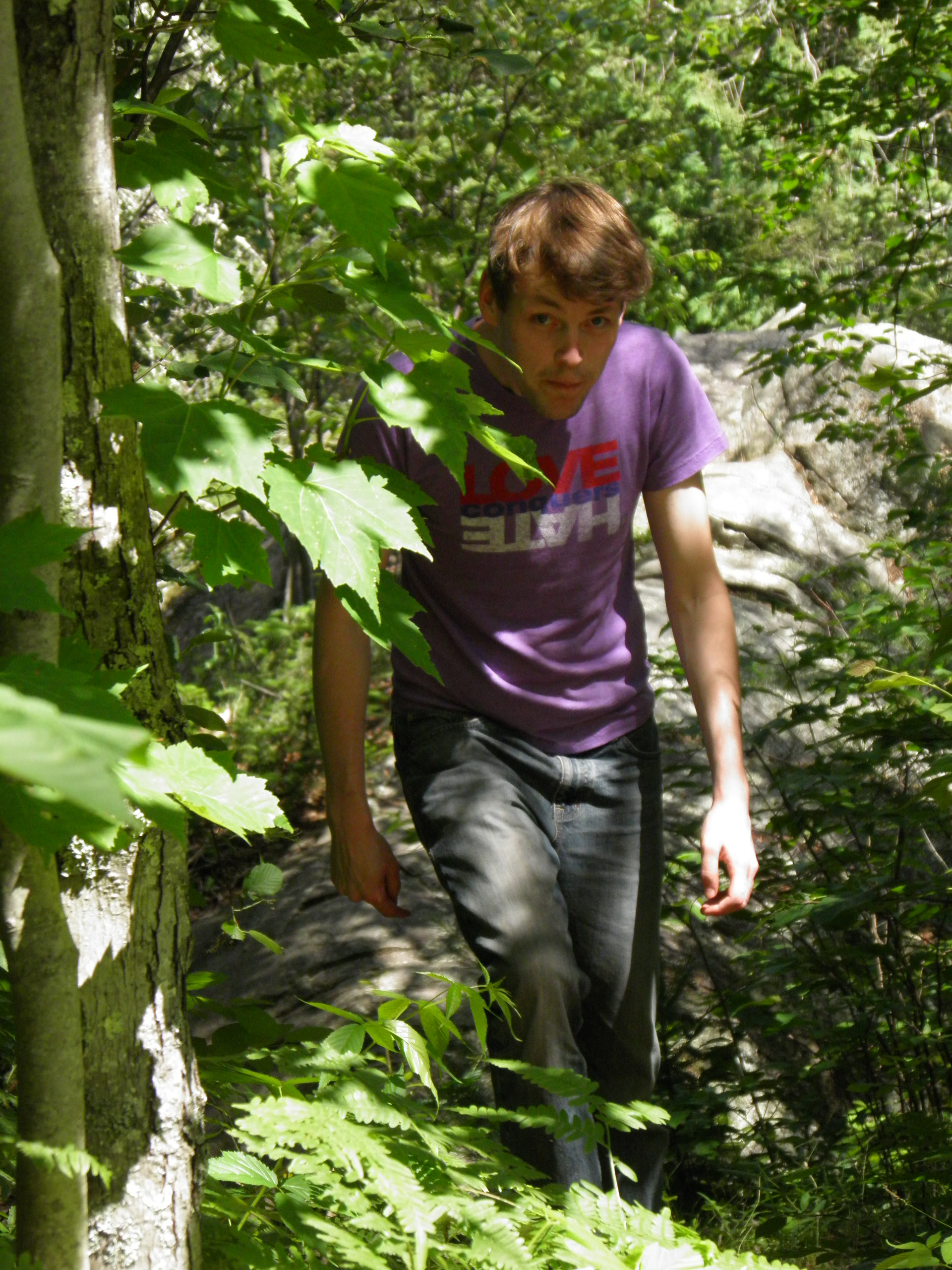
Up until this point Amy had been a little bit of a stick in the mud, and I couldn’t blame her. She hated riding in cars and I’d trapped her inside of one for a good portion of two days, and when we finally arrived in Crystal Falls I didn’t even know where to begin looking for the giant mushroom I’d been bragging about since she first met me. But when she found out this wild goose chase involved hiking through some of the most majestic scenery in the state, Amy was fully invested. I basked in the serendipity of the fact that I had accidentally brought geology major Amy into an ecosystem constructed on and around a gigantic iron slab. In fact, Amy’s professor had even referenced the township of Mastodon in one of her classes, noting that there has never been a mastodon fossil recovered there.

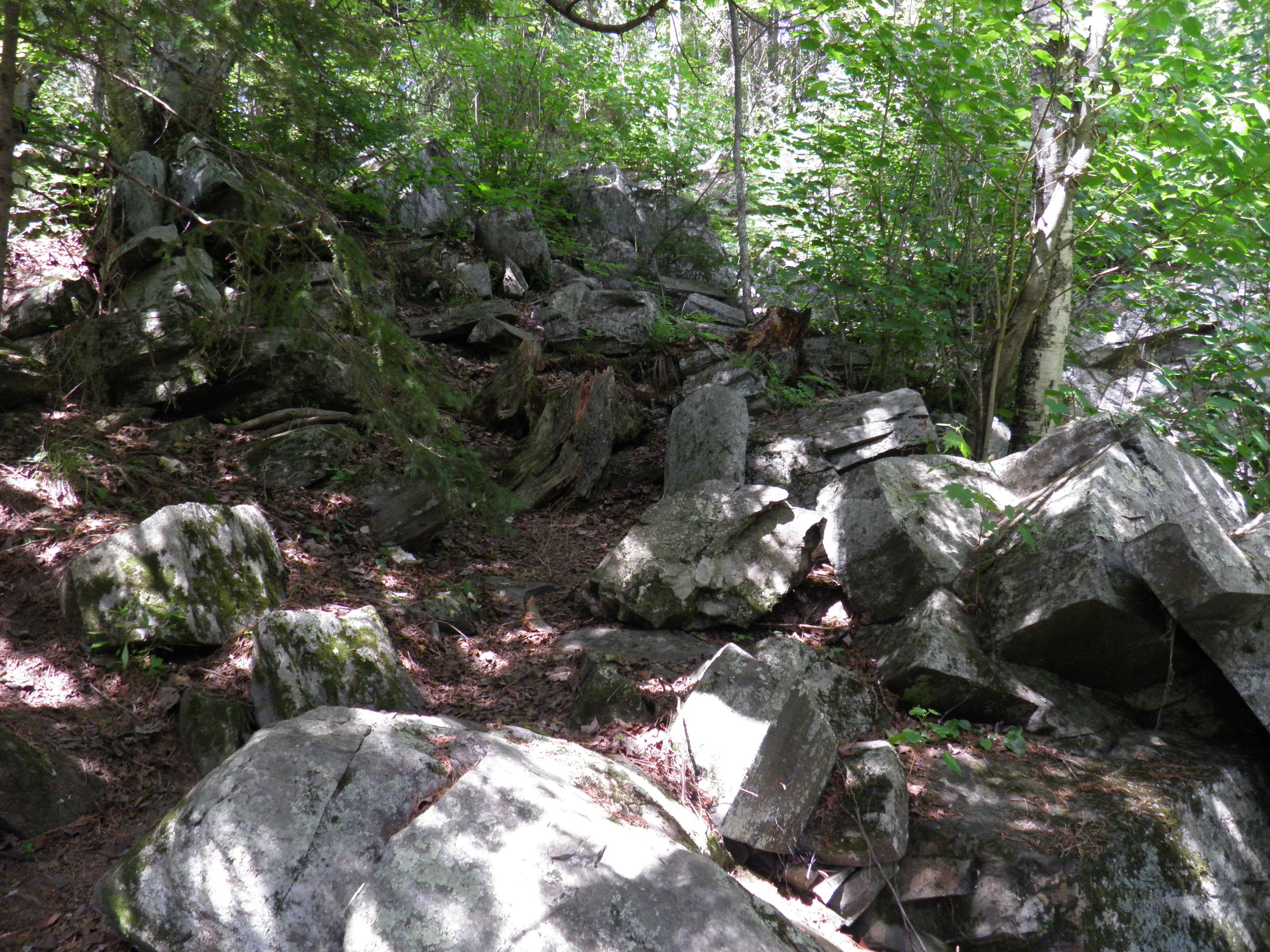
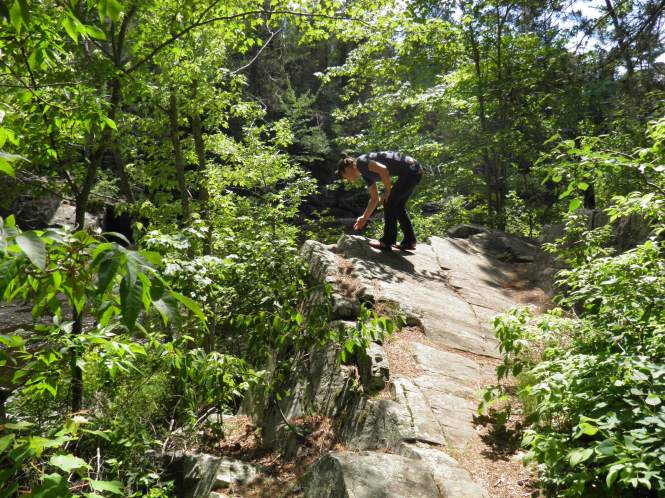
A few yards down the path it became clear that what the woman at the BP had described as a waterfall was actually just a rapid. I tried my best to disguise my disappointment as Amy had the time of her life climbing up onto towering boulders, navigating twisting and turning paths, and pointing out mineral deposits and fun examples of geological principles, and it ended up working to my advantage.

OLYMPUS DIGITAL CAMERA

OLYMPUS DIGITAL CAMERA

OLYMPUS DIGITAL CAMERA

OLYMPUS DIGITAL CAMERA

OLYMPUS DIGITAL CAMERA

OLYMPUS DIGITAL CAMERA

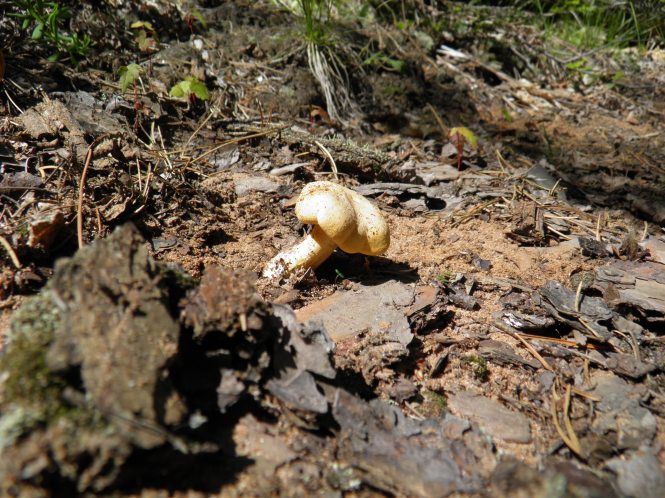
In her excitement, Amy was the first one to find a mushroom, a little thing nearly hidden by an exposed root but elucidated by a shaft of light that pierced the tree cover. We ended up encountering three mushrooms total on our trip to find the Humongous Fungus.

OLYMPUS DIGITAL CAMERA

OLYMPUS DIGITAL CAMERA

OLYMPUS DIGITAL CAMERA

After sending photographs of my findings to the Western Montana Mycological Association, I received the following response:

hi Justin, it will help if we can see clear pictures of the cap, stem, and underside of the mushrooms. Sorry but not able to ID from these pics

As I compared the mushrooms I saw in Iron County with the sample images of Armillaria gallica on a variety of mycological web sites I had this sinking feeling that none of the three toadstools I saw were the toadstools I was looking for. It made me sad for a little bit, but ultimately I came out of the malaise with a higher outlook on the subject. When we had driven through the forest and seen the acres of trees cut down for logging purposes, the humongous fungus had been in those trees, eating away at the stumps. As we hiked through the iron hillside the fungus had been there, and it had been everywhere else, because where can’t a species live that can grow even in the nutrient-poor areas between large food sources. Though I never witnessed the invisible hyphae, once I got to the rapids I was never not surrounded by them.

The question was no longer whether or not I had experienced the humongous fungus. It now came down to whether or not the humongous fungus is paranormal.

Amy and I took a walk some weeks after this experience as I was preparing to write this post, and I asked her point blank what it means to be paranormal. She said, “It has to be unexplained phenomena.” I then asked her if she thought the humongous fungus was paranormal and she said no. It may have been paranormal at some point, but as soon as the scientific team of Smith, Bruhn, and Smith investigated the phenomenon and exposed it to the public it was no longer paranormal. This was Amy’s thought, at least, and it is a thought supported by most people. All the same, her answer felt unsatisfactory. For me there was something much deeper to the humongous fungus than what we knew. Armillaria gallica had been detected in soil samples, but its greater existence had only been inferred. Nobody had ever experienced the entirety of this individual clone, and to my knowledge there is no scientific method in existence yet that can discern the whole without the use of inference. Furthermore, were there a break in the hyphae connecting the entire organism as there must have been when the scientists took the soil samples, would the living cells still be considered part of one organism? Could I take a cubic meter of the fungus home with me and still consider both discrete entities the same organism?

Stephen Jay Gould takes up the ontological question posed by Armillaria gallica in an article in Natural History titled “A Humongous Fungus Among Us.” He writes:

A human observer sees nothing of this interwoven subterranean mat except for the occasional and spatially discontinuous mushrooms that poke through the forest floor.

And later:

But the deeper fascination of this tale lies elsewhere – in the striking way that the underground fungal mat forces us to wrestle with that vital biological (and philosophical) question of proper definitions for individuality.

Gould makes the reader question whether there are levels of individual identity “above” (community, ecosystem, biosphere) or even “below” (organ, tissue, cell) the level of the organism in the classical structural hierarchy, and not just for kicks, but because one must do so in order to truly understand the humongous fungus. His conclusion is probably unsatisfactory for most of us:

Nature is not an intrinsic harmony of clearly defined units. Nature is built at multiple levels, interacting frizzily at their borders.

Armillaria gallica, and for that matter the entirety of Kingdom Fungi, compose some of the frizzy matter at the borders of biological classification from Linnaeus through Darwin. It also exposes a bias in some of the basic tenets of biology, namely that the study of life leans toward those organisms who fit easily into our animal understanding of individuals.

While driving a friend of mine to a bar one evening, she revealed to me that she believes in fairies. She explained that it was not some simple wish that fairies were real; she honestly thought they existed. Her proof was that she had a very realistic dream about fairies. If I were to ask her to point to a fairy, therein proving their existence to me, she would be unable. On the flip side, if she asked me to prove the existence of the largest organism on the planet I would be at a similar loss. I don’t mean to undermine the work of the brilliant scientists who discovered the humongous fungus. Rather, with Gould, I would like to focus on the complexity of this situation. If we traverse the history of science, there are very few people, theories, or schools that can help us to understand the metaphysical implications that Armillaria gallica brings to light. The humongous fungus is not normal. The Greek prefix para- usually means “at or to the side of.” For something to be paranormal, it need only be beside the normal, just beyond the normal, or, as Gould writes, “interacting frizzily” at the border of normal. Of course, by this definition, all we know of nature is paranormal. Who among us could stomach the ramifications of this conclusion.

Just a couple of years ago I was blown away by the fact that Nintendo’s Wii console had access to an online service titled Virtual Console (VC). Through VC, gamers had access to classic games from the NES, Super Nintendo, Game Boy, and a variety of other outdated systems. In other words, I could play the same video games that I played as a boy with my uncle only now I could play them on giant flat screen displays with my hip friends while consuming alcohol. And with all of the wisdom I’ve accumulated over the years, I could meet every one of my unfortunate deaths with the words, “That sucks humongous fungus.” Or, I could go crazy and say, “That sucks taiga.” That’s right, not even biomes are out of bounds. But ultimately, I still don’t understand what it would mean to suck a taiga, and I don’t want to. In fact, with all of that wisdom I have a sneaking feeling that I now understand what it means to “suck donkey” or “suck mother blue whale,” and I’m no longer certain I want to make any such exclamations in the future. I think next time Mario meets his demise I might just take a drink instead.

Man Out of Time: Chris Evans’ Future as Captain America

Chris Evans has been the cause of major controversy among fans of the Marvel Cinematic Universe in recent years due to statements he made about quitting acting in favor of directing. After the success of Captain America: The Winter Soldier, this has put many true believers into a panic over the future of the character and led to many jumping to conclusions that Steve Rogers will die sooner than later and the winter soldier or the falcon will take up the shield and star spangled uniform.

Before we jump to conclusions, lets examine what we actually know about the situation.

  • Chris Evans’ contract with Marvel includes a total of 6 movies, not including his cameo in Thor: The Dark World.
  • Evans has already met his contractual agreement for 3 of those 6 films. He finished filming the 4th one, Avengers 2 which is in theaters this May.
  • Captain America 3 is on the docket for 2016
  • It is well documented that Evans is not a fan of the grueling training routine, and was reluctant to play Cap in the first place, refusing a 9 film contract, and requiring convincing by Robert Downey Jr.
  • Sebastian Stan has signed a 9 movie contract, and many believe he is next in line to be cap.
  • Evans stated in an interview that he would like to quit acting in favor of directing

So the evidence is great, but take it with a grain of salt, everyone is asked to sign long contracts just in case, so a 9 movie deal for Sebastian Stan is not an indicator of intent. Additionally, actors have been known to make public statements as pre-negotiation tactics in order to get more money which was  likely the case with fellow Avengers’ star Robert Downey Jr. who became the highest paid actor in the world after publicly stating that he did not want to do Iron Man 3. Renegotiations are common after successful movies such as Winter Soldier. We’ve seen it recently with Guardians of the Galaxy star Dave Bautista who renegotiated his contract for more movies, higher pay, and a prominent roll in Avengers 3 after GotG’s success this summer.

Even more compelling, Evans clarified in a later interview that he would like to continue to play Captain America, but quit acting in non-Marvel films in favor of directing

Even more recently, he has stated his love for playing the character and resistance to his shield being taken from him. His devotion to the character has been backed up by Captain America: the Winter Soldier directors, the Russo Brothers, who caution fans about jumping to conclusions.

Will we see Rogers’ die and pass the shield on to the winter soldier or falcon? Possibly. But it may not be as soon as you think. The Marvel Cinematic Universe is still quite young and has plenty of places to go for character development.

Robert Downey Jr. is not getting any younger and when he hangs up his Iron suit, Marvel might make someone else the highest paid actor in the world? Could that be Chris Evans?

That depends on how well Age of Ultron, and Captain America 3 does. If he brings in billions for Marvel the way RDJ does, Marvel may begin construction of a money pipeline directly to the Evans’ residence to keep him around.

How lame is that? Mascots in professional hockey

The Dallas Stars in recent years have become one of the more exciting up and coming franchises as they have seen new ownership, a new general manager, head coach, color scheme, logo, uniform, and a completely retooled line-up that saw the Stars return to the post season for the first time since 2008 with only one player on the roster from that 2008 team. They are gaining traction as the twitter world and hockey blogger communities sweetheart and generally believed to be returning to the glorious team they were in the mid to late 90’s. But they are missing one key component to become a true NHL power house, and I’m not talking about a #1 defenseman.

What the team that brought ice-girls to the hockey world sorely lacks is a horribly cheesy, cringe-worthy mascot.

But it appears that is about to change. The winners of the 2014 off-season are poised to introduce their first ever mascot, and all we know is that it will have over sized sneakers to walk on and a cowboy-boot-hockey-skate-hybrid for on the ice.

So how does a team like the Stars come up with a mascot? Let’s take a look at some of the best and worst that the NHL has to offer, and see what the stars can learn from them.

Before we start, can we all agree that the Montreal Canadians win the greatest mascot of all times with Youppi! He is a furry guy, his name is the french word for Yippee!, he has an exclamation point in his name and his jersey number is also an exclamation point! It does not get any better than that.

The runner up is obviously Wild Wing of the Anaheim Ducks, but they really had an unfair advantage as a Disney originated sporting franchise. Disney has a history of successful mascots, and the Ducks were able to pluck theirs directly out of the Mighty Ducks cartoon that is based off of Disney’s the mighty ducks movie.

But the stars do not have a disney cartoon to draw from, and the glory of Youppi! cannot be replicated. Additionally, it is not as easy for the Stars as it is for a team like the penguins, who obviously made their mascot a penguin, and the coyotes understandably have a coyote.

The following is a list of do’s and don’ts for selecting a mascot

DO

  • Crawl into the crevasse, the cheesier the better, embrace it. See Harvey the Hound
  • Draw upon your teams name-sake. See SJ Sharkey
  • Draw upon your city or states culture. See Gnash the saber tooth tiger drawing upon the first archaeologically excavated cave site in America which is near Nashville.

DON’T

  • Make your mascot a bear if you are not the bruins. See St. Louis, Toronto
  • Change your mascot to a St. Bernard when you have a perfectly good Yeti a la Colorado
  • Have your mascot be a green colored bee when your team is called the blue jackets
  • Anthropomorphize a whale. Hartford did it perfectly the first time. There can be only one, and his name was Pucky.

So where does this leave the stars? Obviously they need a big ugly star with boots on, a la this lovely toddler costume except with cowboy boots.

Please feel free to post your thoughts on a future Dallas Stars mascot, or who gets your vote for the best mascot in professional hockey.

*update*

The stars have selected their mascot. Victor E. Green, and from what I can discern, he’s a fuzzy green Nerds candy, with cowboy boots and hockey sticks coming out of his head. Something for everyone.

NHL EXPANSION! NHL EXPANSION! NHL EXPANSION!

Yes hockey fans, it is definitely August. As we impatiently wait for the hockey-shaped void in our lives to be filled this coming October, we eagerly jump on any piece of hockey-related news or gossip we can find. Overnight last night, the restless hockey media exploded with news about the expansion of the NHL into previously rumored markets such as Seattle, Las Vegas, Quebec City, and Toronto. Words like “done-deal” were liberally thrown around in news reports and twitter comments.

I’m sure I wasn’t alone in looking at a map and trying to redraw the conferences and divisions and come up with new playoff formats to fit the teams. I was not the only one to ask why now? And why does Kansas City get the shaft?

The problem is that nothing is official, the reporters cite sources close to the expansion markets, but until the NHL announces it, anything can happen. And as much as we would like to see an NHL team in Toronto, until it is officially announced, even if the sources are reliable, the NHL can back out. This could very well be just a case of NHL summer sensationalism.

But since it is the off-season and we already know based on the events of this summer that the Dallas Stars have won this years Stanley cup, we have nothing better to do than discuss what this new 34 team NHL would look like.

Why Expansion Would Happen

This season the NHL saw a change in the conference and divisional alignment due to complaints of teams in the eastern time zone like Detroit and Columbus playing in a conference with teams on pacific time, as well as teams like Dallas who had to travel across 2 time zones to play against teams in their own division. The new alignment however is lopsided, the eastern conference has two more teams than the west and one can easily see why the NHL would like to expand to fill that void. Adding a Seattle and Las Vegas could solve this problem.

Further more, Quebec City and Toronto could each easily support an NHL expansion team. Toronto has one, but NYC and LA both have two teams and the leafs have been awful for years and still sell out their arena months in advance. Quebec would welcome the return of NHL hockey just as Minnesota did (and hopefully not like Atlanta did). More markets means more money for the NHL, so everyone would be happy.

Why Expansion Wouldn’t Happen

            Las Vegas and Seattle are relatively unknown markets for hockey, so a team in these places could be a risk. Adding another team in Toronto and a Quebec City team out east would give us the same conference alignment problems since it is unlikely that the league could come to an agreement to move Detroit and Columbus back out west. Would the second Toronto team have to play in the WC, leading to more time-zone and travel issues, or would the Leastern Conference continue to have 2 more teams fighting for the same amount of playoff spots?

Likely Scenario

Most likely, the NHL will move ahead with the plan to expand into Seattle and Las Vegas as they have seemed highly interested in for years, and the other two destinations will get green-lit for an NHL team as soon as an existing team is in need of a change of scenery (Hello Quebec Panthers). Whether this will happen in 2016-17 is up in the air, but if I’m a betting man, my money is on Vegas getting a team by 2019.