Campaign Stories: Wiliken 17

Heightened awareness has its advantages, but it has its disadvantages as well. That evening, after Jean-Baptiste parted ways with the githzerai, as Wiliken attempted to go to sleep, the new level of understanding he had reached was much more taxing than ever before.

Wiliken could feel his bow through the wall that separated them. It was not just there. It was as if the bow were running its hand along the wall, tapping here and there, trying to communicate something to him. He could feel tendrils of consciousness emitting from the device, slithering through holes in the matrix of space, creeping ever closer to the githzerai.

Conscious or not, there was no reason to believe that the bow wished its owner any harm. The dreams that the weapon provoked whenever Wiliken slept within close proximity of it were frightening, just as any unexpected glimpse into some higher power might be, and yet they did not seem to mean him harm. Though the vision of the camel prompted the githzerai to act foolishly and get a group of party guests killed, the vision itself lead Wiliken to free a wise old man stuck in animal form. That man was Jean-Baptiste, and for all Wiliken knew the mystic may have been the only thing that kept Douglas, Jenkins and the Baroness of Felshore from relieving Wiliken of his head. For the most part, Wiliken believed that the bow had, for lack of better words, good intentions.

But then there was the one dream that Wiliken could not shake. He remembered witnessing death and destruction across the entire empire, and not in some abstract way. Clear scenes of real people in real turmoil had appeared before his eyes. A woman dressed in rags being raped by a brute of a man with thick hair on his knuckles. Nearby a church aflame, its bell still ringing as the flames raced up to silence it. A boy coming home to find his baby brother, still in his crib, but in pieces. The githzerai wondered how pictures like this could lead to any kind of greater good. Was he supposed to stop them? And if so, why so many scenes of the problem and none of the solution?

It was these troubling thoughts that occupied Wiliken’s mind until he finally drifted off to sleep. What greeted him in his slumber was the most realistic vision of them all.

At first, the githzerai had thought he was witnessing a continuation of his recurring dreams of death and destruction, and, in truth, he was. But this one was different. There was a woman running. At first she was carrying some clothing and picture frames, but after stumbling on loose cobblestone they all fell to the ground and she was too imperiled to pick them back up. When she got back to her feet, the hood covering her face fell, revealing Wiliken’s wife Iseley. The githzerai attempted to will the dream in another direction, to give more force to Iseley’s flight or at the very least to wake up from his nightmare, but events continued unaffected by his thoughts and Wiliken was powerless to stop them.

Behind Iseley was a hunting party of some twenty Iuzian soldiers. Guilt colored the vision blue, for it was certainly Wiliken’s decision to stand against Valgaman’s torture that brought down the ire of the empire upon his wife. Yet, there, at the head of the party, was the one Iuzian Wiliken was certain would keep his wife safe, his son, the one they called Iiuza. His laugh was a cackle, and he taunted Iseley, calling her a traitor. The hunting party cornered the githzerai’s wife in no time, and Iiuza held a blade to his mother’s throat.

“You will die an unpleasant death,” he said. “A traitor’s death. The same death that father has waiting for him.”

With a quick flick of the wrist, Iiuza opened a gash in his mother’s throat that would never close again. She collapsed as her lifeblood soaked the street and snaked eventually into a gutter. Wiliken felt his mind hovering over the scene, and with one last push, he attempted to manifest himself into the dream, to take flesh and strike his son, or at least to hold his wife in her last moments. Doing so made him feel like his skin was on fire. He remained stationary in that place of terror until his body naturally awoke.

The other visions had been of events that would happen in the future, events that the githzerai could reasonably affect and turn another way, but this one felt different. It happened under the same stars that Wiliken would be able to see were he a free githzerai, people dressed for the same weather. The vision described events that were happening simultaneously as Wiliken slept. He had just witnessed his wife’s murder in real time.

The githzerai felt guilt. He knew he had never been present for his wife. He had seen her as a gift from her grateful father, the first possession bestowed upon Wiliken as he began his life as a human. As he trained and warred and even later as he settled down, Iseley had been someone who was there in the background as he lived his own life. If he were worried about something, instead of confessing these concerns and discussing strategies, Wiliken preferred to trust his own instincts, to steel his mind and solve his problems on his own. He had been self-obsessed. And just as he hadn’t been there for his wife, the murder scene he witnessed from afar was proof that he hadn’t been there for his son. What child could grow to hate his father and kill his mother? If Wiliken had only been more involved…

Wiliken went through all the possible situations, the things he could have done to prevent Iiuza from murdering Iseley, and it kept him awake until morning. As the room began to heat and light began to poke in underneath the door, Wiliken felt dry, nauseated, and most of all, he felt that everything was his fault. Wiliken was the cause of all of the problems, of the murder of his wife, the capturing of the innocent children, the battle at Valgaman’s. He would confess his sins.

He would confess his sins and he would die. Most important of all, he would die.

Campaign Stories continues in Wiliken 18.

Campaign Stories: Wiliken 16

When Jean-Baptiste stood to leave, it felt different this time to the githzerai. It had a strange feeling of finality, as if Wiliken would never see the man again. Despite this, the human’s visage softened and transformed into a smile.

“Thank you,” he said.

“For what?” Wiliken asked.

“Thank you for not asking about Douglas.”

Wiliken knew that there was not much time left to question the old man. He considered asking if Douglas had been the one Jean-Baptiste was sent to protect, but thought better of it. It was not much of a question after all. Douglas seemed to be the only person Jean-Baptiste had any affinity with. He respected the others. Perhaps he even cared for each and every one of them. But Wiliken had lived many years, had seen his friends simply fall asleep, never to awake again. There was a feeling there like Douglas was the only thing keeping Jean-Baptiste alive.

After considering, the githzerai chose a different question to close the conversation, “What is next for me? Ransom? Slavery?”

It was not uncommon for people in border territories to sell their enemies into slavery. Wiliken abhorred the notion. Better to die, he thought. The history books told of a time before the schism of the githzerai and githyanki, when they were one united people, united under the foot of the ilithid, a race of tentacle-faced sentients better known as “mind-flayers.” Before his ancient ancestors rose up against the mind-flayers, they had been slaves to the ilithid for ages untold. Wiliken’s people had known slavery long before even history had been invented. He often wondered, before settling down to sleep, if there had been a Time Before, in which his people had been a free nation, or if his entire race been conceived under the slaver’s whip.

“No,” Jean-Baptiste said. “Nothing like that. You fought nobly at our side, and yet you arrived to an Iuzian event wearing the standard Iuzian grays. At this moment, they do not know if they can trust you. And who can blame them. But you are already a better man than you were yesterday, and tomorrow you will be better yet. Tell them the truth. They will certainly free you once they know the truth.”

“And what is next for you?” Wiliken asked.

“Meditation,” Jean-Baptiste said.

As Jean-Baptiste left the room, he thought upon what Jean-Baptiste had said. Tell them the truth. The old man thought that the truth would set Wiliken free. Earlier the githzerai had suspected that the wise one-time battle companion had surmised Wiliken’s true identity, but once Jean-Baptiste said those words about truth and freedom he showed his ignorance. Some sins are not so easily absolved, Wiliken thought. If they knew the truth, they would kill me on the spot.

Campaign Stories continues in Wiliken 17.

Genesis 3: The Bro Code

Cut and paste existed long before there were computing machines and word processors. Before Ctrl-X (Apple-X) and Ctrl-V (Apple-V) there were scissors, blades, paste, tape, and the ever intoxicating rubber cement, and even before that portions of scripture were taught to people without the support of the narrative context to counteract doctrinal leaps and religious improvisations. I can think of few works more often cut-and-pasted than the first few chapters of Genesis.

The division of the second creation story and the “fall of humanity” into the second and third chapter of Genesis causes a bunch of problems for interpretation. We rush headlong into the story of a serpent who is actually the devil in disguise – the home audience knew right away because the serpent was talking in a non-Disney and non-parseltongue context – who wins woman over to his side with deceit a single sinful suggestion. Eve becomes a sorceress, wielding the magicks of her womanly ways in order to tempt her noble and innocent husband Adam into eating the forbidden fruit, and as the camera fades to the tune of “Careless Whisper” we fill in the blanks for the fruit metaphor.

The woman and the devil become man’s two favorite scapegoats. This was, of course, before man enacted the holy ritual of coming home from work and kicking the dog, so I decided not to add man’s best friend to the list just yet. Adam wasn’t the first man to pass off his own iniquities upon women. It happens today whenever a man blames his “impure thoughts” on the woman that is the object of said thoughts, and it happens every time it is determined that a woman is asking for what comes next. Have you ever wondered why nuns wear habits? It is because the priests were incapable of looking at a woman’s flesh without falling from grace. Their answer: cover up the flesh.

This story has spread like an unfortunately virulent game of telephone, and much of its popularity stems from the fact that people don’t trouble themselves to read the entire story. A snippet is enough.

In the previous two chapters, it is made clear that humanity is created in God’s image. As if that weren’t enough, humanity is also the most beloved of created things. It is not a stretch from these distinctions – and I think this interpretation would hold up even if I had a rudimentary understanding of Hebrew, which I don’t – to call humans god-like, or at the very least godly. In fact, God reveals in Chapter 3 that the only components humans are missing for godhood lie in the very garden he has blessed them with, namely, knowledge of good and evil and eternal life. No wonder we’re so prone to personify our deities, to call God a “he” and to get butt hurt when someone suggests that God might be anything other. We are so much like gods that God treats humanity as equals to the divine, or at least as near equals, when God decides to parlay with the first human, to enter into a covenant. After all, one never signs a treaty with one below ones station. It is not as if the farmer signs a contract with the fox who kills his chickens in which they promise to put down shotgun and teeth respectively for the sake of mutual peace. Also, I never read anything in the Iliad about proud Agamemnon negotiating the surrender of Troy with a Turkish peasant. To go into business in this way, humanity would have to be at least similar enough to God for the terms of the agreement to make sense.

God places an offer on the table that will certainly intrigue the first human. “You may freely eat of every tree of the garden” [Gen 2:16 NRSV]. In other words, Adam is offered a home in the garden of Eden in which each every one of his needs is completely taken care of. God offers something beneficial for humankind, but there is one condition: “but of the tree of the knowledge of good and evil you shall not eat” [2:17]. This is beneficial to God, because if humans obtained the knowledge of good and evil it would be as the serpent explained, “[F]or God knows that when you eat of it your eyes will be opened, and you will be like God, knowing good and evil” [3:4]. Not only that, but Adam “might reach out his hand and take also from the tree of life, and eat, and live forever” [3:22]. A human who had become a god would be threatening to the God who created them, so God made this covenant in order to assure that this would never happen. As if any human would give up the perfection of the garden of Eden, God added an additional clause upon breach of contract detailing that death is the punishment for obtaining knowledge of good and evil. The details of this first covenant have been outlined, but the main point has not: God made a treaty with Adam after the creation of terrestrial vegetation, before the creation of animals, and before the creation of Eve.

God does not entreat with Eve. While there is certainly something misogynistic about this whole endeavor – the creation of Adam first (which is contradicted in the first chapter), a covenant of a God who has historically been depicted as a man with the first human who has also been depicted as a man, the whole kit and kaboodle – there must be some people out there who realize that it is wrong to blame the woman in the story when the man is found in breach of contract. Do I believe that the covenant between God and Adam is meant to extend to Eve? Yes. I actually do. When the serpent first mentions eating of the tree of the knowledge of good and evil, Eve recites the wording of what was said to Adam. Later, when God asks the woman what she has done, Eve responds that the serpent had tricked her. She acknowledges her guilt. I’ve used a couple of analogies before, of a couple of parents talking to their child and of a family entertaining a house guest, but in order to elucidate this point I want to use yet another, that of the manager of a business.

Adam is the manager of Eden. It is his job to name all of the animals. He holds dominion over them, whatever that means. He has entered into covenant with God for the sake of all humanity. He is the point person for this contract. If my business promises to deliver a truck full of goods to another business and my employees in shipping can’t get the product out on time, it is nobody’s fault but mine. I am the manager of the business. I signed the contract. I will need to hold my shipping department accountable, but this is an internal matter. The fault, in the eyes of my customer, is mine, and rightly so. The buck stops here. The responsibility goes no further than my own desk. As misogynistic as it is to imagine Eve as one of Adam’s underlings, this analogy works only insofar as it assigns blame. It is Adam’s duty to make sure that everyone in the garden is compliant with their contractual obligations with God. They should all be trained on day one on the locations of the exits, the places to meet in case of tornado or fire, the placement of fire extinguishers and eye wash stations, and not to eat the fruit of the tree of the knowledge of good and evil. (In a business environment, the aforementioned tree would be turned into an acronym, because businesses LOVE acronyms.) If Adam had been the noble and innocent soul that we are lead to see him as, when God found them hiding from him and called them out for eating the forbidden fruit Adam would have hung his head and said, “It is true, God. I have come into conflict with the terms of the deal.” Instead he throws Eve under the bus, who in turn throws the serpent under the bus. His spinelessness does not redeem him, but rather reveals yet another one of Adam’s shortcomings as a manager.

One again I flash forward to modern day where I see the story of Genesis 3 playing out in this world right now. I once read that the natural resources present just within the borders of the Democratic Republic of Congo are enough to sustainably feed the entire population of the earth forever and always. The trouble is that the area has been constantly engaged in one war or another at least since the time of the first European settlers. Though the earth might itself turn into a desert, if we had only this, our own garden of Eden, none of us would ever go hungry. It is through this lens that I think we have proven what we would have done with our godhood were we to stay in Eden and sup on the fruit of the tree of life as well. We’re currently only god-like and we’ve managed to destroy significant portions of the rain forest, poison the land, air, and sea in myriad ways, to taint our own food supply, to kill one another as farmers turn their plowshares into swords, and so on and so on. We gained the ability to destroy and irradiate entire cities – an ability we have already demonstrated on two occasions – when we discovered the nuclear bomb. But that is nothing compared to what just one of us could do with the powers we understand God as having.

We’ve proven again and again that we’re not worthy of the gifts given us. Thank God we’re not gods! There would be nothing left to be a god of.

Further Reading:

Letter to a Confused Young Christian at Political Jesus
The Quest for the Historical Eve & Adam at Political Jesus
Sunday Funnies: Real Men of Genesis 
at Political Jesus
Welcome, Real Men of Genesis! at Real Men of Genesis
Is The Devil Real? 
at Political Jesus

Genesis 2: Enter Human

If you’re into science fiction and fantasy there is no shortage of stories about fallen and/or rebel angels. Sure, it’s hip to be noble with an edge, like the main characters in Rebel Without a Cause, Easy Rider, Road House or Rumble Fish, but why would an angel choose this path. They spend their lives in heaven, the exotic destination that everyone everywhere else wishes they were, contemplating the good, the just, and the beautiful while everyone else is wallowing in the bad, the unfair, and the ugly. It slowly starts to make sense when you think of these celestial beings and their perspective on life. Your eyes are trained upon the face of God, but God’s eyes are not trained right back upon you. God is looking elsewhere, and according to Genesis he’s saying “This is good,” and “That is good,” but he’s not spending a whole lot of time basking in the good that has been at his side the entire time. The creation of humanity might be something that the angels aren’t aware of. All they can see is God’s face, and what they notice is that God’s focus is elsewhere. Soon an all-too-human emotion begins to surface, and even the heavens prove unguarded against the power of jealousy.

I’m sure that if you polled all movie and television angels and asked them why they fell from grace, they would talk about how humans were created with free will, that they screw up ALL THE TIME, and yet they are still God’s favorite in all creation. I wouldn’t be surprised if the events of Genesis 2 were the cause of this enmity.

In Genesis 1, we are told the story of the creation of the universe, or at least of history, or at least (according to my buddy Rodney) of theology. We are amazed at how quickly popular movie series are rebooted in 2014, but in Genesis the origin story from Chapter 1 has already been retold differently by the time we get to Chapter 2. And this is before the advent of Sam Raimi’s emo Spider-man, even. What happened in seven days in the original now appears to happen in one day, or perhaps one particular era, something we might call the creation era. Not only do we get rid of the days of the week as a method of organization, but the order of events is completely different as well. Genesis 1 told the story pretty succinctly, but now that we have to add Genesis 2 to the story what we’re left with is a mess. The one thing both stories have in common, a touch stone to help us push forward, is that humankind is placed at the center of all created things.

In the first creation story, the creation of mankind is placed at the end of the narrative, making it feel like the wonders of separating night from day and the waters from the dry land, the creation of all other living things, was all simply a herald for the really special moment, when humanity enters the cast. What was created before us was created for us. Perhaps my own situation seeps into this reading. For the last year and a half I have been doing everything I can – looking for better paying positions at work, getting engaged and planning a wedding, struggling to find a way to buy a house, trying to get two reliable vehicles – to prepare my world for the child Amy and I plan on having some time after we become husband and wife. I can’t help but to see the creator of this chapter acting just as we are. While Amy and I are trying to make a better world for our potential future children, this deity has the bigger duty of actually making a world. It seems that there wasn’t really a world before Genesis happened and for the good of humanity you kind of need a place to put them.

If I’m sticking with analogies I think the second creation story is more like entertaining guests in your home. The first step is to invite your guests into the house. After that, you have to offer them some lemonade, or perhaps some sun tea you brewed on the back porch. You have to show them the bathroom, in case they need to use it, open up a guest toothbrush for them and then show them to the guest bedroom where they can throw the private, personal items they brought with them. It is your job to keep your guests company even when you are not present to do so yourself, so you have to introduce your guests to the television, because how else would we pass time in 2014? The entire time you’re afraid that what you have provided is not good enough. Genesis 2 is kind of funny, reading a little bit like a sit com. “Here, have a garden. Honey, they seem bored with the garden. What should we do? Well, we have some lovely animals in this garden. You simply must name them all. Darling, we have to think of something else. Do we have any other people handy for our guest? You didn’t forget to pick up more people at the grocery store, did you?” There is certainly some comedy to this scene, but throughout there is a theme. This story is for humans (with the establishment of traditions), about humans (and our origin), and perhaps most difficult to deal with, this story is by humans.

I can’t help, sometimes, to see the hubris in this story. Maybe this is only because I know the often spoken of “fall” is coming. But a group of humans tell a story about how humans are the most beloved by God in all of the cosmos. Say what you will about how the humans are divinely inspired or even dictating the perfect word of God – I’m not here to argue that point – but regardless of the source of this text, there is no better way for humanity to become the most hated creatures in the universe, by the angels, by the animals, by the plants and their mother earth, than to be labeled the most beloved. At this time we were unashamed of our nakedness. We didn’t have any of the rules of society or the smell of civilization. We simply lived as the other animals lived, without struggling for purpose, without fearing our inevitable death. But we had to be elevated above all that, and in so doing God, and the storyteller responsible for this tale, painted a target on our backs. Humanity was created in a land governed by peace, but the seed of violence, the pride of being the closest to God’s heart, was planted in us even at the very beginning. We never even had a chance. Everything was bound to fall apart.

I keep going back to the idea of a community fresh out of exile in Egypt and wandering through the wilderness looking for a land that seemed more like a pipe dream than a promise, and I think of the parents who are telling their children these stories in order to let them know that who they are and where they com from. They know all of this gets spoiled by violence, and it leaks even into their telling of this perfect era. They are aware of the irony in the story of how humanity is elevated above all else because they know the story of two brothers named Abel and Cain and the first murder that was caused by God elevating the gifts of one over the gifts of the other. I could take another step back and imagine that the story of these parents is being told by another set of parents who lived their lives in the promised land only to see everyone they know scattered by the powerful empire that ended their dream of Israel. These parents see another irony – that the exile in the wilderness ends in even more violence than these former slaves experienced themselves, only this violence was committed by the children of God. With one last step, I imagine telling all of these stories to my children when they come of age. Will I be willing to take responsibility for the violence caused by my people and driven by the way we tell the stories of God, humankind and creation? Or will I experience the third irony, that even in this age of enlightenment, at the end of all stories, we have not learned to curb the appeal of being at the top of the pile, that we have not yet overcome our violent natures?

Further Reading:

Letter to a Confused Young Christian at Political Jesus
The Quest for the Historical Eve & Adam at Political Jesus

Genesis 1: A History of Nonviolence

Genesis 1 tells a story of six days in the life of the creator of Earth. On the first day, our main character, the one called God, creates day and night by separating the light from the darkness, and yet this is not a day, at least, not how we know days. The great light that rules the day (presumably the sun) doesn’t get created until the fourth day, which rules out the traditional measure of a 24-hour period of time, and the atomic clock won’t be invented for, well, for another couple days, so what are we talking about here? It seems like the only real point of reference we have is that a “day” is the space (for lack of a better term) for rising and falling, for development, that on the first of these days God created time. How much time is there in a day? It appears that there is just enough time to complete a great work.

If time is created on the first day, and God swept over the face of the formless void like a mighty wind “before” (time words become more difficult in a time before time) creating time, then this is not exactly the story of the creation of all, of everything, of the cosmos. This is the beginning of history. And everything else – the formless void, the darkness, the face of the deep, the wind and the water – all of that is pre-history.

On the second day the atmosphere is created in order to separate the terrestrial waters from the extraterrestrial waters. The third day brings the separation of earth and the seas, and with the introduction of Earth we meet one of the first co-creators, for it is Earth who brings forth plants and trees and fruit and seeds, all the vegetation of the world. I already mentioned that the sun and moon and stars poke their head in during the fourth day to assist in human measure of time and direction, but I’m getting ahead of myself by even saying the word human. On the fifth day, the world was populated by sea and sky beasts, including the “great sea monsters” [Gen 1:21 NRSV]. I wonder what these horrors of the raging waters must have looked like so near the beginning of time. The sixth day introduces humankind (“male and female God created them” [1:27]), and with humankind, violence.

To be fair, the violence comes later – it is something I talk about because I’ve read this story before – but as of this moment, this day, this moment of great works, we see a brief respite from violence, a hypothetical time of nonviolence before the popular Christian concept of “the fall” into violence. I can’t help but to think of a series of Tweets I read recently from comic book writer Justin Jordan (Green Lantern: New Guardians) about theme parks / lodgings created to mimic the actual conditions of so-called Golden Eras.

The implication of these Golden Aging camps is that the actual conditions and way of life would be so difficult that people wouldn’t even want to stay there if it were rent-free.

On a side note, Jordan also referenced the Biblical days of the week in a Tweet shortly after this particular rant:

For all intents and purposes of the narrative, the golden era before the advent of violence is just as unreal as the good times of old that Jordan talks about. I imagine that the Genesis account is a tale told from a parent to a child at about the time of the story that unfolds surrounding Moses and his people in the book of Exodus. Some of these people have experienced enslavement and oppression in Egypt, though not, I imagine, the child actively listening while on a seemingly never ending walk, all of them have experienced the destructive forces of nature while wandering on their way, and many the age of this child will have to witness and participate in horrible acts of violence that put the previous ones to shame during the conquest of the land that was promised them at the end of this road. These former slaves, now nomads, have known nothing but violence, suffering and death, but in their stories they imagine this present existence is bookended by peace, the peace that was in the beginning and the hope of peace to come.

For these people nonviolence is order in the midst of chaos, a first mover who transforms the formless void into a world that follows patterns and can be understood by the human mind. It is collaboration, a world populated by the fruits of some divine force working alongside the earth and the sea, plants with the seeds of the next generation, animals commanded to fill the land, sea, and air with their offspring, and humankind who are created to be creators (“God created humankind… in the image of God” [1:27]). Every “plant yielding seed” and “tree with seed in its fruit” [1:29] is given over to the animals of the land (present company included) for food – not the meat of animals or even the portions of plants that will result in their death; no flesh, only the food that can be regrown with little effort, the fruit offered as a gift freely given. This paints a picture of radical pacifism – thou shalt not kill humans, animals, or eat of plants in such a way that brings about their destruction. Humankind is given dominion over life on earth, but in this context it feels less like the power to dominate than it does stewardship, a duty to promote the proliferation of all life.

Of course, this dominion might also be the first in a series of flaws in the ordering of this universe that prove deadly in later chapters. When I look back on the years I attended Grand Valley State, I grow more and more fond of the Marxist/feminist counter-culture there, of the one or two students in each of my favorite classes who vexed me at the time but who warned of the dangers intrinsic to placing one person above another in terms of power. Is this what is happening in Genesis 1? Adam and Eve (not named, as of yet) have made little more than a cameo and we may already be seeing the peace they were born into unraveling at this early juncture. How horrible!

As anyone who has been tuned-in to current events for the last few lifetimes can tell you, this particular passage is constantly embroiled in controversy. It is a key piece of evidence for the religious persons on the side of creation being taught in schools alongside or at the expense of evolutionary biology, big bang cosmogony, and many facets of science in general. If you ask me, most of the people involved in this argument are talking past one another. The original audience of this text was almost certainly pre-scientific just as the current audience is almost certainly not, but for both the idea of time espoused is rhetorical. The time serves the poetry and the poetry serves the moral and the moral is nonviolence. This, the first story for some people, is a story about how we as a people have experienced peace before, a long time ago, and we called it Eden, or delight. I cannot read this prologue without the hope popping out at me that, maybe, through our actions, we can return to this original state, that we can plant the seeds for the return of peace. And maybe that is where this story belongs, alongside the parents teaching their child in the hopes that the next generation can live without the taint of violence, can escape the wilderness and establish a peaceful way in the promised land.

Spoiler Alert. That is not how the story goes down, but hope is a resilient bugger, not so easy to extinguish. Hope is a funny thing. It doesn’t really rely on the outcome of a series of actions, but emerges as a quality of a person’s character. Some find poets like John Lennon fools for wasting their lives preaching of peace with little to no measurable results, but that does not make his words any less true: “War is over if you want it.” Though everything else may be imaginary and fleeting, a nonviolent way is possible. Genesis holds it as a hypothesis; may the future hold it as a law.

Further Reading:

Letter to a Confused Young Christian at Political Jesus
The Quest for the Historical Eve & Adam at Political Jesus

Would You Go All the Way for the USA?

As if the epic gravity of the fact that you were at the most highly attended hockey game of all time or the fact that you have probably never paid this much money for tickets to a sporting event weren’t enough, Winter Classic coordinators decided to deliver an added bonus for those brave enough to stay until the very end of the January 1st showdown between the Detroit Red Wings and the Toronto Maple Leafs. (If you guessed that Nick Fury inducts Pavel Datsyuk into the Avengers after the credits, you are incorrect. Romanoff never trusted the guy.)If you hadn’t already been carted away in an ambulance after suffering symptoms of severe hypothermia, you had the option to experience the supreme treat of hearing the exclusive live announcement of the 2014 US Olympic Men’s Ice Hockey Team.

I went to the Winter Classic with my buddy Tom Mitsos, a die-hard Detroit and Team USA fan, and had he been able to feel his toes he would have made me stay through to the end of the announcement. As it was, he’d forgotten what toes were like, what they were used for, and how it might feel to wiggle them. While sitting in Ann Arbor traffic for a matter of hours, I found the time to look up the Men’s Hockey Team using my phone’s browser. Red Wings goalie Jimmy Howard was joined by Maple Leafs forwards Phil Kessel and James van Riemsdyk and a long list of current American hockey royalty. There was no shortage of talent on this team, but there was an unsurprising lack of my guys.

In order to unpack this phrase, “my guys,” we’ll have to flash back a few years to when I waited out the toughest three years of the recession living in North Texas – Denton and Fort Worth, to be specific – and in the process became a lifelong fan of local NHL team the Dallas Stars. While in Denton, my brother Micah and I would walk down Fry Street, which at the time was considered the best bar scene in the area, over even Dallas’s Deep Ellum area, and over to Riprocks (or “Rips,” as Micah called it) to watch the Stars battle their foe-of-the-week on a TV tuned to Fox Sports Southwest. My brother’s love of the team was intoxicating, and fairly virulent, but there was something about this team that was bigger than just sharing a deep love with my brother. I’d watch hockey games while nursing a Ziegenbock and chowing down on a burger and when I looked up at the screen it was as if the Stars were the only team broadcast in color. Even the Detroit Red Wings, the beloved team of my youth and of my home town, only played in grey-scale. The other teams were Kansas and the Stars were Oz. I’d only had that feeling two other sports teams in my life, and both for only a year: the first was with the Dallas Cowboys during Terrell Owens’ last year with the team, and the second was the year the Detroit Lions looked like they might go undefeated, before most of the team had been arrested for drug crimes or otherwise. As of the 2013-14 hockey season, if my calculations are correct, I’ve been a Dallas Stars fan for a full seven years.

After looking over a Team USA roster devoid of Dallas Stars, I started to peruse the line-ups for some of the other contenders for Gold in the Olympics Men’s Hockey tourney. Dallas goalie Kari Lehtonen had joined Boston’s Tuukka Rask and San Jose’s Antti Niemi as goalies for Team Finland, up-and-comer Valeri Nichushkin was playing for Team Russia, and captain Jamie Benn joined head coach Lindy Ruff on the roster of a star-heavy Canadian Olympic Team. Just prior to the Olympic break, I remember staying home sick from work, the only thing keeping me both warm and comfortable enough to sleep through my illness being the outdated Brenden Morrow Stars jersey Amy had bought me along with Valentine’s Day tickets to a Detroit-Dallas game at the Joe Louis as Christmas presents a previous year, and posting a selfie on Facebook just prior to a Stars game reading, “Go Stars! Go Canada! Go Finland! Go Russia!”

Exhibit A. Full, original Facebook caption: "Home, sick, but staying warm Micah-style. Go Stars! Go Canada! Go Finland! Go Russia!"

Exhibit A. Full, original Facebook caption: “Home, sick, but staying warm Micah-style. Go Stars! Go Canada! Go Finland! Go Russia!”

I hadn’t followed Olympic hockey in previous years – it was always over before I realized it had even started – but I had always assumed, in the current world climate, that the way I’d chosen which Olympic hockey teams I would support was the same way everyone chose which team they’d root for. For example, fans of Henrik Zetterberg would be fans of Team Sweden and fans of Pavel Datsyuk would cheer for Team Russia. This was not the case. In the days to come, I was bombarded by people horribly offended by my Facebook status simply because I was not rooting for Team USA to win the gold medal for ice hockey at the 2014 Olympics.

Don’t get me wrong. Some of these people had good arguments. There were those who said that I am merely a “contrarian,” choosing opposing teams simply to act as a devil’s advocate, and to some extent they are right. I have a lot of trouble joining in the actions of a mob, and one of my greatest fears is the tyranny of the majority. I was also called a “troller,” which is equally accurate. I do like to put things out there so we’re not silent about possible sources of oppression. I even have a friend who is known to refer to me as an “iconoclast,” but in a post-Nixon world of pedophile priests and human rights sacrificed for the sake of fleeting public security, what remains unspoiled to be placed atop a pedestal? The annoying part of the dialogue that followed my post was not being called these names that I clearly have little problem with being called. The annoying part was when people would act like there was a moral imperative to root for Team USA, like my choice to support any other team was simultaneously killing Tinkerbell along with all of America’s deployed armed forces and the American public as a whole. When George W. Bush was deposed of, I thought I’d see an end to McCarthyist accusations wherein ones opponent is labeled a terrorist, but that thought went up in smoke when I ended up on the wrong side of sports.

And this is the point where my good friend and fellow Winter Classic attendant Tom comes into the conversation, at exactly the wrong time. As one might expect, things got explosive. Before you all start lecturing me on the value of tact, I want to let you know that tact is overvalued in our society. It is not tact, exactly, that is the problem, but the thing that people parade around as tact. People prefer to be dishonest, to avoid conflict, and to be generally spineless, a series of vices that they define as a virtue, and as a result we see rumor-mongering and passive aggressive cold wars popping up left and right. Tact is downright useless in today’s moral climate. What it ought to be replaced with is understanding that effective communication requires a particular type of argument coupled with a particular type of delivery, both of which vary according to the circumstance. What follows is a good argument that I managed to attach to a terrible delivery, and the explosive consequences that I mentioned earlier.

THE ARGUMENT

While these are not the words that I exchanged with the my various angry interlocutors, they are the foundations of my perspective on the subject. If you’re looking for my response to my good buddy Tom, you can feel free to skip this section and jump ahead to “The Delivery.”

One of the current trends, alongside gluten free and non-GMO, is the buy local movement, but there was once a world where you had little choice but to buy locally. If you couldn’t grow or make a product at your own homestead or with the help of your kith and kin, you would bring your excesses to market and trade them to other people. This myth is both true and false. For many people, all of life took place within a thirty mile radius from birth to death, and yet even some of the earliest civilizations – the pre-Greek Minoans and Myceneans – were known for vast shipping networks, with suggestions of boat routes from Ancient Greece and Turkey all the way to Great Britain. For most, if not all, of recorded history, humankind has been cosmopolitan by nature.

We are more cosmopolitan now than at any other time. While for most people cosmopolitan means a drink or a magazine, it generally means that you are at ease in one country as much as in any other country. It derives from the Greek “cosmos,” or world, and “polis,” or citizen, suggesting that a cosmopolitan is a citizen not of any particular sovereignty, but of the world. There are some who are going to argue, “I am not cosmopolitan. I’ve only ever lived in America. I’ve never even traveled overseas. I did go to Tijuana on Spring Break once, but that doesn’t count.” I challenge these people to look at the nationality of the people who read their blogs, of those who post your favorite YouTube videos, or to simply check the tags on their clothing for their country of origin.

Some might argue that the Olympics was created not to fan the fire of petty local vices and feuds with ones neighbor, but in order to create a greater citizenship, a kindred spirit with people of different regions that might prevent future warring and trade disputes. Whether or not that is the case, I have a lot of difficulty finding any sporting event where you will find something purely American going up against something purely Chinese or purely Latvian. The main threats in the Olympics Hockey tournament were, as always, USA, Canada, Russia, Sweden, and Finland, and we have expected this to be so for some time simply due to the fact that these teams are loaded with highly skilled NHL players while many of the other teams are not. Now, players for these teams don’t simply stick to their home country and wait for the Olympics to come back again. These NHL players spend nearly all of their time practicing, playing, and making money for teams that are located only in North America, US teams like Philadelphia and Washington as well as Canadian teams like Montreal and Toronto. The majority of the players for the Dallas Stars may be Canadian by birth, but they are paid by an American team and in turn make money for the same American team, have houses or apartments in America, buy food and drinks from American drinkers, and bring their cars to American auto repair businesses when they break down.

The time when the purely American team or individual could be found has long been over, and that is assuming it ever existed in the first place. The original European settlers had nothing in common, no unifying language or national origin, and the American identity was defined in the negative, as not-British, not-French, not-Dutch, and they had even less in common with America’s original human settlers, the so-called Natives who traveled across land bridges from Eurasia long before any settlers accidentally stumbled upon the continent. Everyone is tainted, by this country or that country, through coaching, sponsorship, family, friends, financial support, media support, merchandising, or ancestry, and this is exactly as it should be. As a result, our thinking about who we want to support in any sport is rich and complex, allowing us to express our freedom to choose not only through popular vote for US public office but also by rooting for another nation’s Olympic team for reasons as simple as liking their story.

This is the argument that my beliefs on the topic stemmed from…

THE DELIVERY

…and this is how I delivered those beliefs.

When Tom came at me with a “home team trumps everybody else” [Tom, a text] argument, I hit him back with three incredibly long texts explaining a series of questions that complicates the idea of “home team,” asking whether a goal by Tomas Tatar (Detroit Red Wings) or a win for Team USA is better for Michigan, and suggesting that the American revolution was fought so people wouldn’t have to be “guilted into liking the most popular [team]” [me, a text].

Shortly thereafter, I started a guerilla attack on Tom via Twitter. Tom wrote an innocuous statement that perfectly fit his post as a sports writer and Detroit Red Wings blogger / podcaster, a Valentine’s Day tweet reading, “Today is the worst, not because it’s Valentine’s Day, but because Zetterberg pulled out of the Olympics” [Tom, Twitter]. I implied that because of Tom’s position regarding Team USA, he must want Zetterberg to die because his efforts are not for the glory of Team USA and also that Ryan Kesler, Phil Kessel, Max Pacioretty, James van Riemsdyk, and Blake Wheeler should “be hung for traitors” [me, Twitter] because they play for un-American teams in Vancouver, Toronto, Montreal and Winnipeg during the regular season.

One week later, when Team Canada won the gold medal qualifying game with Dallas Star Jamie Benn scoring the game-winning-goal, the entire thing came to a head. We exchanged angry texts for the entirety of the morning, and it only stopped because my fiancee said that I was being a dick and should apologize to Tom. What happened next was unexpected, and did a lot to change my perspective about petty arguments. We’ll get into that soon, but first a flashback.

Several years ago, I was living in New York City. I spent a lot of my free time on AIM – little did I know, but it would be my last year using the program – listening to my brother talk about this great hockey team called the Dallas Stars and explaining their virtues and victories, and yet this was before I was even a Stars fan myself. I was in a band called Get Stop Ticket with my three friends Becky, Elliot, and Fiona, who had also relocated from Grand Rapids to NYC. We never played any gigs, but we certainly made the rounds of the Brooklyn and Manhattan (and sometimes even Queens) night life. One weekend, another Michigan compatriot and fellow musician, a DJ named Jon came to visit us. We attended a concert at Studio B – I think it may have been the electronic band Modeselektor, and if that is the case then my brother was there in attendance as well for this story – and I remember Jon checking in every couple moments to tell me something about the music or to crack some joke. I remember feeling really annoyed that the experience was peppered with this side-commentary and creating this unfair perspective of Jon as a pest that evening. Later, however, we went to a bar, and Jon started to unload some things about his past that I didn’t really know. We had gone to the same high school and I’d always seen Jon as much more popular than me and having a wealthier family, but I had never bothered to wonder what was going on in his life. That evening at the bar I began to feel for Jon more than ever before and to this date I believe that we are kindred spirits in ways few others are. I respect Jon and value him as a human being and a friend. The lesson I learned that night was like that of the classic parables of ancient history.

It was a lesson that I hadn’t learned well enough to treat Tom with the dignity that he deserved during our Olympic-sized battle. As soon as I backed down from the offensive, Tom felt safe enough to admit that his father had been in the hospital and he was terrified that things might go poorly for him. It’s not my place to tell Tom’s story for him, but it is my place to point out that this was an instance of the same lesson. I spent so much time attempting to meet the teams and players involved in Olympic Men’s Hockey where they are, loving them despite national affiliation, that I had forgotten to meet Tom where he was. Tom was in a scary place and he needed a friend, and what I brought to the table was yet another enemy.

Eventually Tom and I got on the same page, and I think we’ve put this dispute in the past. We’re both firm in our beliefs and I think we respect one another. To Tom’s credit, he was quick to share the blame for the series of events that had us at one another’s throat. In the end, we were two people who held different opinions, both with completely understandable and positive reasons for holding those different opinions (The Argument), and yet we clashed like Titans because of how we decided to let those opinions play out in public discourse (The Delivery).

Children are concerned with fairness, but only insofar as they gain from it. As a child I believed it unfair that my brother got presents on my birthday (Christmas) but that I didn’t get presents on his, so my parents would get me a present on February 4th. People on Facebook speak up for justice, but only insofar as their own cause is served. Tom and I, along with all of the others embroiled in the Olympic controversy I’ve written about, valued the concept of respect, but not in its fullness. We wanted people to respect our own opinions, either before or at the expense of offering the same respect to their opinions. Respect was at best a compromise and at worse a battle won or lost. If I had been able to see past the delivery and even past the argument and noticed the human being behind it all, a lesson I had claimed to learn after the incident with Jon, I would have seen another person who suffers through the difficulties of life just as I do. I would love that person for exactly the right reasons and I would have nothing but respect.

I’ve learned this lesson before, but I haven’t figured out how to live this lesson. Some would say this is the ultimate message that the people of the book (Jews, Christians, and Muslims) profess in unison, the same set of words uttered in different tongues by Confucius and to some extent – to lay individuals – by Lao Tzu and Buddha. As for me, I know that I am often presented a chance to prove that I have become the embodiment of this concept of respect, and that I can think of two times when I have failed. My fear is that I won’t get that many more chances.

(Oh, and by the way, Tom’s dad made it through that difficult time, and we were all pretty darn happy about it. We love you, Mr. Mitsos!)

Campaign Stories: Wiliken 15

When Wiliken had desired the company of his wife, the sun on his face, the fresh air in his nose, and the conversation of a friend, he was locked away. Naturally, as soon as he had contented himself with solitude, he began getting visits from one of his captors.

It was not as if the githzerai had been left completely alone. There were the people who brought his meals, three times daily, and more ample than the dinners his own wife prepared for him. His trays were picked up shortly after he had finished, and his latrine was emptied often. He had been put up not in a dungeon but in a fairly nice barracks room. His was more the life of a soldier than the life of a prisoner, and he’d never had much difficulty with the life of a soldier in his youth. His bed was supportive but not too comfortable, and the people of Felshore were keen on making sure he had clean bedding as well. He always had a candle for light, and if he’d asked Wiliken had no doubt he’d be granted scrolls to read or a quill and parchment to write on. People shuffled in and out of his room, but when Jean-Baptiste arrived, it was the first time anyone had spoken with him.

Wiliken remembered the first time the old man had visited him. The first thing he said was, “How many means of escape have you figured out?”

With the heightened focus the githzerai had gained from his peaceful meditation, Wiliken had learned to see the room for what it actually was. While most would be fooled into believing that the linens from a bed are meant to keep you warm in the night, Wiliken understood that the true purpose of his bedding was to be twisted into rope. Everything had a different purpose, from the utensils he used to eat to the bucket he emptied his bowels into, but the names and the familiar uses disguised these things from the mind. After six weeks of solitary confinement, Wiliken wondered how many people had lit a candle without considering the utter devastation that can be caused by its flame.

“Thirteen,” Wiliken responded. Jean-Baptiste smirked. The others were intelligent, but the gristly man of the wilderness who stood before him was wise. “Eighteen, if you decide to let your guard down.”

The githzerai and the human laughed together.

“You seem more… attuned than previously,” Jean-Baptiste said.

“A githzerai is measured by the calm of his mind,” Wiliken said. “I have lived as a man for many years, concerned with wages and possessions, with bantering for the sake of alliances and pandering for power. I cannot remember the last time I put my distractions aside and retired to my inner dwelling.”

“Your awareness has expanded.”

“You are keen to notice,” Wiliken responded, somewhat disturbed by how well Jean-Baptiste could read him. “For the last few days I’ve had the sense that my bow is located in the next room over, leaning against our shared wall, near the doorway.”

Jean-Baptiste looked over as the githzerai pointed to the approximate location of his weapon. “Indeed. That is the case.”

When Wiliken worried about nothing more than the ease of his morning commute to work, he would see elderly men gathering together in parks in order to play simple games or share a hot beverage. For these men, there was nothing else to life. Their meetings helped them to keep a schedule, to remember to get up in the morning and shave, to remember how to be human. Wiliken had viewed these rituals as foreign, and yet it seemed that this is exactly what his relationship with Jean-Baptiste had transformed into. Over time, the githzerai wasn’t quite as sicked by this insight about their meetings. The familiarity was warm. It was refreshing. Jean-Baptiste brought news of the outside world, or at least the small time-displaced portion of it that his battle allies occupied in the Shining City. He told of Jurgen disappearing shortly after they escaped from Valgaman’s Menagerie, of Morgan building an orphanage for the would-be sacrifice victims, of Grace’s Pelorite church and its unexpected growth.

Jean-Baptiste never mentioned Douglas, and Wiliken never asked.

One evening, Jean-Baptiste arrived with a dark look in his eyes. Some beast was eating away at him, asking questions that he did not want to be entertaining. Wiliken had sensed it building, despite his kind manner during their get-togethers, and he expected that it was only a matter of time before this secret got the best of Jean-Baptiste.

“I know who you are,” Jean-Baptiste said, grimly.

Wiliken had often suspected that their interchanges were not quite so light as they had seemed, but this was the first time he’d felt frightened by his friend.

“If you are referring to the Iuzian greys I wear, I assure you that not every citizen of the empire is a villain like Valgaman,” Wiliken said.

“It’s not your clothes,” Jean-Baptiste responded, irritated.

“Then my son – ”

“Stop,” Jean-Baptiste said. “I know who you are. I have not told the others. We’re old soldiers, yes, but you and I fought on opposite sides when the big terror went down. If rumors have value, and in this case I think they do, then you weren’t just a spectator. You had a role to play in the would-be-destruction of this city. A role bigger than most.”

Wiliken was quiet. Not only was he in a make-shift prison, but he was caught, and that was worse. Baseless mistrust was one thing, but certain guilt – that was something else. There was no sense playing games with Jean-Baptiste. From here on out, things were serious. Neither the human nor the githzerai spoke for some time, and it was Wiliken who finally decided to break the silence.

“Where do we go from here?” Wiliken said, because he honestly did not know.

Campaign Stories continues in Waiting for the One Who Comes.

Campaign Stories: Wiliken 14

On the other side of the teleportation portal, Wiliken was met with the splendor of the Shining Kingdom of old. He’d heard some of his allies speak of the Felshore having been transported through time just at the moment of its destruction, but the githzerai hadn’t believed it. In the years since the destruction, he’d heard songs where the good people of the Shining City were spirited away from some god or other just before everything was obliterated. He’d never imagine that he’d see the place with his very own eyes. In that moment, Wiliken felt that he could put down the burden he’d carried for all those years, that he could be forgiven for his hidden sin.

In the moment that followed, the githzerai was captured by a motley group of soldiers in mismatched armor and dragged off.

In the holding cell they’d fashioned for Wiliken, the githzerai spent all of a week in a rage. He raged about his wife, who would be in harm’s way without their intervention. When his guards had begun to fear for their own safety, Douglas had showed up to explain that they didn’t have any means of communication with the outside world, that the normal methods would attract the wrong kind of attention to a city that is not supposed to exist. He further explained that the only mode of transportation was teleportation, and that all requests had to go through the wizard Jenkins. Every word that came from the human’s mouth sounded like a lie to Wiliken, and he raged thinking that Douglas enjoyed the githzerai’s misfortune.

Slowly, the githzerai was able to keep his anger in check. Sense suggested that his wife was not in very much danger. His father-in-law was a very influential man. As such, anything that happened to Wiliken’s wife would call down the terrible justice of the empire. Furthermore, while Wiliken’s own son was clearly a dangerous adversary, the githzerai could not imagine that the boy would kill his own mother…

With these calming thoughts, Wiliken was able to turn to meditation, spending the next few weeks doing little other than sitting cross-legged in a state of keen focus. He meditated on the recent past, on the ways in which his recklessness had nearly killed him and his one-time friends. In time, his thoughts drifted to the present and there they remained, until the object of his thoughts was a small sliver of a moment.

There had been rumors that someone adept at meditation could gain extraordinary powers. Wiliken had seen monks move objects, not with arcane rituals or devices, but strictly through the exercise of their own minds. With his focus turned inward to his own mind, he began to feel the boundaries of his consciousness expanding. At first, he felt a great existential fear of this expansion, but in time even this subsided.

After six weeks in a makeshift prison, Wiliken found peace. It was short-lived.

Campaign Stories continues in Wiliken 15.

Project Karamazov: Pronunciation Guide

For those of you who wish to know the proper Russian pronunciations of the names featured in The Brothers Karamazov, I’ve pieced together this pronunciation guide. Special thanks to Tatiana Uglova for her tutorial on AllExperts.

Note: Capitalized letters denote which syllable is emphasized.

Adelaida – ah-dellah-EE-dah
Alexei – ah-lick-SYAY
Dmitri – DMEE-tree
Fyodor – FYO-daur
Fyodorovich – FYO-daurau-vich
Ivan – ee-VAHN
Ivanovna – ee-VAH-nauv-nah
Karamazov – kahrah-MAH-zauf
Mitya – MEE-tyah
Miusov – mee-OO-sauf
Pavlovich – PAHV-lau-vich

As of right now, I only have the names featured in the first chapter, but more are forthcoming.

Project Karamazov

The Longest Windiest Winter (Classic)

Of the thirty-one years I’ve spent on this Earth, I believe this year has been the longest, coldest, snowiest, stormiest winter I’ve experienced. In many regards, this is not just a subjective hunch of mine, but an objective, measurable fact. The winter of 2013-14 was quite a bear to make my way through, and even more so because I walked to work every single morning through the frigid, frosty winter wonderland of Lowell. Because of a streak of bad luck with a pair of Ford Tauruses (Tauri? Taura? Taurs?), both of which ending up totaled after all of the repairs added up, Amy and I found that we were once again a one car family. She had been working in Kentwood, which is much too hefty of a walk, so I ended up putting more miles on my feet than any other season I can remember.

There is a widely spread myth that languages in the Eskimo-Aleut (Eskaleut) family have hundreds of words that they use to describe snow. Even if this is not the case, I could understand why it would be so. Every morning I walked to work – and the amount of snowy days I walked to work had to be nearly 100 – was a different situation. I remember embankments of snow pushed together by plows. (I like big buttes and I cannot lie…) I remember when the Huntington Bank near my apartment turned its overflow parking lot into a 30 foot high snow dump simply because there was nowhere else to put the snow from the main lot. Children would play atop the piles with the same vim and vigor they exhibited when they played on the toxic sandbag sand disposed by the city in a grassy green field down the road from my apartment after the flood of 2013. I remember shoveled sidewalks protected by a four-foot wall of snow on either side. I remember even more sidewalks that weren’t shoveled. At one point there was word that Governor Snyder was warning people not to even go outside to shovel your sidewalk because of how dangerous the cold had been, but there were still those who got up and scraped out a path for me every morning by 6:15 AM. There were times when I had hiked in knee-deep snow for so long that when I got to a patch of shoveled sidewalk I nearly cried, vowing to someday buy a gift basket for those who put in the effort to make my commute easier.

Making my way through the heavy snow made my legs stronger, and I finally felt like I might be able to keep up with my fiancee Amy the next time she decided she wanted to take a summer hike to through Fallasburg Park. It was the ice that was the real menace. What you don’t realize when you drive to work in the winter is that the roads are always, with no exception, in better condition than the sidewalks, and it makes sense because the nation depends on the transportation of goods and automobile slip-and-falls can be much more deadly than pedestrian slip-and-falls. I remember one day when everything was covered in ice. I had traversed carefully across the ice for about a mile before this indescribable terror set in – I had spend so much energy keeping my balance, but that energy was running out. At one point, I stepped on someone’s driveway and, like Gumbi on some invisible skateboard, just kept slipping until I was across it. I didn’t fall that day, but I can remember two times when I did. The first time I exercised every precaution, planned every step, and still managed to fall flat on my back my first step off of my porch. The second time was when, like Moses, I glimpsed my final destination – Litehouse, the promised land of my morning walk – only to plummet to the ground the first moment my foot touched the parking lot, backpack and all. There was ice like a glaze or candy coating on the snow, ice with water underneath it that bubble-danced about as you stepped on it like coy in a pond, and sometimes I even became part of the ice. I could always tell when the temperature was circling around ten below freezing, because my eyelashes would begin to freeze together.

In the break room coworkers would say that they saw me in the flurries and morning winter storms as they drove in to work. Soon they began to pity me, offering me rides, and eventually I put my pride aside and let an electrician named Eric drive me home. But when those same people talked about how terrible it must be to have to make that walk every morning, I must have seemed like such a stereotypical “manly man.” I’d say something like, “Nah. That walk was nothing. You should have been at the Winter Classic.”

Photo Jan 01, 11 12 20 AM

The Big House as viewed from our seats before the Winter Classic.

The NHL Winter Classic is a tradition established in 2008 where two professional hockey teams, usually teams from the North and usually on or around New Years Day, match up in order to play an old time outdoors hockey game. This year I spent the first day of the year with my good friend Tom watching the Detroit Red Wings take on the Toronto Maple Leafs, two teams with a decent potential to underachieve their way out of a playoff spot, at the Big House in Ann Arbor. A friend at work would later express how awesome it must have been to see Detroit greats like Gordie Howe and Steve Yzerman, but we didn’t end up seeing them. The alumni game, which usually precedes the Winter Classic, was held on the previous day in Detroit, making it much harder to attend both events.

While I was born and raised in Michigan, people who know me might have wondered why I even went to the 2014 Winter Classic. As a Dallas Stars fan, I really didn’t have a dog in the race, and while I love hockey it is the other Tiemeyer brother that people usually associate with the sport. My buddy Tom was a Wings fan, so his attendance made sense. Amy had been a Leafs fan ever since she first saw players like Tyler Bozak and Jonas Gustavsson while watching a Stars/Maple Leafs game on NHL GameCenter, but she had decided to step back and give me some bro time with Tom. I was excited to be a part of such a big hockey event. I had once attended a Red Wings/Stars game in which Detroit broke the record for most consecutive wins on home ice in a season, but this Winter Classic was expected to break an even bigger record. According to ticket sales, it was boasted that this would be the most highly attended hockey game in the history of the NHL.

One of the cuter pre-departure photos I took. That's Tom on the left and me on the right.

One of the cuter pre-departure photos we took. That’s Tom on the left and me on the right.

While January 1 was the day I would be part of hockey history, it was also my first day of documenting as much of 2014 with my camera as humanly possible. I am looking forward to getting married to Amy in September and I want my family – Amy and all of our little potential kids – to have access to the events that preceded our marital fusion. To this end I took photos of pre-departure, pictures on the road, pictures of everything I could. As we were walking up to the stadium, surrounded by a sea of red (Wings) and blue (Leafs), it became more and more painful to take off my gloves and capture the moment with my camera phone. This was the first sign of the trouble to come.

The Ascent, or, In Which We Realized it was Too Cold to Take Pictures Anymore

The Ascent, or, In Which We Realized it was Too Cold to Take Pictures Anymore

In our excitement, we arrived in Ann Arbor over two hours early for the game, which gave us the time to walk around the Big House more times than we would have liked. The first lap was to check out what was going on in and around the stadium. Every subsequent lap was an attempt to keep our bodies from freezing in place, never to be thawed again. We encountered some interesting things on our adventure in the cold. There was a film crew from CBC (Canadian Broadcasting Company) that had gathered a crowd of Wings and Leafs in a semi-circle to shoot an adversarial promo for the event, there was a giant Bridgestone Winter Classic billboard that we took the time to pose in front of, and best of all, a generic hot dog that ended up being my favorite dog ever simply because it injected a little bit of heat back into my body. First, my extremities had gone numbed, and then the wave of cold had encroached upon my core, so that little bit of stolen heat was like manna from heaven.

Tom of the Franzen Jersey and the heaven-sent hot dog

Tom of the Franzen Jersey and the heaven-sent hot dog

The snow had started falling as soon as we entered the stadium, so when we returned to our seats after the walk our collectible seat cushions were covered with powder. The game hadn’t even started and I colder than I had ever been, colder than the time I slipped down a snowy hill into an icy river in the back of an elementary school friend’s house, colder than at any Polar Bear camp out I had attended in the Boy Scouts, colder than I could imagine cold to be. This was a really big game for Tom and we had paid a lot of money for the tickets, but if Tom had asked my honest opinion at that very moment I would have told him that I wanted to go home before the players even hit the ice.

I didn’t ask Tom to take me home, and we still survived the experience. As more people started filing into their seats I started getting hopeful that they might share their warmth, but the heat didn’t seem to be able to survive the minute gap between one person and the next. My scarf kept slipping from my face, revealing my bare skin to the elements. At one point, I took a big risk, unraveled my scarf, and re-applied it tightly over my neck and face, but it had turned around in the process making my neck wet and cold from the ice that had formed on the fabric. My thoughts drifted to the emergency medical stations established throughout the stadium and how warm they must be inside. If I could just walk over to one, perhaps things would be better. But I couldn’t leave Tom on such a big day. I just couldn’t. To this day, I wonder how many people ended up needing medical attention at the most attended game in hockey history. I would gird myself against the elements and tell myself that I could make it, but then I would see someone wipe snow off of a seat cushion with their bare fingers and something deep inside me would scream – THIS IS DEATH!

The Wings and the Leafs were pretty balanced that day on the ice. Neither team ever got more than one point ahead of the other. Though I estimated more Leafs fans in the bleachers, the audience of the game was fairly balanced as well. Many of the Wings fans were acting like frat boys and being really inhospitable to their rivals from across the lake, but after a while that feeling of Canadian friendliness began to take over. One of the most powerful moments I can remember was when the chants of opposing fans began to weave together like verse and chorus of the same song: “Let’s go, Red Wings. Go Leafs, Go. Let’s go, Red Wings. Go, Leafs, Go.

But that was merely an interlude in the burning coldness that lead to complete numbness. At one point I remember feeling like a huge block of ice had formed within my boot. I’d try to move my toes and push it away from my flesh, but it wouldn’t budge. Later, when we got to the heat of Tom’s car I would come to understand that the block of ice was the outer layers of my own foot as perceived by the portions that still had some feeling left in them. During both the first and second intermission, we escaped to the refreshments stand in order to pick up expensive hot chocolates. Tom cradled his in his hand for a long time, sipping and enjoying the feeling of the hot cup on his cold fingers while I gulped down my drink, hoping that the spark on the inside of me would re-ignite the fire in the rest of my body.

When we returned to our seats and I felt just as cold as I had before the hot chocolate, I started having a guilty thought. I knew I was supposed to be rooting for the Red Wings – after all, that was Tom’s favorite team, and the guy had just driven me across the state and I’d gotten into the event with a ticket that I hadn’t even paid him back for – but in honesty my one hope was that the teams were not tied at the end of regulation. I didn’t want to sit through overtime. I didn’t want to sit through a shootout. I wanted to leave as soon as possible. When Amy’s favorite player Tyler Bozak scored the goal that put Toronto ahead, I cheered on the inside while grieving with Tom on the outside, but when Michigan native Justin Abdelkader tied it back up I did the reverse. The game went into a scoreless round of overtime before Bozak struck again and won the game for Toronto.

I may have seemed like Mr. Endurance to the people at my work who shivered from just walking from their car to the entrance, but if they had heard me complain for hours like a little child I am certain they would have thought differently of me. As it was, I gained something much more valuable from the Winter Classic than Tom did. When Tom got back behind the wheel of his car he was forced to sit for hours in post-Winter Classic Ann Arbor traffic while thinking about how the Toronto Maple Leafs spoiled this momentous occasion for him. Amy had been watching the game from her parents’ warm living room on NBC and when she sent the inevitable text gloating about how her boy Bozak brought ruin to Tom’s Red Wings, I wished that I could have seen the cellular signal as it zipped across the state and intercepted the communication. I just couldn’t see more sorrow befall my buddy. Tom gained an experience that his friends couldn’t claim, but he also gained his fair share of sadness and remorse. As for me, I gained confidence in the resilience of my own body that would last me years.

As I prepared my life for the wife and children that seemed to be barreling straight for me, neither stopping to rest nor waiting for me to be ready, I imagined a day when I would take my children on a winter hike through the woods. I would be leading the pack, and they would be dragging their feet saying things like, “Can we go home yet?”, “I’m hungry,” or “I HAVE TO PEE!” It would be sunny outside without so much as a breeze and they would start complaining about how cold they were. I would stop, turn around, and I would say, confidently, like the crotchety old man I already feel myself transforming into, “You think this is cold? Let me tell you a story about when me and your Uncle Tom went to the Winter Classic in ’14.”

And the story wouldn’t end there, because this blog isn’t called The Longest Wind for nothing.

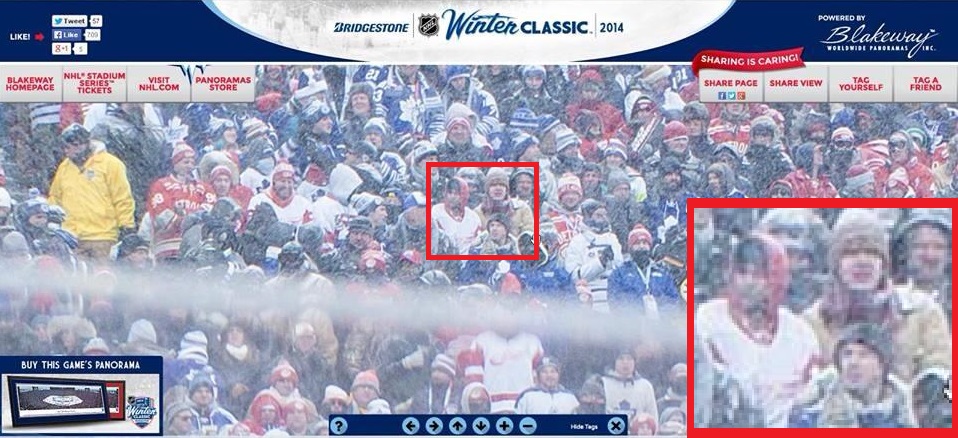
Tom and I were captured on the official HD Panorama. Don't we look excited to be out in the cold!

Tom and I were captured on the official HD Panorama. Don’t we look excited to be out in the cold!