Project Karamazov

Project Karamazov

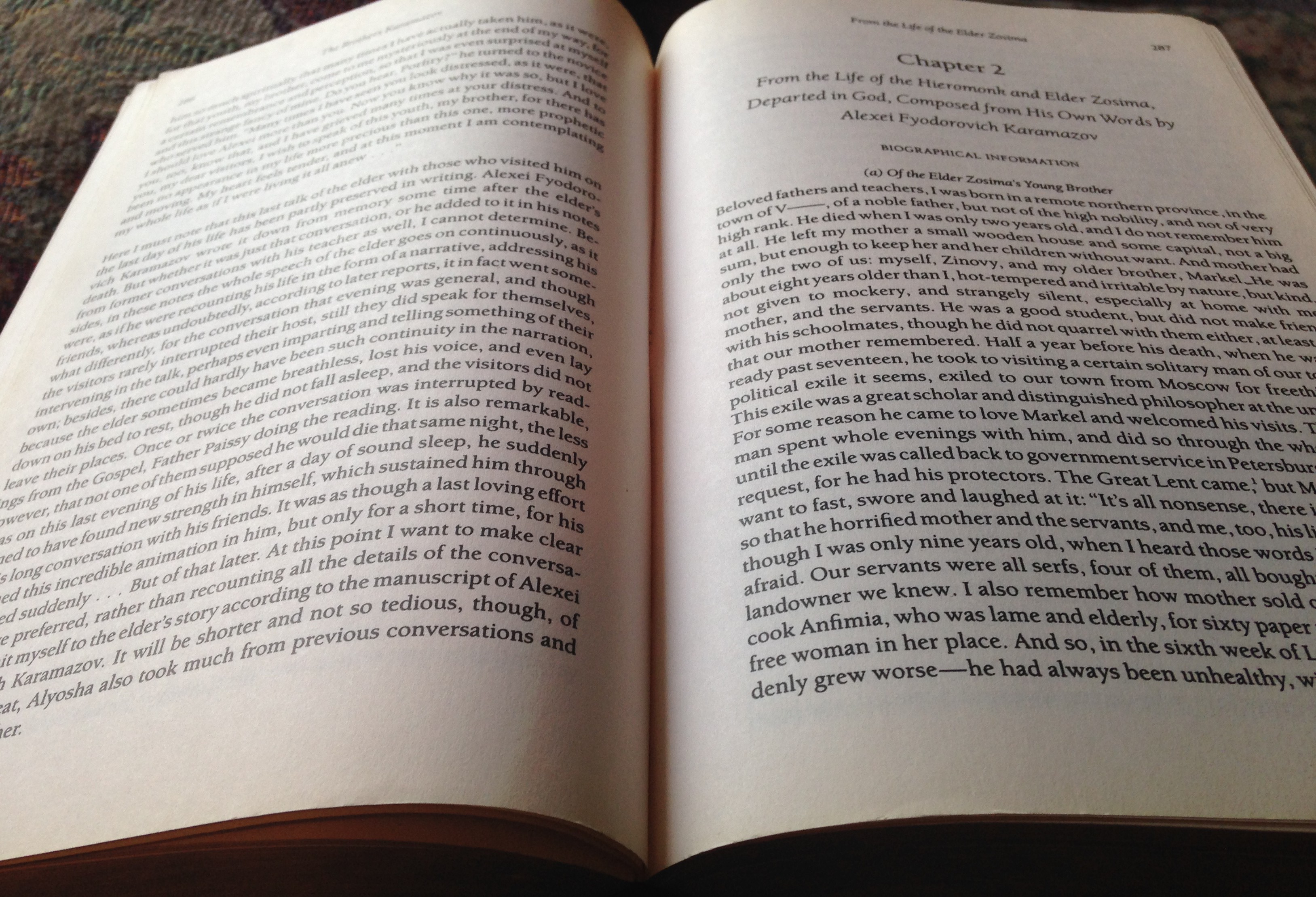
Fyodor Dostoyevsky wrote The Brothers Karamazov in 1880, when the art of recording and replaying sounds as they passed through the air was still an exciting and new concept. With recordings by Simon Vance, Frederick Davidson, and Tim Pigott-Smith, among many others in the current Dostoyevsky library, the advent of the audiobook – or “book on tape,” as we called it in the grand old days of analog – made it seem as if there had never been a novel that could not be listened to via speaker or ear bud. In the years since Dostoyevsky’s final novel, Karamazov has entered the public domain, which resulted in perhaps the most democratic audiobook of all time, the free version as read by volunteers worldwide and distributed by Librivox.

I can think of only two frontiers that could make an audio recording of The Brothers Karamazov exciting and new again. The first involves recording Dostoyevsky himself as he verbalizes his magnum opus “the way it was meant to be heard,” (as with so many studies – historical Jesus, historical Socrates, etc., we’d seek to hear the true utterances of the master himself and in this case we’d be utterly ashamed to admit that none of us know enough Russian to even value this reading) and the second involves getting a large number of public figures to record, one sentence at a time, the entire work from beginning to end. The first idea is on hold until I clear my time machine with the Oppenheimer Board of Ethics in science which, like my time machine, doesn’t exist yet. The second idea is #ProjectKaramazov.

I could go on about how important Dostoyevsky is to the art of literature, how influential he’s been to the writers who have followed him, or how The Brothers Karamazov is his finest work. I could cite the conversation from LOST where John Locke (Terry O’Quinn) and Ben Linus (Michael Emerson) discuss how Hemingway never felt like he could excel as a writer in a world where the artifacts of Dostoyevsky’s existence still remained. In reality, my motives are entirely selfish – Dostoyevsky is my favorite author and The Brothers Karamazov is my favorite book. If you’re a F. Scott Fitzgerald fan feel free to tweet daily about #ProjectTenderIsTheNight. For me it has to be #ProjectKaramazov.

How does Project Karamazov work? I, myself, or another member of #TeamKaramazov, make contact with a public figure – I use the term public figure very loosely to mean someone who is known, or should be known, on at least a nationwide basis, if not worldwide – and request a reading of one sentence from The Brothers Karamazov. As the public person prepares a recording, I prepare a bio to accompany the public figure’s performance of the sentence. Once I receive the recording, I publish the audio file and details about its reader for public consumption, and then the process begins anew.

Regarding the time frame of this project, I do not delude myself into thinking that #ProjectKaramazov will be completed within my lifetime. Just as there must be a variety of public figures to read the work, there must be a variety of “true believers” behind the scenes of #TeamKaramazov to make sure the project keeps going. Though readers will be recording passages from my favorite novel, this is ultimately not my project, at least not mine alone; it is a community collaboration where we will discuss literature, charity – certainly those focused on literacy and education – and what it means to create, to have your voice heard in a public forum. #ProjectKaramazov is all these things, but it is also simply one recitation of one story written long ago.

If you have any questions or comments about #ProjectKaramazov, this is a good place to share them.

Resources:
How-to Recording Guide
Russian Name Pronunciation Guide

Campaign Stories: Wiliken 4

“Remind me to exercise caution before calling you old,” Jurgen said.

Wiliken had been hot, both in terms of accuracy and in terms of anger. He felt strong and he felt proud, proud enough that he shouldn’t have to lower himself to retrieving his own arrows. But the only remaining party guests were his co-worker Jurgen, the dragonborn Morgan, and a mysterious noble named Douglas, whose electric strike mowed down the enemies, and each had pulled his weight enough in battle to be exempt from arrow duty.

The man named Douglas was a curiosity to Wiliken. The githzerai had learned the measure of many men, but he was having difficulty figuring out who or what this human truly was at his core. His dress suggested that Douglas was a wealthy supporter of Valgaman the Terrible, but he was highly concerned with the caged camel, which was now surrounded by hideous beasts, and such concern was not common in Valgaman’s circle. His hair, still scruffy in places, his wild eyes, and the fact that he’d attempted to disrupt the party before Wiliken had his chance, these things suggested that the man who stood before him was some sort of adventurer or soldier of fortune. But that couldn’t be entirely true. His speech was that of one highly born. To Wiliken, Douglas was an onion – you peel away one layer and you’re left with yet another.

To stack one curiosity on another, both Douglas and Morgan had clearly made their way into Valgaman’s party only through disguise and deception. Wiliken understood from this fact that these two each had their own agenda, something they wished to carry out at this event, and until Wiliken uncovered these agendas he would have to keep a close eye on these fellow warriors.

Wiliken shifted his focus to his surroundings as he filled his quiver. Any askew floorboard or out-of-place trinket might be the key to lowering the force field. In the end it was the mysterious man Douglas who found the switch. He had knocked on the stage supporting Valgaman’s throne until he’d found a hollow spot.

“Here!” Douglas had shouted, and he pried the compartment open. Douglas wore the clothing of one who had servants to do this sort of work, and yet his hands found the grooves in the wood with expert ease and cracked open the hidden chamber like an expert thief.

Wiliken and the others gathered behind Douglas.

“Perhaps we should scout for traps before Wiliken-” Jurgen said, but before he could finish, Wiliken had flipped the switch within the hidden compartment. “And there he goes again.”

The pressure in the room spiked as a blue dome appeared above the pit. Moments later, it flickered out, and the charge from the field pulled upon their bodies, forcing them over the banister and into the pit.

Down here, Wiliken could feel the rumble as the submerged beast circled. He recognized that gargantuan creature that swam through the sand as if it were water as a dire bulette. He’d seen whole squadrons of experienced warriors fall to a single bulette in the wild. Equally dangerous were three large boars whose tusks shimmered as if aflame.

“I say we fight a straight line to the cage,” Wiliken said to Douglas. “Once there, I’ll cover you from atop the camel’s prison while you work at freeing the animal.”

Douglas nodded, and the two rushed into the fray of battle. Jurgen shouted after Wiliken, “Good work. We’ll end up killing all these beasts just to save one camel. Are all githzerai ignorant of the study of mathematics?”

The archer’s first shot struck a boar on its thickly ridged back. The beast had been goring the cage with his tusks, but when the arrow struck he turned and charged his assailants. Douglas was able to react quickly enough to dive out of the way, but the boar struck Wiliken head on, driving him back into Jurgen and knocking them both prone.

Before they could arise, a jolt of electricity surged through the two combatants, knocking them back down, followed by another and another. Wiliken wondered if Douglas had turned on them, using the same lightning that ended the golem battle on Wiliken and Jurgen. He certainly had his suspicions about any man who disguised his true self. But both Douglas and Morgan were busy dodging deadly boar tusks while trying in vain to make quick strikes against the mad creatures. The static charges were coming from a pair of reptiles, basilisks by the looks of them, though Wiliken admitted he could be wrong. They stood to either side of the pit, each taking cover behind massive pillars and only popping their heads out to discharge deadly bolts of lightning against their foes.

Wiliken found that it was no use trying to get up. The twin reptiles kept them thoroughly pinned. Instead, Wiliken drew and fired while still laying on his side. He fired at the reptile to his left between crippling jolts, nock, fire, – BZZZZT – and was able to remain in the battle just long enough to kill one of the two beasts, but before he could turn on the second a final excruciating bolt hit him and everything went black.

Campaign Stories continues in Wiliken 5.

Campaign Stories: Wiliken 3

Jurgen grabbed Wiliken by the shoulders and attempted to rush him toward the exit. Wiliken fought back, shouting about the camel. This time it was Wiliken’s impracticality that saved them. The guests who had attempted to exit had found the doors locked, and yet the guests continued to pour toward the exits, pinning layer upon layer of noble against the solid doors. Wiliken watched as the stone pillars that lined the room began to shake, shedding dust onto Valgaman’s exotic floor coverings and revealing a series of large golems, several of which hacked their way through the cornered prey as if the nobles were served to them on a platter.

The slaughter that followed was Wiliken’s fault.

Despite Jurgen’s curses, all of which were aimed at the githzerai, Wiliken set aside his guilt momentarily and allowed his years of training to kick in. The muscles remember, he thought. He nocked and fired, nocked and fired, nocked and fired, and the oaken bow True Shot earned its name once again. He made quick work of the approaching foes as the massive bulks stomped slowly toward the pair of survivors, never giving an inch of ground. This afforded Jurgen the chance to withdraw an implement from his satchel – Wiliken recognized the crystal orb as Jurgen much touted Skull of Pelagius – and just when the githzerai thought his ally had lost his nerve for battle a snake of grey-green smoke meandered out from the skull. Instead of striking at a golem, the arcane energy collided with perhaps the only remaining noble.

Wiliken understood that that magic that issued forth from Jurgen was only animated in the sense that it was a command given physical qualities and mobility – one wouldn’t have to be trained in arcana to understand this fact – but as the vapor trail first contacted the human, it seemed as if it were confused. Jurgen’s spell struck about a hand’s length from the man’s chest, and what happened then surprised even the deva himself: two images, that of a man, and that of a much larger dragonborn fought, each representation advancing and withdrawing on the same space until finally there was only the one giant warrior. As if the act of shedding his magical disguise weren’t disturbing enough, the combatant began to writhe with obvious pain as boils began to sprout from underneath his scaly flesh.

“What have you done?” Wiliken screamed at Jurgen, appalled.

“I’ve evened the odds,” Jurgen said.

From the boils, which were visible even beneath the party guest’s battle raiment, sprouted fiendish legs, and while the dragonborn was now revealed as nearly the same size as his golem opponents, far less defenseless than he’d seemed as a small human scrapper, he disposed of his adversaries much more quickly.

Wiliken frowned as boils continued to erupt across the dragonborn and knot together into dense disgusting muscles.

“Don’t worry, it’s reversible,” Jurgen said. “I think…”

Turning from the horrorshow Jurgen had enacted, Wiliken continued to press his attack. Enemies that had crumbled before him had begun to reform, pebbles spinning and coalescing into their original form, and Wiliken felt his first moment of fear. The githzerai had begun to wonder if the golems would best Wiliken, Jurgen and Jurgen’s abomination, when a blast of lightning sizzled through the air and connected all of the stone-hewn enemies with a lattice of sparking energy. The golems froze in place before exploding, pulverized by one deadly strike.

When the dust settled, Wiliken saw a figure before him. It was the same man who had rushed the force field prior to the battle.

“Anyone need saving?” he asked.

Wiliken was struck by how many arrows he saw throughout the room. Perhaps more amazing was the fact that each of these arrows had cut down a stone warrior before they were all put down for good. Wiliken’s brain told him that he should collapse, but his body felt strong, virile even. He felt a rush normally reserved for wine or woman, and though he needed to gather his arrows, he badly wanted more battle.

Campaign Stories continues in Wiliken 4.

Campaign Stories: Wiliken 2

Wiliken had told the guards that he’d brought his bow because he’d heard word of upstarts in this side of town and he’d just as soon not die at their hands. He’d mentioned something about how the youth no longer respect their elders, something expected, but the truth was that he mistrusted his host, Valgaman, now the self-aggrandizing Valgaman the Terrible, even less than street thieves.

“I’ll be happy to check the bow with you at the door,” Wiliken said. He’d been uncharacteristically long-winded in his explanation and he feared he’d roused the suspicions of the heavily armored guards. He’d expected to be seized, but instead he was laughed at.

“Valgaman trusts his guests,” said the guard to his left. Rather, he trusts his own ego, thought Wiliken.

“And, after all, that bow might come in handy during tonight’s entertainment,” said the guard to his right.

Wiliken hoped the event would start soon, not so he could witness the Menagerie of Death, but so the event might end soon as well. He enjoyed the company of his wife far more than that of a bunch of thugs and buffoons calling themselves nobles, and least of all Valgaman, yet it was Valgaman who first approached Wiliken. The gnome was dressed in a black robe with a skull on the front. If Wiliken was not mistaken in his estimations, this was the costume of a petty gang of criminals with aspirations at prominence called the Boneheart Clan. Valgaman was making some sort of power play, and Wiliken doubted he’d much enjoy the consequences.

A series of guests passed between Wiliken and Valgaman, and the githzerai used the opportunity to lose the attention of the host. He did not stop until he’d reached a table laden with piping hot appetizers and strange glass decanters of drink. It was here that Wiliken bumped into the sullen deva Jurgen. If he had to pass his time with anyone, he supposed Jurgen was as good of a conversation partner as anyone.

“Fancy seeing you here,” Jurgen said.

“The gnome,” Wiliken said. “He’s up to something.”

“Well, of course,” Jurgen said. “Do you think a Menagerie of Death just comes together of its own volition?”

Perhaps Jurgen’s voice was the trigger – after all, he was the last being Wiliken had encountered before the invitation incident – but a panic came over Wiliken far worse than any social anxiety he might feel over being forced to attend this party. He felt suddenly nauseous and fought to keep from giving outward sign of his inner turmoil. Instead, Wiliken focused on Jurgen’s voice, used it as an anchor.

“I had been meaning to ask you,” Jurgen said. “When the golden city fell -”

“I don’t want to talk about that,” Wiliken interrupted. The panic grew in him like a child, and like any life form it felt as if it were forming intention and will. Wiliken gave into this strange sensation and turned around. Though the room he’d entered had been on the ground floor, there was a broad balcony circling a central pit which appeared to be full of sand, and in the center of the pit was a rickety cage occupied by the camel that he’d seen day after day since receiving the invitation to this event, each time he closed his eyes.

Wiliken was no longer bothered by the fact that he’d envisioned this camel. Many people have brief images of things before seeing them, probably little slivers of the infinite number of images one sees while asleep. It was not the fact that his eyes had predicted this scene that made boiled his githzerai blood, nor that strange sense of foreboding that beat the war drum of his heart – DOOM, DOOM, DOOM, DOOM – but the fact that the quivering camel was locked inside a cage, and all for the sport of an arrogant gnome and his social climbing friends.

For you too were once a slave.

Before there were githzerai or githyanki, there was a race of beings in the world next to this called the illithid. Wiliken couldn’t remember these times any better than his grandfather might have – these truths were the content of stories passed down generation after generation by Wiliken’s people. But before Wiliken had ever heard of these tentacle-faced monsters referred to as illithid, he’d heard the older children refer to them as “mind flayers” because they ravaged the psyches of the creatures they imprisoned, all the creatures of the land, including the ancient ancestors of the githzerai. The inscription on his bow may as well have been tattooed on his body. “For you too were once a slave” meant that Wiliken descended from a race who were familiar with life inside a cage.

Wiliken was aware that the small talk had died down and that Valgaman the Terrible had begun a speech, but his heart spoke louder than the gnome, for Wiliken saw a ripple beneath the sand, no doubt a predator abused and coaxed into ripping apart the imprisoned camel. Wiliken had to act now, to jump over the balcony and free the animal, or at least to put a body between the beast and certain death.

Wiliken stepped forward but was stopped from rushing the banister by a hand on his shoulder, Jurgen’s, and the words, “Restrain yourself, my friend – you’ll get killed,” also Jurgen’s.

Jurgen often seemed like he was only looking after his own best interests, but his pragmatism was an endearing quality. Their lives would be on the line, certainly, but the more sobering thought Wiliken faced was the likelihood that his own family would be targeted. Githzerai valued their self-control more than anything and humans – the race Wiliken had been raised as – valued their families. Both of these tendencies shamed Wiliken for making such a harsh decision.

“Across the lobby,” Jurgen whispered. Wiliken followed Jurgen’s gaze across the circular balcony where a guest lurked in the shadows, our of view from the other guests who had faced the opposite direction in order to listen to Valgaman speak. It appeared that this guest had the same intention as Wiliken, to jump the rail and enter the pit, but just as soon as he was airborne his forward momentum stopped abruptly and he fell to the ground. A dull blue light revealed a matrix of squares in the place where the guest had hit. Valgaman had erected a force field of some sort across the pit.

The guest across the room had tested the shield in relative obscurity. Had Wiliken done the same he would have fallen mere yards from Valgaman with all eyes upon him. Wiliken had certainly dodged an arrow, but only with the help of Jurgen’s wise counsel.

Acting the party guest, Wiliken scanned the room. He was looking for a power source or control panel, perhaps a talisman or a group of mages concentrating on the center of the room. Any of these might be a means of dropping the force field, but none were present to Wiliken’s keen archer’s eyes. Valgaman must have installed a secret panel of some sort. This would be more difficult a situation than Wiliken had thought.

Wiliken’s concentration was broken by the loud din of a cheering audience. Around him nobles raised glasses or clapped.

“What is this about?” Wiliken asked Jurgen. “I wasn’t listening.”

“Valgaman announced the sacrifice of your camel,” Jurgen said.

It seemed that the camel would die and there was nothing Wiliken could do. Wiliken saw his vision once again, but this time the camel burned into his eyes was superimposed over the actual camel’s image and the juxtaposition spoke to the githzerai. It said, “You must prevent the slaughter that is to come.”

For you too were once a slave.

Wiliken was shown that flesh could not penetrate this force field, but during his years he’d seen many similar walls breached by some object or other. He didn’t have any enchanted items on him, but he was aware that iron had certain properties that allow it to overcome magic, and he had several iron-headed arrows. One such arrow could collapse an arcane force field, and if not, the same arrow could split the head of the party’s host.

The githzerai quickly drew his bow and, shouting a battle cry in deep speech, nocked and fired an arrow at the force shield. The arrow snapped on impact, but before it hit the ground, Wiliken had wheeled to his left and fired once again, this time at Valgaman the Terrible. As the arrow passed through the gnome, his image flickered and disappeared. Wiliken’s aim was true. Unfortunately, his target was false. The Valgaman who had hosted the party was a hologram.

For a moment, nobody spoke or moved, but then the booming voice of Valgaman returned. Voice divorced from body, Valgaman’s words sounded like those of an angry god:

“You’ve made a dire mistake.”

Campaign Stories continues in Wiliken 3.

Campaign Stories: Wiliken 1

The githzerai sat at his desk and stared into the shifting void before him. Back when he fought more wars than he signed scrolls, he might suspect an enchantment. He’d focus his iron mind and clarity would rush in like stream water over a flesh wound. Since he’d taken a desk job nearly forty years ago, however, he’d experienced this very feeling periodically. Its source was neither talisman nor potion; the githzerai had simply been sleeping poorly.

He hadn’t slept well for weeks, not since his father-in-law had given him that oaken bow. The wood was beautiful and strong. He’d taken the bow home and placed it above the mantle in his parlor. Looking upon it, he’d felt that his house, which had always been more of his wife’s creation, had finally made a place for him. The comfort stayed only shortly. By night he saw disturbing visions, looters streaming through his house, picking it clean, fire in the streets. Each night he’d close his eyes and live a different life, this time an official marched to the gallows by a screaming mob, the next a child cowering under his bed as warriors did terrible things to his screaming mother in the next room.

He’d told himself over and over again, “It’s not the bow that haunts me. It is merely the shadows of my past wearing the skins of my daytime acquaintances.” Just the same, he’d moved the bow to a prominent position behind his desk at work. The dreams lessened in intensity, but never abated.

The githzerai had no purpose for the bow – he no longer hunted, the thirst for battle had left him with age, and he had far finer military-grade weapons hidden throughout his house for use in the event of a break-in – but he couldn’t bring himself to dispose of it. On the day that Sazeran presented the bow to him, the githzerai had said, “Thank you for our generous gift, Saz.”

At first Sazeran had frowned. He said, “You misunderstand me, my son. I do not give to you something that belongs to me. I return to you that which has always been yours. I believe when we first met, you called this bow True Shot, no?”

Try though he might, he simply could not recall those early days. This created a strain in their relationship because Sazeran himself was quite fond of those days. Though his memory no longer served him regarding these things, the name of this oaken bow had never left him. “True Shot, yes.”

Though the githzerai had nearly no connection to his early experiences, the outline of his past had been recounted to him so many times that he’d become a good student of his own personal history. He had been the sole survivor of a githzerai war party that had come to this plane in order to assault an Iuzian platoon desecrating a forest with their arcane energies. Though he was only ten years of age at the time, he’d wielded the most powerful bow on the battlefield, a boy wielding a man’s weapon. When he became Sazeran’s ward, all things githzerai left him, his tribal battle gear, his memories of his family, and that great oaken bow; the githzerai had learned to live as a human. He’d enjoyed great success and prestige and taken Sazeran’s daughter Iseley as his wife. He’d become a legend by the age of twenty and retired to a simple life shortly thereafter.

“I must make a confession,” Sazeran had said. “I kept True Shot from you because I did not trust you. It shames me to say it, but it is true. You were a fierce warrior, and I feared that one day you’d find me among your enemies. To return this bow is by no means expiation. No. But I do it no less. You are my son and heir and this is your bow.”

The githzerai could no more rid himself of this bow than strike Sazeran dead with an arrow fired from its string. The old man was dying after all, and such heartbreak as that would be hard enough to endure in good health. Sazeran himself admitted that his end was near. He’d said, “I could commission another arcane ritual to keep me around another ten years or so, but to what end? Even now I’m little more than a walking corpse.”

He looked at the oaken bow, the source of his morning haze, and when the knock came upon his office door, he jumped. The mustachioed face of his workmate Jurgen appeared through the opening door. He felt an all-too-human surprise at the deva’s otherworldly blue tinted flesh. His judgment might have been considered ordinary among his peers, but not to the githzerai, who also claimed an otherworldly origin.

“Good morning, Wiliken,” Jurgen said. “You are still going by that name, yes? Perhaps I should call you the githzerai formerly known as -”

“What’s on your mind, Jurgen?”

Jurgen smiled. “Will I be seeing you at Valgaman’s party?”

“Party? What party?”

“Valgaman the Terrible,” Jurgen said. “He’s throwing some sort of sporting event. You should have received an invitation in your inbox.”

“Inbox?” The githzerai scanned his desk and saw a scroll that had previously escaped his notice. He held the scroll up. “I’ll let you know.”

“I’ve asked around. They say that Valgaman is… connected. Not attending might be hazardous to your well-being, to put it bluntly.”

“Consider me well advised.”

Jurgen must have read the disdain in the githzerai’s voice because he exited without further discussion. This gave the githzerai the opportunity to read Valgaman’s invitation. He’d scanned only the first line – “You are cordially invited to Valgaman the Terrible’s Menagerie of Death” – before he was struck with a stabbing headache which left him crumpled upon his desk in a feverish sweat. It took him no short amount of time to recover, and even afterwards he was left with a strange sense of urgency and the absurd negative of some sort of caged pack animal – a camel – across his field of vision.

The githzerai drafted a quick letter confirming he would be in attendance before going home and spending the remains of the day in bed. Prior to leaving the office he gave the oaken bow an accusatory look. An inscription on the side of the bow stared back at him, a phrase in rellanic that he didn’t have to read so much as his blood sang it:

For you too were once a slave.

Campaign Stories continues in Wiliken 2